




Clearing the air on the incident of misprinted banknotes, the State Bank of Pakistan (SBP) on Wednesday said internal controls are being “further strengthened” while the system in place is “still susceptible to a margin of error”.
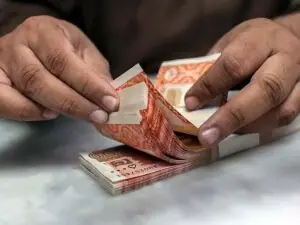
The response comes after a bank branch located in Karachi on Tuesday reportedly received a few currency notes of Rs1,000, which were misprinted from one side.
The branch manager of the bank made a video of these currency notes that went viral on social media and created panic among masses that reportedly fake currency notes are in circulation.
Responding to the public concern, the SBP explained the process of printing banknotes.
The central bank said that SBP’s printwork, namely Pakistan Security Printing Corporation (PSPC), has a robust system of quality control to segregate and to prevent the flow of misprinted banknotes into public circulation.
“Some of the notes are misprinted occasionally but the same are detected through the checks and balances put in place,” it said in a statement on Wednesday.
“However, no matter how robust and effective a manmade system is, it’s still susceptible to a margin of error, whether here or elsewhere including the developed jurisdictions.
“The instant case involves the discovery of only ten misprinted banknotes in the consignment of NBP’s Model Colony Branch, which is minuscular as to be immaterial when compared with total number of notes that are printed and circulated in the country.
“However, the internal controls are being further strengthened to avoid recurrence of such instance in future,” it added.
The central bank said the misprinted banknotes, received by the public or commercial banks can be claimed in exchange for fit banknotes from any Office of the State Bank of Pakistan, Banking Services Corporation (SBP-BSC) across the country under the State Bank of Pakistan (Note Refund) Regulations, 1963.
On a query whether there has been any previous such incidents where a half print banknote was delivered to a commercial bank, the central bank said the production processes of such large magnitude are prone to some imperfections.
“Therefore, there is a possibility that in-spite of all quality checks, certain pieces of misprinted banknotes may end up with banks or public. However, as explained above, such banknotes can be exchanged at SBP-BSC counters,” it added.
Earlier, Business Recorder reported that the SBP has decided to investigate as to how the misprinted currency notes of Rs 1,000 denomination got into circulation.
Noor Ahmed, Chief Spokesman of the SBP, said there is a very strict system of note printing and it’s just a misprinting of note on one side but the SBP will investigate the issue to avoid such a thing in the future, the report added.






















Comments
Comments are closed for this article.