


Smart bandages will now repair wounds through smartphones
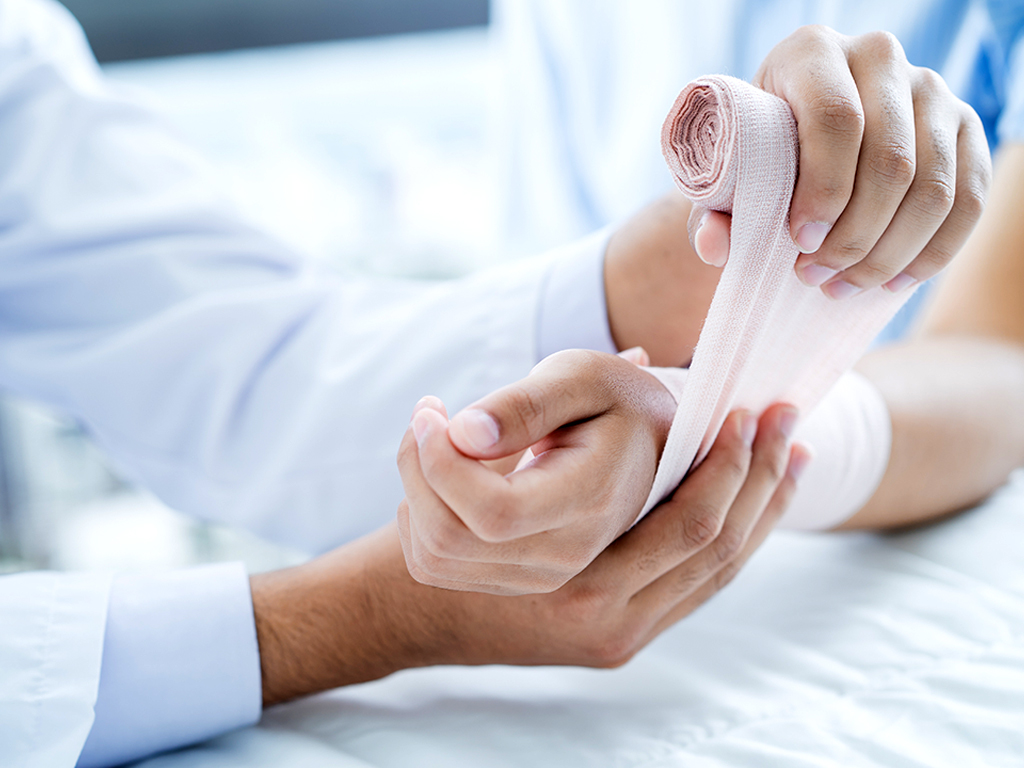
Researchers have manufactured a futuristic smart bandage that can repair severe wounds with its each individual fiber via mobile devices.
Researchers from University of Nebraska-Lincoln, Harvard Medical School and MIT together made this invention whose individual fibers store medications that can be deployed through smartphone or any other mobile device.
The smart bandage is made of electrically conducive fibers that are covered in gel, which houses medications ranging from infection-fighting antibiotics to painkillers and tissue-regenerating growth factors. Each fiber can then be activated through voltage from a connected microcontroller, which is not bigger than a postage stamp, triggered by a connected mobile device. The voltage heats up the fiber and its hydrogel and discharges whatever cargo it contains, informed Phys.
Researchers develop glue that seals wounds in seconds
One of the researchers Ali Tamayol stated in a press release, “This is the first bandage that is capable of dose-dependent drug release. You can release multiple drugs with different release profiles. That’s a big advantage in comparison with other systems. What we did here was come up with a strategy for building a bandage from the bottom up.”
As per Futurism, the bandage would come in handy for dealing with battlefield injuries, treating chronic wounds common in diabetic patients and more. He continued, “This is a platform that can be applied to many different areas of biomedical engineering and medicine.”
The design has already went through various experiments and is expected to go through a few more before coming to human tests and then being available in markets. Tamayol says that though most of the design’s components are already approved by the Food and Drug Administration, this process will still take many years.
Publishing their research in Advanced Functional Materials, the researchers are now working to integrate thread-based sensors capable of measuring glucose, pH and other few other health-related indicators of skin tissue. This would provide the team with a bandage that can independently provide proper treatments.




















Comments
Comments are closed for this article.