


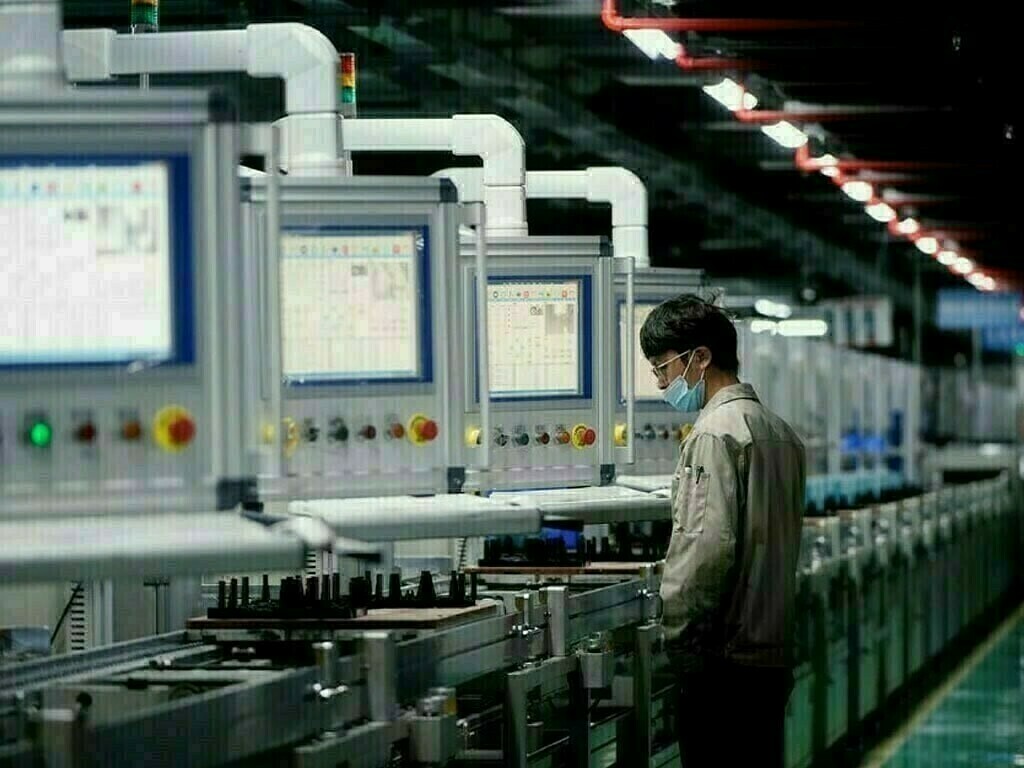

TOKYO: Factory activity in many Asia economies weakened in March despite a rebound in China as lacklustre domestic demand dragged on growth, surveys showed on Monday, clouding the outlook for a once fast-expanding, key driver of the global economy.
Export powerhouses Japan and South Korea saw manufacturing activities shrink, as well as Taiwan, Malaysia and Vietnam in a sign of the fragile state of the region’s economies.
China’s Caixin/S&P Global manufacturing purchasing managers’ index (PMI) rose to 51.1 in March from 50.9 the previous month, a private survey showed on Monday, expanding at the fastest pace in 13 months with business confidence hitting an 11-month high.
The finding joins an official PMI survey released on Sunday that showed China’s factory activity expanded for the first time in six months.
The rebound in China, which is struggling to mount a strong economic revival partly due to a protracted property crisis, provides some welcome relief to Beijing and investors globally.
Yet, the weakness in other parts of Asia highlights the challenge the region’s policymakers face as they wrestle with patchy signs of recovery in global demand and uncertainty on when the US Federal Reserve would start to cut interest rates.
“China’s exports are picking up a bit but that’s because their goods are cheap. That means other Asian countries must compete with China for demand that’s not growing,” said Toru Nishihama, chief emerging market economist at Dai-ichi Life Research Institute.
“With no clear driver of global growth, it’s hard to paint a rosy outlook for Asia,” he added.
Japan’s final au Jibun Bank PMI stood at 48.2 in March, the highest level since November and recovering from February’s 47.2 which marked the fastest pace of contraction in over 3-1/2 years.
But activity contracted for a 10th straight month as new export orders slumped, reflecting souring sentiment in key markets like China and North America, the survey showed.
South Korea’s manufacturing activity also weakened in March as slowing domestic demand offset robust overseas sales with the PMI falling to 49.8 in March from 50.7 in February.
Taiwan’s PMI fell to 49.3 in March from 48.6 in February, while that for Vietnam dropped to 49.9 from 50.4, and Malaysia’s declined to 48.4 from 49.5, the surveys showed.
By contrast, manufacturing activity expanded in March in the Philippines and Indonesia, the surveys showed.
In revised forecasts issued in January, the IMF projected Asia’s economy to expand 4.5% this year, driven by robust US demand and the boost from expected stimulus measures in China.
Asia’s factories end 2023 on soft note amid fragile China recovery
But it said the recovery would be divergent across economies with Japan likely to see growth slow to 0.9%, in contrast to an expected 6.5% expansion in India.
The IMF expects China’s economy to expand 4.6% this year, slowing from 5.2% in 2023.

























Comments
Comments are closed for this article.