


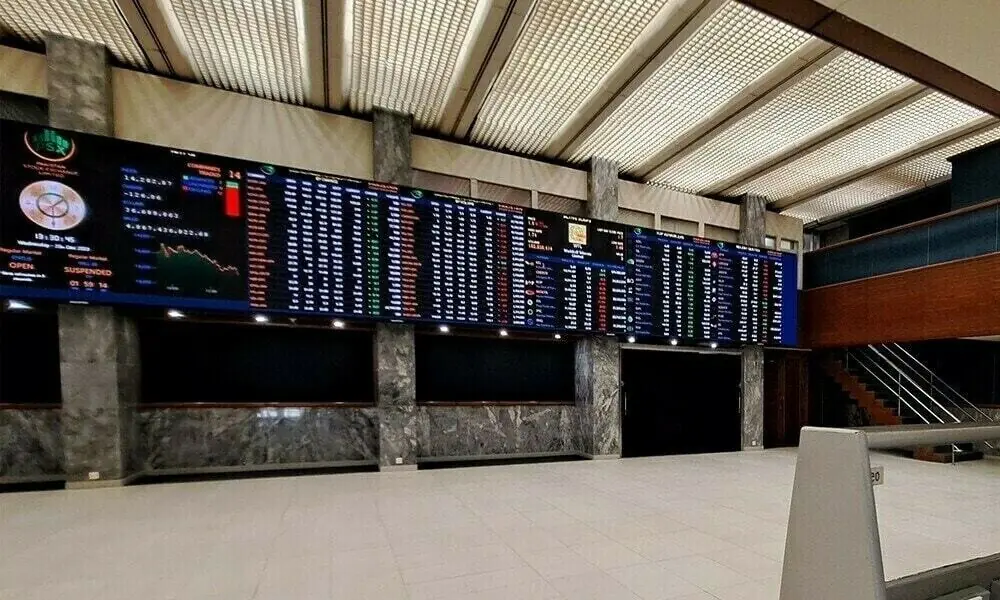

KARACHI: Escalating geopolitical tensions between the United States and Iran triggered a sharp risk-off reaction across global financial markets during the week, with Pakistan’s equity benchmark suffering a pronounced correction amid heightened uncertainty and rising oil prices.
The benchmark KSE-100 Index at the Pakistan Stock Exchange fell 6,434.02 points, or 3.6 percent week-on-week, to close at 173,169.70 points, marking one of the steepest weekly declines in recent sessions.
The index opened the week at 179,603.73 points but failed to sustain early stability as geopolitical rhetoric intensified. Washington’s warning of potential military action against Iran, should diplomatic channels fail, amplified global uncertainty.
As tensions rose, Brent crude oil climbed to a seven-month high of USD72 per barrel, fuelling concerns about energy price pressures and their broader macroeconomic implications for emerging markets, including Pakistan.
Meanwhile, the BRIndex100 opened the week at 20,325.04 points and declined to close at 19,314.08 points, registering a drop of 1,010.96 points over the period.
Total weekly turnover in the BRIndex100 stood at 2.57 billion shares, indicating active trading despite persistent selling pressure. Similarly, the BRIndex30 slipped from its weekly opening level of 74,036.48 points to close at 69,299.47 points, marking a contraction of 4,737.01 points.
Weekly turnover in the BRIndex30 reached 1.92 billion shares, highlighting heavy activity in large-cap and liquid counters as investors rebalanced portfolios amid uncertainty.
The sell-off was broad-based and persistent, eroding Rs756.82 billion in market capitalization over the course of the week.
Total PSX market capitalization declined 3.7 percent to Rs19.60 trillion from Rs20.36 trillion last week. In dollar terms, the market’s value contracted to US$70.12 billion from US$72.81 billion, reflecting both falling equity prices and currency-linked valuation effects.
Investor participation weakened noticeably. Average daily traded volume on the Ready Board dropped 24.2 percent to 653.53 million shares, compared to 862.26 million shares in the preceding week.
The contraction in volume suggested a combination of profit-taking, risk reduction, and sidelined institutional participation.
In value terms, average daily turnover declined 11.7 percent to Rs37.57 billion, equivalent to US$134.38 million, compared with Rs42.56 billion (US$152.19 million) last week.
The sharper decline in volumes relative to value indicated selective activity in high-priced and index-heavy names rather than widespread retail churn.
Despite equity market turbulence, macroeconomic indicators provided mixed but structurally supportive signals. An International Monetary Fund (IMF) mission is scheduled to arrive on February 26 to review Pakistan’s performance under the US$7 billion Extended Fund Facility (EFF) and initiate discussions on the FY27 federal budget.
The engagement is being closely monitored by market participants, given its importance for fiscal discipline, reform continuity, and external financing access.
Encouragingly, Pakistan recorded a current account surplus of USD121 million in January 2026. This brought the cumulative surplus for 7MFY26 to USD1.07 billion, nearly double the USD560 million surplus recorded in the same period last fiscal year.
The widening surplus reflects strengthening external buffers, supported by remittances and import moderation.
On the debt front, Pakistan successfully repaid a USD700 million commercial loan during the week. Meanwhile, a USD1.3 billion Eurobond is scheduled to mature in April 2026.
The government also plans to raise USD250 million via Panda bonds following the conclusion of Chinese holidays, highlighting efforts to diversify funding sources and manage upcoming external obligations.
Moreover, in the latest Treasury-bill auction, the government raised Rs677 billion against a target of Rs450 billion, reflecting strong participation and liquidity absorption.
However, yields increased by 9–20 basis points across tenors, suggesting marginal tightening in financial conditions and slightly elevated risk pricing in fixed-income markets.
In a key industrial support measure, the National Electric Power Regulatory Authority (NEPRA) notified a reduction of approximately Rs4 per unit in electricity tariffs for industrial consumers.
The move is expected to ease cost pressures on manufacturing and export-oriented sectors, offering medium-term competitiveness support despite near-term market volatility.
Sectoral performance remained overwhelmingly negative. Refinery stocks suffered the steepest weekly decline, plunging 12.5 percent, followed by Oil and Gas Marketing Companies (OGMCs), which dropped 8.4 percent.
The weakness in energy-related stocks coincided with global oil price volatility and shifting investor risk appetite.
Chemical stocks declined 5.5 percent, while engineering fell 5.1 percent. textile composite (-5.0 percent), cement (-4.9 percent), fertilizer (-4.9 percent), power (-4.8 percent), technology and communication (-4.6 percent), pharmaceuticals (-4.6 percent), autos (-4.3 percent), exploration and production (-2.4 percent), banks (-2.2 percent), and food (-1.5 percent) also closed lower.
By traded volume, the Power sector dominated with a 19 percent share, followed by technology and communication at 15 percent, banks at 13 percent, investment banks at 10 percent, and OGMCs at 5 percent. Other sectors collectively contributed 38 percent of total activity, indicating relatively diversified participation despite overall volume contraction.
Among individual stocks, INIL emerged as the top gainer, rising 9.0 percent to Rs184.39. SSOM gained 8.2 percent, THALL advanced 4.6 percent, BNWM added 1.2 percent, MUREB rose 0.7 percent, PTC gained 0.5 percent, and NESTLE edged up 0.4 percent.
On the losing side, PIOC recorded the steepest decline, plunging 22.2 percent to Rs274.70. TRG fell 16.1 percent, UNITY declined 13.9 percent, PSO dropped 11.8 percent, MEHT lost 10.9 percent, CNERGY shed 10.5 percent, and ATRL retreated 10.0 percent, reflecting pronounced weakness in selected industrial and energy-linked counters.
Overall, the week was characterized by elevated geopolitical risk, rising oil prices, contracting liquidity, a sharp reversal in futures positioning, and broad-based declines across benchmark indices.
While macroeconomic indicators such as the current account surplus and industrial tariff relief provided structural support, global tensions dominated sentiment, leading to one of the most pronounced weekly corrections in recent months.
Copyright Business Recorder, 2026




















Comments
Comments are closed for this article.