


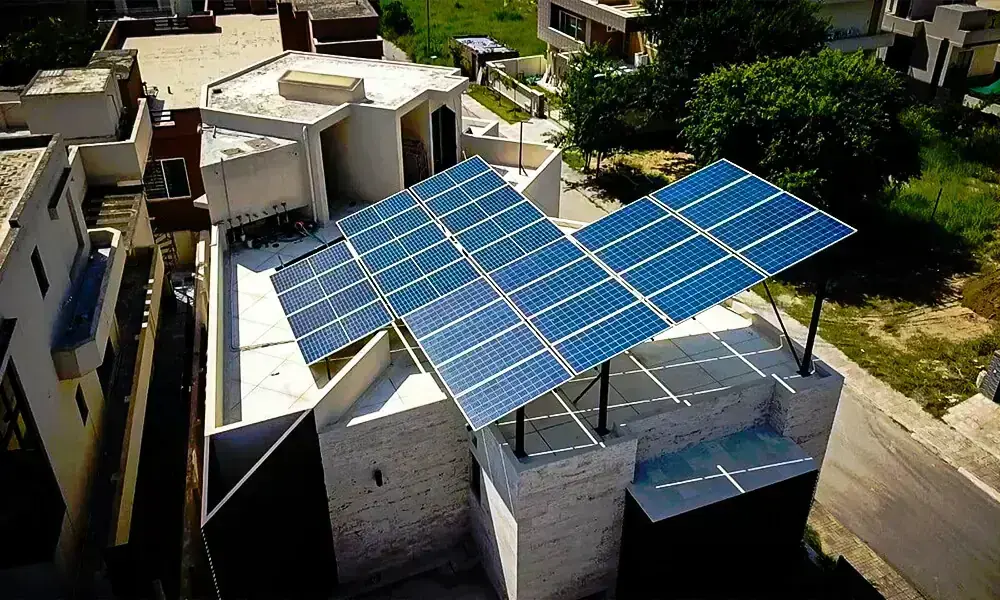

ISLAMABAD: Though the government has tightened installation of solar net metering in the country due to its financial impact on other consumers via the national grid substantially during day time, electricity consumers who can afford the panels, are switching towards net metering and off-grid.
Amid rising electricity tariffs and increasing pressure on household budgets, installation of a 10-kilowatt (kW) net-metering solar system is emerging as a financially viable option for consumers, offering substantial savings and long-term energy security.
Currently, generation from net metering and off-grid systems is around 20,000 MW which usually creates a duck curve during the day time and puts the entire generation system at risk in winter months.
READ MORE: Net-metering regime: Solar generation surges in FY26: Advisor
Industry experts estimate that a 10kW rooftop solar system in Pakistan can generate between 1,200 to 1,500 units of electricity per month, depending on location and seasonal variations. This level of generation is sufficient to meet the electricity needs of an average upper-middle-income household, significantly reducing dependence on the national grid.
“Pakistan’s rapid expansion in solar net-metering capacity—growing nearly 37-fold in six years to around 7,000 MW by June 2026—has triggered a major policy shift from net metering to net billing, as authorities grapple with mounting technical and financial pressures in the power sector,” said one of the analysts.
Under the net-metering regime, consumers first utilise solar electricity for their own consumption, while surplus units are exported to the grid. In return, distribution companies (DISCOs) provide credits, which are adjusted against the consumer’s monthly bill.
According to estimates, consumers paying tariffs in the range of Rs45 to Rs60 per unit can save between Rs50,000 to Rs90,000 per month through self-consumption alone. Additional financial benefits accrue from exported units, which are typically compensated at rates ranging from Rs19 to Rs27 per unit.
A typical case shows that if a household consumes around 1,200 units per month and generates approximately 1,400 units through a 10kW system, it can export nearly 400 units to the grid. This translates into total monthly financial benefits of around Rs55,000 to Rs60,000, combining savings and export credits.
The upfront cost of installing a 10kW system currently ranges between Rs1.5 million and Rs2.2 million, depending on equipment quality and installation standards. However, with prevailing electricity tariffs, the payback period has reduced to approximately 2.5 to 4 years, making it an attractive investment option.
Experts highlight that over a system lifespan of 20 to 25 years, consumers can save between Rs15 million to Rs25 million, while also insulating themselves from future tariff hikes and frequent power outages.
However, stakeholders caution that net-metering policies and export tariffs remain subject to regulatory changes by the National Electric Power Regulatory Authority (Nepra) and the Power Division, which could influence future returns.
Despite these uncertainties, solar net-metering continues to gain traction across urban centers, particularly in Punjab, where favorable sunlight conditions further enhance system performance.
With electricity prices expected to remain high and policy focus shifting towards renewable energy, analysts believe that rooftop solar solutions will play a critical role in easing the financial burden on consumers while contributing to the country’s overall energy mix.
The surge was shaped less by policy design and more by macroeconomic factors, including around 75 percent depreciation of the rupee, nearly 140 percent increase in electricity tariffs, and approximately 60 percent decline in solar panel import prices between FY2021 and FY2025.
The market is rapidly evolving from smaller residential battery modules towards larger 14–16 kWh systems, reflecting increasing consumer confidence, declining battery costs and growing demand for self-consumption post the changes inregulations.
As battery deployment accelerates, Pakistan has a unique opportunity to establish an enabling framework covering technical standards, grid integration, safety requirements, market participation, and long term planning to maximise the value of energy storage for both consumers and the electricity system.
Currently, the government is encouraging BESS so that pressure on national grid is minimised during winter months.
Copyright Business Recorder, 2026



















Comments