


PSX: Selling intensifies, KSE-100 loses over 1,400 points
- Benchmark index settles at 179,846.68
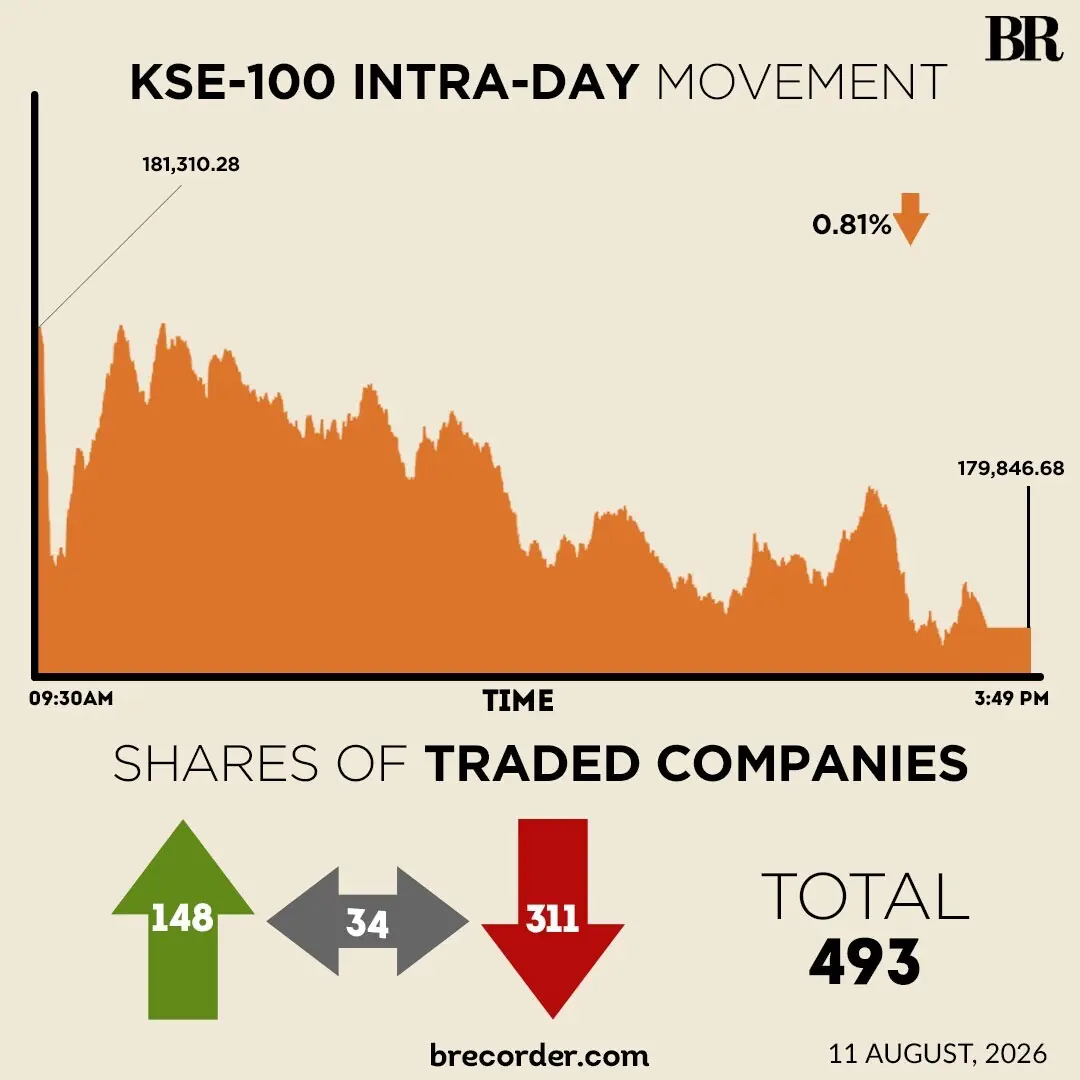
The KSE-100 Index fell over 1,400 points amid fading hopes for a US-Iran deal, escalating geopolitical uncertainty, and profit-taking, despite an early session recovery.
- Geopolitical uncertainty from the US-Iran stalemate.
- Rising crude oil prices and global market reactions.
- Key companies impacting the KSE-100 Index decline.

Selling pressure was observed at the Pakistan Stock Exchange (PSX) amid fading hopes of a deal between the US and Iran to end their war and reopen the Strait of Hormuz, with the benchmark KSE-100 Index shedding over 1,400 points on Tuesday.
The benchmark index initially came under pressure after opening around the 180,000-point level, before recovering sharply and touching the intra-day high of 181,017.29 during early trading.
However, the recovery failed to sustain momentum as profit-taking and selling pressure emerged later in the session. The index gradually retreated from its early peak, with the decline becoming more pronounced after noon.
Although the benchmark briefly attempted a recovery during the final hours, it failed to hold the gains and slipped towards the intra-day low of 179,778.98.
At close, the benchmark index settled at 179,846.68 points, down 1,463.60 points or 0.81%.
“Market activity remained volatile throughout the session, as early gains failed to sustain amid rising crude oil prices and diminishing prospects of a near-term US-Iran agreement,” brokerage house Topline Securities said in its post-market report.
On the negative side, FFC, LUCK, ENGROH, UBL, and BAHL emerged as the largest drags on the benchmark, collectively eroding approximately 778 points from the KSE-100 Index, Topline said.
On Monday, PSX closed marginally lower as profit-taking in key heavyweight stocks during the second half of the session erased early gains, leaving the Index almost unchanged. The KSE-100 Index declined by 119.74 points, or 0.07%, to settle at 181,310.28 points.
Internationally, oil prices rose on Tuesday as negotiations between the US and Iran over a peace deal and the reopening of the Strait of Hormuz hit an impasse, while Asian shares drifted on protracted uncertainty over the global inflation outlook.
US President Donald Trump on Monday responded to Iran’s conditions for a peace deal with his own demands that Iran pay compensation for people killed in wars, attacks and protests, in a rhetorical escalation likely to complicate efforts to reopen the crucial waterway.
Brent crude futures edged up to hit $88.00 per barrel and US crude futures ticked up to $82.45, both the highest levels since July 31, after the contracts rallied roughly 5% on Monday.
The latest uptick in fuel costs raises the stakes for the U.S. July consumer price report due on Wednesday, where expectations are for a monthly rise of 0.1% in the headline reading and 0.2% for the core measure.
MSCI’s broadest index of Asia-Pacific shares outside Japan swung between losses and gains and was last up 0.2% while South Korea’s Kospi rose 0.3%, as the latest escalation in Gulf hostilities kept market sentiment fragile.
Nasdaq futures edged 0.28% higher while S&P 500 futures added 0.1% after Wall Street ended lower in Monday’s cash session.
Meanwhile, the Pakistani rupee extended its marginal gains, appreciating 0.1% against the US dollar on Tuesday. The local unit closed the day at 277.67, a gain of Re0.03 against the greenback.
Volume on the all-share index decreased to 860.26 million from 917.27 million recorded in the previous close.
The value of shares declined to Rs38.86 billion from Rs44.80 billion in the previous session.
Cnergyico PK was the volume leader with 133.91 million shares, followed by K-Electric Ltd with 61.85 million shares, and Hascol Petrol with 45.03 million shares.
Shares of 493 companies were traded on Tuesday, of which 148 registered an increase, 311 recorded a fall, and 34 remained unchanged.



















Comments