


The real test of a petrol subsidy is at the pump
- If state can deliver targeted assistance to vulnerable citizens that is improvement in governance
Pakistan's targeted petrol relief scheme provides essential support to vulnerable citizens, demonstrating responsive governance through accessible digital implementation and continuous adjustments based on feedback.
- Targeted petrol relief for vulnerable segments.
- Government's responsive policy adjustments.
- Accessible digital delivery via SMS.
- Future potential for targeted assistance.
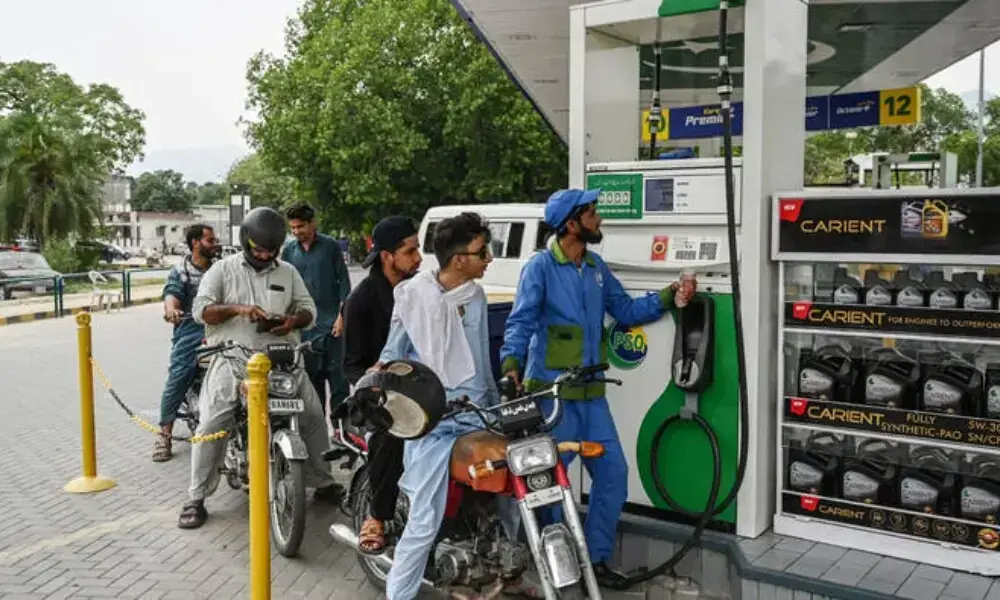

There is a very simple way to understand what rising petrol prices mean to an ordinary Pakistani.
Look at the motorcycle parked outside a small workshop. Look at the rickshaw waiting outside a hospital. Look at the delivery rider checking his phone for his next order.
Look at the man who fills his motorcycle before leaving for work every morning, already knowing exactly how much money he has in his pocket and how much of it will be left at the end of the day.
For these people, petrol is not a luxury. It is part of the cost of earning a living.
That is the starting point from which the Prime Minister’s Special Relief Scheme should be understood.
The recent turmoil in the Middle East and resulting pressure on international oil markets have created a difficult situation for countries such as Pakistan, which depend heavily on imported fuel. When international prices rise, the impact does not remain in global markets. It eventually reaches the petrol pump, the transport system, the price of goods and, ultimately, the household budget.
Read More: Fuel relief scheme: How to get Rs100/litre petrol subsidy?
The question for government is then straightforward: when fiscal space is limited, how do you provide meaningful relief to the people who feel that shock most directly?
The government has chosen a targeted answer.
Instead of subsidising petrol for everyone, the scheme focuses on motorcycles, rickshaws, Qingchis and vehicles up to 800cc.
That distinction matters.
A person using a motorcycle to get to work or make deliveries is not necessarily in the same economic position as someone filling the tank of a much larger vehicle.
Targeting the relief does not solve every problem. But it does recognise an important reality: when resources are limited, assistance has to be directed towards those who need it the most.
The most interesting part of the scheme, however, may not be the announcement itself. It is what happened after the announcement.
Within days, the government received feedback from citizens and changed the mechanism.
The five-litre minimum requirement for motorcycles, Qingqis and rickshaws was removed. Eligible users can now receive a Rs500 weekly token even if they purchase less than five litres of petrol. They can receive one such token every week, up to four tokens a month.
That may sound like a small administrative adjustment sitting somewhere inside a government notification. It isn’t.
Think about the person for whom even five litres may be difficult to purchase in one go.
For a salaried family or a daily-wage household, money is often managed day by day. A policy that looks perfectly reasonable from behind a desk can become inconvenient when it meets real life.
The government changed the rule. That is what responsive policy should look like.
The same applies to the decision to extend eligibility for two- and three-wheelers to vehicles up to 20 years old.
We sometimes talk about an old motorcycle as though it is simply an old motorcycle. For the family that owns it, it may be the vehicle that takes the father to work, the mother to the market, the child to school and a delivery rider to his next customer. Its age does not make it less important to that household.
In fact, the opposite may be true: people who cannot afford a newer vehicle are precisely the people for whom the cost of keeping an older one running matters most.
The scheme also continues to provide relief for vehicles up to 800cc, through three 10-litre tokens each month, with Rs100 per litre relief.
But there is another part of this programme that deserves considerably more attention: how the relief is being delivered.
Registration is being done through a simple SMS system using 9771. The government has made the registration SMS free, and the system links the applicant’s identification and vehicle information with the fuel-relief mechanism. Citizens can register without needing a smartphone or an internet connection.
This is important in a country where digital access is still uneven.
A government programme designed only for smartphone users can unintentionally leave behind the very people it is trying to help.
An SMS, by contrast, is something almost every mobile-phone user understands.
And there is an important principle here.
Good public policy is not just about what government decides. It is about how easily an ordinary citizen can access what government has decided.
Nobody standing at a petrol pump cares how complicated the policy was to design in Islamabad. They care whether the SMS arrives. Whether the token works. Whether the petrol station accepts it. Whether the promised Rs500 actually reduces the amount they have to pay.
That is why implementation matters as much as announcement.
The government has, in fact, been making adjustments to implementation. Arrangements have been approved for fuel stations in areas without reliable internet connectivity, including remote parts of the country. The authorities have also been monitoring registration, token redemption and payments to fuel stations.
This is the part of governance that rarely makes the front page. But it is the part citizens experience.
A policy can be announced in a press conference. Its credibility is earned at the petrol pump.
There will, of course, be questions about the scheme. Is the relief enough? Are all eligible citizens being reached? Are there technical problems? Are petrol stations being reimbursed quickly? Is the fiscal cost sustainable? Could other forms of assistance be more effective?
These are legitimate questions. They should be asked.
In fact, the strongest defence of a public programme is not to pretend that it has no weaknesses.
It is to show that the government is listening, measuring and fixing them.
The Economic Coordination Committee approved Rs75 billion for the scheme, with the stated objective of providing targeted relief to lower-income segments following the rise in petroleum prices. The Ministry of IT and Telecom is managing the digital Fuel Pass System intended to support transparent delivery and accountability.
That scale of public spending comes with an equally important responsibility: show the results.
The government should regularly tell citizens how many people have registered, how many tokens have been issued, how many have actually been redeemed, where problems are occurring and how quickly complaints are being resolved.
Transparency should not be treated as something that weakens a government narrative. It strengthens it.
There is also a bigger possibility here. The digital infrastructure being developed for targeted fuel relief could, with proper safeguards, offer the state a better way of responding to future economic shocks.
The next crisis may not be a fuel crisis. It could be a flood. A heatwave. A food-price shock. A disruption to transport. Another sudden increase in the cost of living.
If the state can identify vulnerable citizens and deliver targeted assistance quickly, without forcing them through layers of paperwork, that is an important improvement in governance.
But this comes with a responsibility that cannot be ignored.
Personal information must be protected. Data must be used responsibly. Citizens must have confidence that the information they provide for relief will not be casually misused.
Digital government should mean more convenience for citizens – not less trust.
Ultimately, however, the most important story about this scheme is not about technology, databases or even petrol.
It is about the relationship between the state and the citizen.
For a delivery rider, Rs500 may mean part of another day’s fuel. For a rickshaw driver, it may mean that less of the day’s earnings disappears into the petrol tank. For a worker commuting every morning, it may mean a little more money remains available for groceries, school expenses or a utility bill. For a household running an older motorcycle, it may simply mean one less financial worry that week.
These amounts may look small when viewed from the perspective of a national budget.
They do not necessarily feel small inside a household budget. And perhaps that is the right way to judge public policy. Not by the size of the announcement. Not by the number of press conferences. Not even by the political argument surrounding it. But by what happens to the person standing at the petrol pump.
If that person finds the system accessible, the relief real, the process dignified and the government responsive when something goes wrong, then a government intervention has achieved something more important than simply announcing a subsidy.
It has demonstrated that, even in a difficult economic moment, the state can see the citizen behind the statistics.
The real test of a petrol subsidy is not what is announced in Islamabad. It is what the citizen feels at the pump.
The writer is Advisor at Pakistan Institute of Legislative Development and Transparency (PILDAT) and can be reached at [email protected]

























Comments