




The central government debt, in terms of GDP, has inched up in FY25 after falling in FY24. The ratio stood at 70.2 percent in FY25 compared to 67.8 percent in FY24, while it was 75.2 percent in FY23.
Earlier, due to high inflation, nominal GDP was growing rapidly, inflating the debt ratio downward. Now, with lower inflation, the debt ratio is creeping up again. However, it is not alarming, and neither was the decline last year solely due to fiscal prudence.
The key is to look at the fiscal deficit – since debt is supposed to increase in line with the fiscal deficit. If there is a primary surplus (as was the case), that helps lower the debt in the medium term. Hence, consolidation continues, but the overall fiscal deficit must reduce to slow the increase in debt.
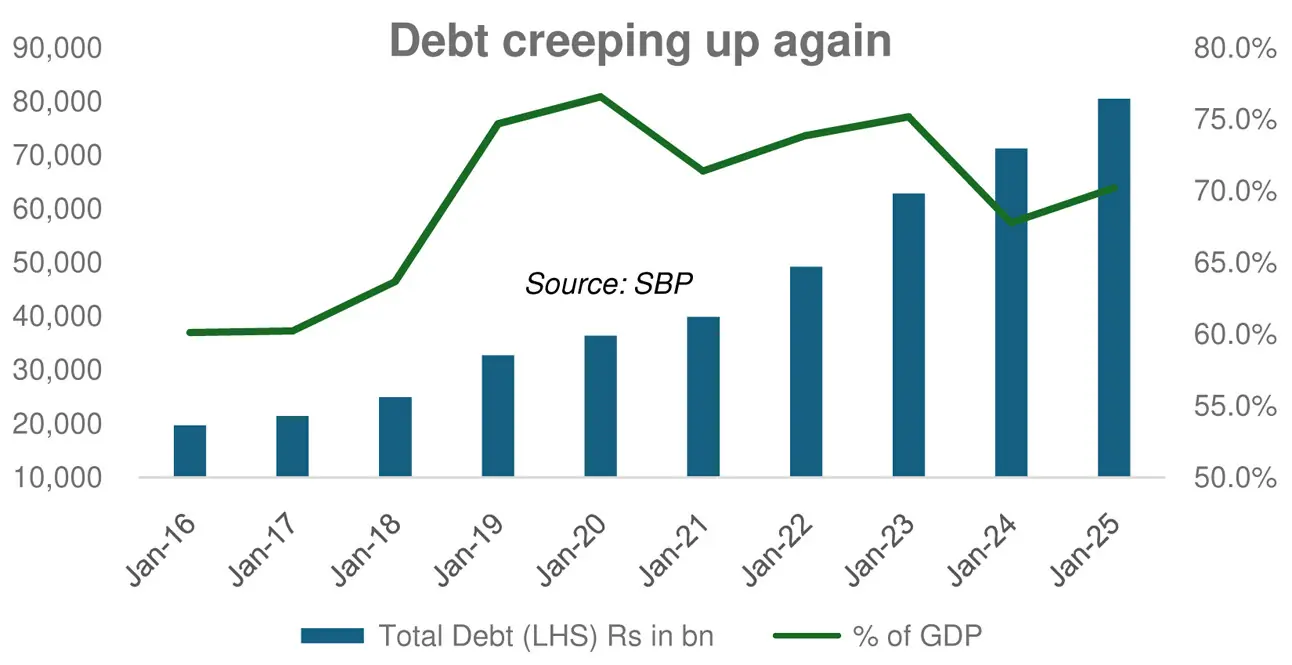
In absolute terms, the debt increased by 13 percent in FY25. Growth was similar in FY24, though sharply down from 28 percent and 24 percent in the two preceding years, respectively.
The total government debt stood at Rs80.5 trillion as of June 2025, up Rs9.3 trillion in FY25. The federal fiscal deficit stood at Rs7.1 trillion, and on a consolidated basis, the fiscal deficit came in at Rs6.2 trillion.
The remaining amount adds to the government’s cash balance, as provinces showed surpluses in their respective accounts.
Overall government deposits rose by Rs1.1 trillion in FY25 to Rs7.2 trillion. The debt of the government (based on the FRDLA definition) stood at Rs73.2 trillion (63.9% of GDP). After adjusting for the rise in deposits, government debt increased by Rs8.2 trillion, while the federal fiscal deficit was Rs7.1 trillion.
The remaining Rs1.1 trillion is perhaps due to exchange rate adjustments, as the PKR/USD was 283.74 on the last day of FY25 versus 278.37 on the last day of FY24. The increase is likely higher than the PKR/USD adjustment alone, as the USD has depreciated against other currencies, and Pakistan’s external debt is denominated in multiple currencies.
The point is that the debt increase in FY25 is similar to last year – albeit FY25 was a better year due to a lower deficit. The journey is long, and to bring debt to manageable levels, fiscal deficit reduction is essential, while running primary surpluses is imperative to reduce debt levels in the medium term.
Higher debt growth was recorded in domestic debt – up 15.5 percent in FY25. The maturity profile of the debt is improving, with long-term bonds (PIBs) up 25 percent to Rs35 trillion, while short-term market debt (T-Bills) declined 15 percent to Rs8.6 trillion.
Although the maturity profile is improving, interest rate risk is not declining proportionately, as a major chunk of PIBs are floating-rate instruments.
On the other hand, external debt (in PKR terms) grew by a mere 7.6 percent. In USD terms, external public debt rose by 5.6 percent to $103.8 billion compared to $98.3 billion last year. This is the first time government external debt has crossed the $100 billion mark.
The major increase occurred in June 2024, as within one month the debt grew by $4.5 billion – the prime reason SBP reserves rose to $14.5 billion by the end of June.
Thus, the recent upward movement in reserves is primarily due to higher government external debt. Nonetheless, the SBP has purchased $12–14 billion in the last eighteen months, which helped reserves recover from a low of $3 billion. Still, reserves remain low, and there is a long way to go.

























Comments
Comments are closed for this article.