


China’s Xi at centre of world stage after days of high-level hobnobbing
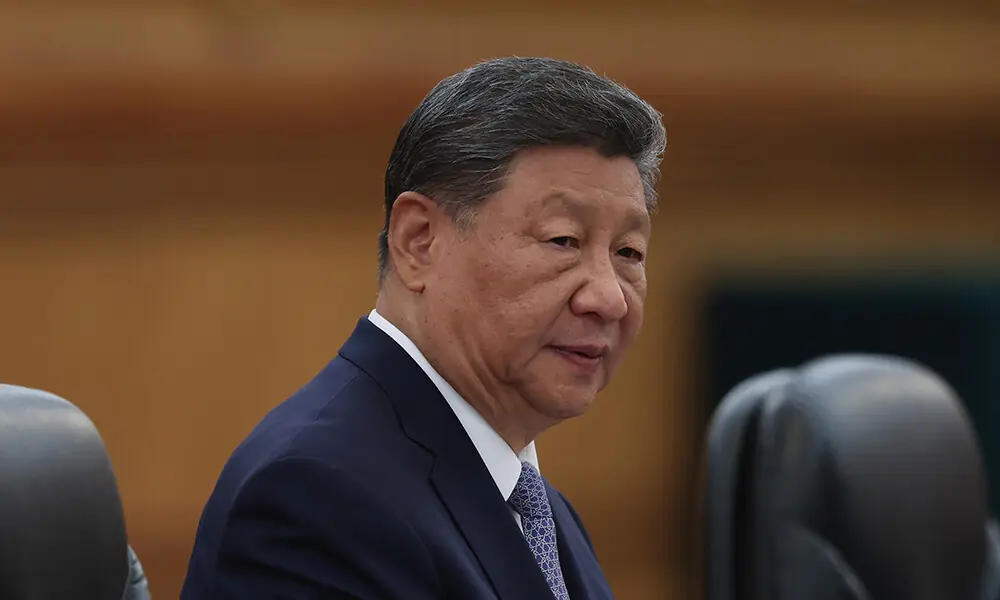

BEIJING: Two blockbuster events in China this week were a successful exposition of President Xi Jinping’s vision of a new world order – one that puts him and his country firmly at its centre while sidelining his rival the United States.
Since Saturday, Xi has met with almost 30 world leaders around the edges of a Shanghai Cooperation Organisation (SCO) summit in Tianjin and a huge military parade marking 80 years since World War II’s end.
The optics of Xi flanked by Russia’s Vladimir Putin and North Korea’s Kim Jong Un as they watched a lengthy procession of long-range missiles, enormous lasers and underwater drones were difficult to misunderstand.
“Beijing is sending a message of defiance – that Beijing will not be afraid to stand by its friends… literally,” Australian National University (ANU)’s Wen-Ti Sung told AFP.
As well as Kim and Putin, largely international pariahs, Xi has hosted over the past days the leaders of Iran, India and Cuba, as well as multiple Southeast Asian, Central Asian and African countries.
Tianjin, then Beijing, became the world’s political talking shop as leaders like India’s Narendra Modi and Putin seized the opportunity to hold meetings together.
Declarations in support of Gaza and against European sanctions on Iran confirmed the SCO as a prominent platform for coordinating political positions at odds with Washington.
Strategic cooperation: Xi reaffirms China’s support to Pakistan
No major Western powers sent leaders to either SCO or the parade, with Slovakia’s Robert Fico the only European Union member state head present.
“China is casting itself as the standard-bearer of a multipolar world led by the Global South, set against the Western narrative of a US-led liberal international order,” said Chatham House’s Yu Jie.
US President Donald Trump had a more direct take.
“Give my warmest regards to Vladimir Putin, and Kim Jong Un, as you conspire against The United States of America,” he wrote on social media during the parade.
‘China has options’
But many have seen Trump’s second term actions – in particular his erratic tariff policy – as a gift to China.
“It’s been Trumpian unilateralism rather than China’s wolf warrior diplomacy when people talk about the leading source of uncertainty in the international system,” said ANU’s Sung.
China’s Xi pushes a new global order, flanked by leaders of Russia and India
The enthusiastic SCO participation of countries that have traditionally leaned towards Washington – such as India, Turkey and Vietnam – underscores that shift.
In one widely shared clip from Tianjin, Modi, on his first visit to China since 2018, stood laughing chummily with Putin and Xi.
India is a close US ally and fierce rival of China – but relations with Beijing appear to be thawing while New Delhi has found itself the unexpected target of Trump’s tariffs.
Xi’s main practical gains from the last few days are this temporary reset of ties with India, as well as the strengthening of existing relationships with its Asian trading partners – all against the background of Trump’s trade war, Chatham House’s Yu told AFP.
The events were “a diplomatic coup for Xi”, said Patricia M Kim from the Brookings Institution, showing China has “options apart from the West”.
“It doesn’t feel that it needs to go out of its way to accommodate US allies, especially when the United States is already alienating many of them.”
‘Smiling and snarling’
Notably, not all SCO attendees continued to the parade, including Modi.
Kim only attended the military parade.
“Diplomacy requires an artful combination of smiling and snarling, and this parade, especially the visuals of Putin, Kim, and Xi together, will likely create reputational costs for Beijing,” American University’s Joseph Torigian told AFP.
China’s calculus might be that a “show of respect” to Kim will stymie North Korea’s growing cosiness with Russia, he said.
Yun Sun, from the US-based Stimson Center, said the choice of guests of honour undermined China’s claim to have a “viable alternative international order”.
“It begs the question as to whether China really has no one better to showcase the diplomatic support (it) has in the world?” she said, adding Beijing had tried to persuade Western diplomats to attend.
The display of military prowess itself may well have made some attendees uneasy, in a region where China has multiple territorial disputes.
Ultimately though the parade is unlikely to change observers’ strategies.
“For those who have already decided to accommodate China, the parade might reinforce why,” said Mick Ryan, a retired Australian army major general now with CSIS, wrote on social media.
“For others who have decided to resist… it may provide additional purpose for doing so.”


























Comments
Comments are closed for this article.