



SINGAPORE: Concerns over escalating hostilities in the Middle East stayed front and centre in markets on Wednesday, sending oil prices higher and investors rushing for the safety of U.S. Treasuries and the dollar while dumping stocks.
Investors have grown increasingly nervous over the possibility of a more direct U.S. military involvement as the Israel-Iran air war entered a sixth day, with President Donald Trump calling for Iran’s unconditional surrender and warning U.S. patience was wearing thin.
“Clearly the Middle East issues have not been solved, and comments by President Trump just mean that things could get more dangerous in that part of the world,” said Joseph Capurso, head of international and sustainable economics at Commonwealth Bank of Australia (CBA).
“The markets are trying to figure out that risk of a big U.S. military intervention. It’s hard to say exactly what the market is thinking, but judging by the oil price and currencies, they’re certainly pricing in at least some risk that something goes very bad there.”
Oil prices extended their climb on Wednesday, with Brent crude futures up 0.33% to $76.70 per barrel while U.S. crude rose 0.45% to $75.18 a barrel. Both had jumped more than 4% in the previous session.
The broad risk-off moves across markets also continued to gather pace.
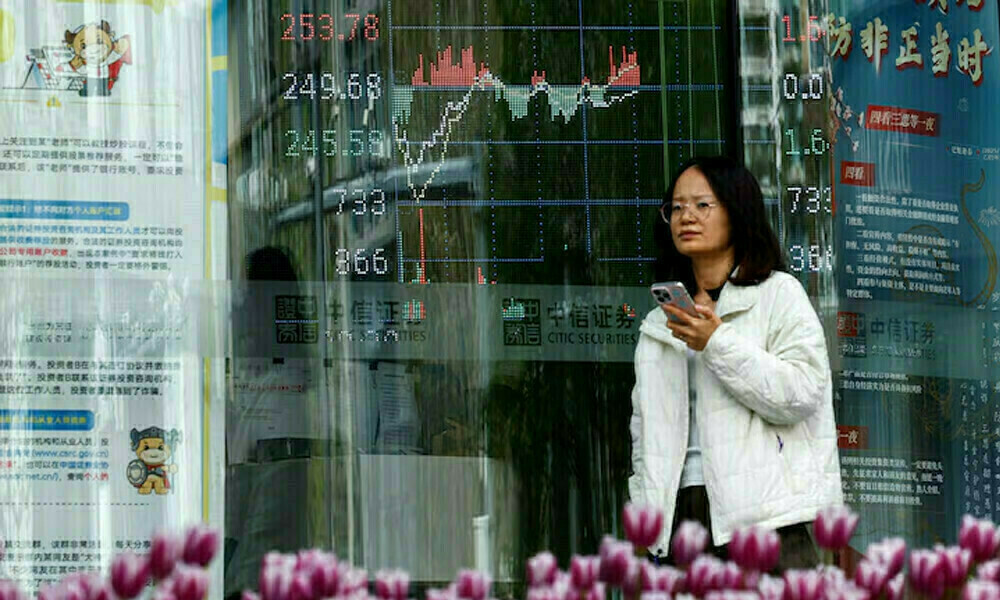
MSCI’s broadest index of Asia-Pacific shares outside Japan fell 0.26% as did EUROSTOXX 50 futures , which declined 0.4%.
U.S. stock futures were little changed after the cash session on Wall Street ended in the red overnight.
In currencies, the dollar firmed at a one-week high of 145.445 yen and held to most of its gains against other peers.
The euro struggled to recover from its 0.7% fall on Tuesday, and last bought $1.1487.
Sterling edged slightly higher to $1.3435, having slid 1.1% in the previous session.
Stocks slide, oil and gold jump after Israel strikes Iran
The spike in oil prices is a negative for the yen and euro at the margin as both Japan and the EU are major importers of energy, while the United States is an exporter.
“The war has demonstrated that the U.S. dollar still retains a bit of haven status in certain situations, such as when the war is seen to raise the risk of disrupting global oil supply, and when the war diverts traders’ attention away from those risks that are U.S.-centric,” said Thierry Wizman, global FX and rates strategist at Macquarie Group.
FED outcome
The conflict in the Middle East, combined with prolonged uncertainty over Trump’s tariffs and signs of fragility in the U.S. economy, make for a challenging backdrop ahead of the Federal Reserve’s policy decision later on Wednesday.
U.S. retail sales fell by a more-than-expected 0.9% in May, data showed on Tuesday, marking the biggest drop in four months.
Expectations are for the Fed to stand pat on rates, though focus will also be on the central bank’s updated projections for the economy and the benchmark interest rate.
“We do not anticipate much novelty from the Fed,” said Erik Weisman, chief economist at MFS Investment Management.
“The only area of interest may come from the new set of forecasts under the Summary of Economic Projections, which may point to slightly slower growth, combined with slightly higher inflation.”
U.S. Treasury yields were steady in Asia after falling on Tuesday, as investors scooped up the safe-haven bonds in the wake of latest developments in the Israel-Iran conflict. Bond yields move inversely to prices.
The benchmark 10-year yield was last at 4.4027%, having fallen roughly 6 basis points in the previous session.
The two-year yield stood at 3.9581%.
Elsewhere, spot gold eased 0.12% to $3,384.73 an ounce.

























Comments
Comments are closed for this article.