


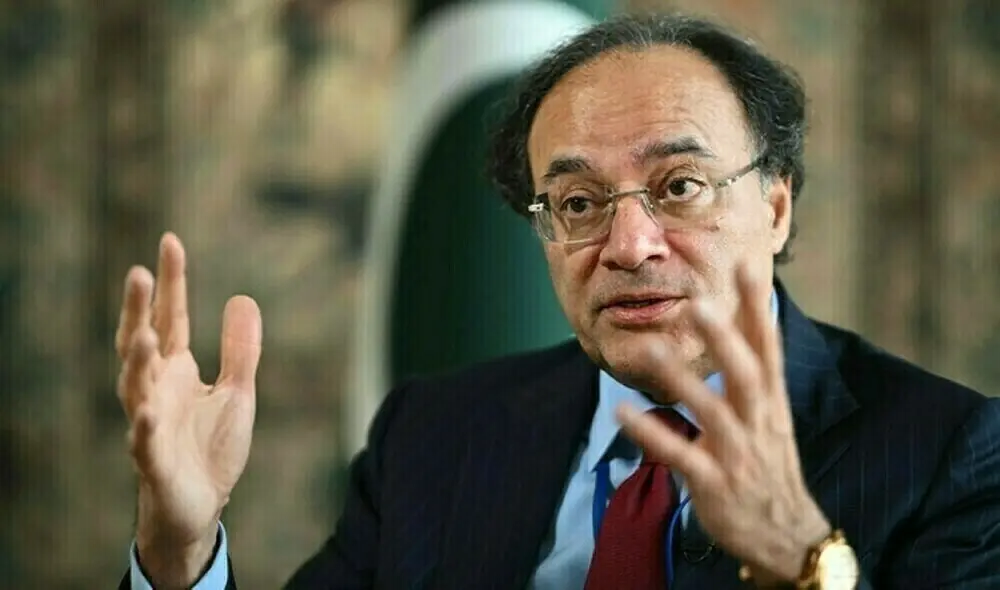

ISLAMABAD: Federal Minister for Finance and Revenue Muhammad Aurangzeb on Thursday outlined five key priorities for Pakistan’s economy, including making macroeconomic stability permanent, shifting towards investment-, productivity- and export-led growth, pursuing structural reforms, moving from aid to trade and investment, and positioning the country to benefit from the New Economy.
Addressing the 9th edition of the Leaders in Islamabad Business Summit (LIIBS) 2026, themed “The Next Move,” via video link, the finance minister said Pakistan’s economic position had improved, and the positive trajectory was continuing into the current fiscal year.
He said the government’s immediate objective was to build on macroeconomic stability and transition towards a sustainable and productive growth model, moving away from consumption-driven cycles towards growth increasingly supported by exports, investment and productive capacity.
READ MORE: Aurangzeb highlights priorities for sustained prosperity
Aurangzeb said large-scale manufacturing had shown improvement, while strong remittance inflows and continued growth in IT exports were supporting the country’s external account.
He stressed that permanence in macroeconomic stability remained central to Pakistan’s economic future, with adequate fiscal and external buffers necessary to withstand domestic and external pressures.
“The objective now is to build on this stability and move towards a more sustainable and productive growth model,” he said.
The minister said Pakistan’s GDP grew by around 3.7 percent during the last fiscal year, while economic activity remained positive in the current fiscal year. The State Bank of Pakistan (SBP) has projected GDP growth of 3.5 to 4.5 percent for the current fiscal year.
Aurangzeb said the government had established a clear direction towards export-led economic growth and was taking measures to improve the competitiveness of traditional export sectors.
He said exporters were being provided refinancing at 4.5 percent, despite the policy rate standing at 11.5 percent, as part of efforts to support export competitiveness.
He said the country needed to increase productivity and create an enabling environment for the private sector to expand investment and productive activity.
The minister also emphasised the importance of providing the right ecosystem, connectivity and data infrastructure to support sustainable growth.
The finance minister said the government was staying the course on structural reforms aimed at strengthening the foundations of the economy, improving productivity and competitiveness, and promoting private-sector-led growth.
He highlighted reforms in taxation, energy, state-owned enterprises (SOEs) and public finance.
On fiscal management, Aurangzeb said Rs8.2 trillion had been budgeted for debt servicing during the last fiscal year, while actual expenditure was Rs6.9 trillion.
He said reforms in public finance and domestic debt management were aimed at improving the efficiency of public resources and reducing financial risks.
On taxation, the minister said Federal Board of Revenue (FBR) revenues had increased by around 40 percent over the past couple of years, mainly through deepening the tax net, while further efforts were required to broaden the tax base.
He said the FBR’s new operating model would move income-tax and sales-tax processes towards a faceless system, with a pilot scheduled for October 1.
The end objective, he said, was to remove discretionary powers from tax officers and restore public confidence in the tax authority.
Aurangzeb said 27 SOEs had been handed over to the Privatisation Commission, while entities including Utility Stores Corporation, PASCO and PWD had either been closed or were in the process of being wound up.
He also highlighted pension reforms under which new entrants into the civil government were being shifted towards defined-contribution schemes, while similar discussions were underway regarding the armed forces.
Aurangzeb described Pakistan’s recent USD 3 billion international bond issuance as an important milestone, marking the country’s return to international capital markets after a four-year gap.
He said orders received from investors were nearly twice the amount sought, while Asian investors showed particularly strong participation.
The minister said the quality and diversity of the investor base were as important as the size of the order book.
The transaction attracted a diversified investor base from Asia, the Middle East, Europe and the United States, he said, adding that strong Asian participation provided an important signal of international investor confidence in Pakistan.
The bond maturities of 5.5 years and 10 years, he said, also suggested that investors were looking beyond the current IMF programme.
Aurangzeb said Pakistan was deliberately moving away from aid-based relationships towards stronger trade and investment flows, with greater emphasis on deepening commercial ties with bilateral partners, attracting private capital and integrating the economy with regional and global markets.
The finance minister identified the New Economy as another major area of opportunity for Pakistan, particularly digitalisation, blockchain and Web 3.0.
He said Pakistan’s young and increasingly technology-enabled population could help the country participate in higher-value segments of the global economy if supported by an appropriate policy, investment and digital ecosystem.
Pakistan’s IT and IT-enabled services exports had reached USD 4.6 billion in the previous fiscal year and were projected to approach USD5.5 billion in the current year, he said.
Freelancers contributed an estimated USD 1.6–1.7 billion of the previous year’s IT and IT-enabled services exports, highlighting the contribution of young Pakistanis to the digital economy.
Aurangzeb said the rollout of 5G connectivity, alongside efforts to upskill and reskill young people in emerging areas, could help Pakistan raise the value of its digital exports.
“We have a real, real opportunity to leapfrog while we deal with the old economy,” he said.
The finance minister said strengthening domestic investor confidence was essential for attracting foreign investment.
“Once you get the basic hygiene, you first need to get the local investors moving,” he said, adding that without confidence among domestic investors in the direction of the economy, attracting foreign investors would remain difficult.
Aurangzeb also said the government was closely monitoring the economic impact of the ongoing regional conflict, particularly its potential second- and third-order effects on inflation and economic growth.
He said Pakistan had so far avoided fuel shortages and queues at petrol stations despite disruptions to regional energy routes. The government was covered for September and essentially covered for October, while planning for November was underway.
He said disruptions involving the Strait of Hormuz and Bab al-Mandab, as well as impacts on regional energy routes and the East-West pipeline, reinforced the need for strong fiscal and external buffers.
The finance minister said the government would continue protecting the gains achieved so far while pursuing reforms aimed at improving productivity, competitiveness and private-sector investment.
He said Pakistan needed to make full use of opportunities available within the country while maintaining a consistent economic direction centred on permanent macroeconomic stability, sustainable and responsible growth, structural reforms, stronger trade and investment flows, and participation in the New Economy.
Copyright Business Recorder, 2026

























Comments