



Pakistan Paper Products Limited (PSX:PPP) was incorporated in Pakistan as a private limited company in 1984 and was converted into a public limited company in 1962 and was converted into a public limited company in 1964. The principal activity of the company is the manufacturing and sale of exercise books, pro-labels and sensitized papers.
Pattern of Shareholding
As of June 30, 2024, PPP has a total of 8 million shares outstanding which are held by 807 shareholders. Directors, CEO, their spouse and minor children have the majority stake of 37.11 percent in the company, followed by general public holding 31.65 percent of PPP’s shares.
Management and Enterprises (Private) Limited, an associated company of PPP holds 11.34 percent of its shares while Banks, DFIs, NBFIs, Modarabas, Mutual Funds, Insurance, Joint stock companies & others collectively account for 8.57 percent of the company’s shares. Around 7.83 percent of PPP’s shares are held by NIT and ICP and 3.50 percent by public sector companies.
Historical Performance (2019-24)
PPP’s topline has posted growth over the period under consideration. Conversely, its bottomline rose only thrice during that period i.e. in 2021, 2023 and 2024. PPP’s margins which eroded until 2020 posted a staggering rebound in 2021.
In the subsequent two years, PPP’s gross margin continued to pick up while its operating and net margins dropped in 2022 and grew in 2023. In 2024, the margins attained their optimum level (see the graph of profitability ratios). The detailed performance review of each of the years under consideration is given below.
In 2019, PPP’s topline posted 11 percent year-on-year growth to clock in at Rs.875.44 million. The growth primarily came on the back of an excellent performance of pro-labels segment which registered 19.79 percent improvement in sales. The sale of exercise books however stayed constant during the year as the Sindh government changed the start of the school season from April to July.
Consequently, seasonal sales hike which occurred in March-April was shifted in June-August. Sensitized paper also showed terrible performance in 2019 with sales falling by 14.15 percent owing to fall in demand coupled with shortage of raw materials as this was considered to be an obsolete product all over the world and was increasingly being replaced by plotter paper.
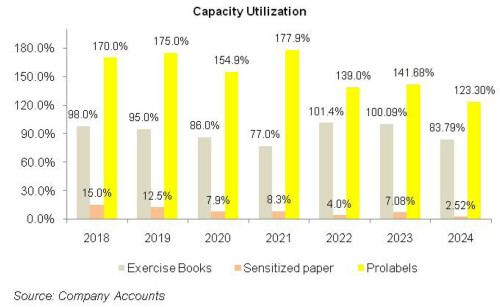
Given the demand pattern, PPP operated its exercise books, sensitized paper and pro-labels plants at 95 percent, 12.5 percent and 175 percent capacity respectively in 2019. Cost of sales grew by 17.87 percent year-on-year in 2019 which was the effect of Pak Rupee depreciation, steep rise in international commodity prices, high indigenous inflation, electricity tariff etc.
This culminated into 23.47 percent year-on-year drop in gross profit with GP margin receding from 16.46 percent in 2018 to 11.34 percent in 2019. Operating expense grew by a marginal 2.21 percent in 2019 due to massive cut in sales promotion expenditure.
Payroll expense continued to grow despite restructuring of workforce from 120 employees in 2018 to 115 employees in 2019. Operating profit plummeted by 36 percent year-on-year in 2019 with OP margin sliding down from 10.11 percent in 2018 to 5.82 percent in 2019. Finance cost radically grew by 77.44 percent year-on-year in 2019.
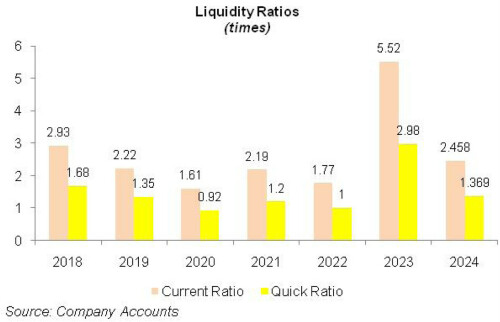
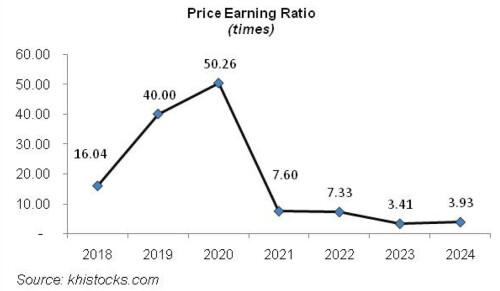
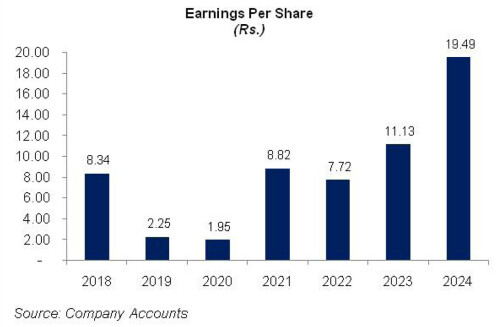
This was due to high discount rate coupled with elevated borrowings owing to delay of Exercise books season as well as extended payment period of pro-label sales which created liquidity issues for the company. PPP’s net profit slipped by 64.10 percent year-on-year in 2019 to clock in at Rs.17.97 million with NP margin of 2.1 percent versus NP margin of 6.35 percent posted in 2018. EPS also nosedived from Rs.8.34 in 2018 to Rs.2.25 in 2019.
The topline growth momentum slowed down to 4.33 percent year-on-year in 2020. PPP’s net sales were recorded at Rs.913.31 million in 2020. While the sales of pro-labels grew by 15.57 percent year-on-year in 2020, exercise books posted a sales decline of over 13 percent due to closure of educational institutions in the 4QFY20 on account of COVID-19.
Sale of sensitized papers also declined by 17 percent year-on-year in 2020. The capacity utilization of exercise books, sensitized papers and pro-labels segment slid to 86 percent, 7.9 percent and 154.9 percent respectively in 2020.
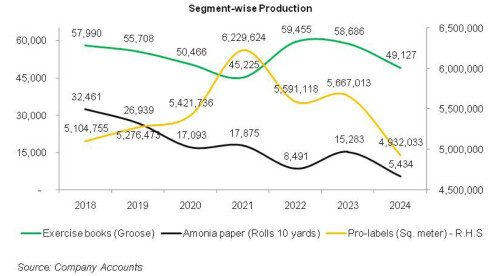
During the year, PPP increased in pro-label production capacity by 500,000 square meters due to robust demand. Cost of sales grew by 5.18 percent year-on-year in 2020 on account of fluctuations in the value of local currency and supply chain impediments, resulting in idle capacity and low absorption of fixed cost.
High inventory cost of exercise books segment also led to higher cost during the year. Gross profit shrank by 2.38 percent year-on-year in 2020 with GP margin falling to 10.61 percent.
Operating expense escalated by 9.39 percent year-on-year on the back of higher carriage and forwarding charges as there were restrictions on the movement of people and goods owing to COVID-19. High payroll expense also contributed towards elevated operating expense in 2020.
Operating profit inched down by 12.83 percent year-on-year in 2020 with OP margin climbing down to 4.87 percent. Finance cost contracted by 15.51 percent year-on-year in 2020 due to monetary easing in the later part of the year.
Short-term borrowings, however, grew during the year due to tighter liquidity position. Bottomline narrowed down by 13.38 percent year-on-year in 2020 to clock in at Rs.15.57 million with NP margin of 1.70 percent and EPS of Rs.1.95.
PPP posted topline growth of 19.67 percent year-on-year in 2021 with net sales clocking in at Rs.1092.96 million. Pro-label sales grew by 22.4 percent in 2021. Exercise books also posted sales growth of 14.5 percent in 2021, however, given the low-base of 2020, the turnover didn’t prove to be as exciting for the company.
Sensitized paper sales grew by 11.92 percent during the year, however, its contribution to PPP’s total sales squeezed to just 1.1 percent. The company was also mulling over discontinuing this line completely as procurement of raw materials for this segment was challenging for the company due to lack of suppliers. Cost of sales grew by 14.18 percent in 2021, resulting in a tremendous 65.94 percent rise in gross profit in 2021.
This was on account of favorable movement of local currency during the year. Operating expense was cut down by 4.10 percent year-on-year in 2021 due to curtailed payroll expense during the year which counterbalanced the impact of increased sales promotion expense incurred during the year.
During 2021, PPP also registered exchange gain worth Rs.4.86 million and amortization of deferred government grant worth Rs.2.67 million which drove its other income up by 5262.75 percent during the year. Operating profit rebounded by 154.23 percent in 2021 with OP margin clocking in at 10.34 percent.
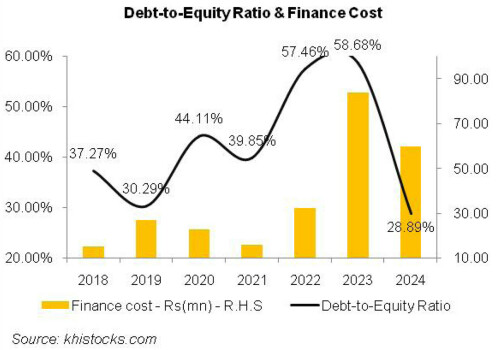
Finance cost slid by 30 percent year-on-year in 2021 despite increased borrowings during the year. This was due to monetary easing. Lower finance cost provided further impetus to bottomline which grew by 353.11 percent year-on-year in 2021 to clock in at Rs.70.55 million. EPS jumped up to Rs.8.82 while NP margin improved to 6.46 percent in 2021.
In 2022, PPP witnessed 12.92 percent year-on-year growth in its net sales which clocked in at Rs.1234.19 million. Pro-label sales remained flat during the year in terms of PKR with 10 percent drop in volume due to lower demand and intense competition in the industry. Exercise books performed really well during the year and registered a robust 45 percent growth in sales which was led by high volume as well as upward revision in prices.
The sale of sensitized paper drastically plunged by 27.9 percent in 2022 (see the graph of segment-wise production and capacity utilization to get a gist of production volumes during the year which were in line with demand). Steep depreciation of Pak Rupee, high inflation, elevated global commodity prices and increase in energy tariff culminated into 12.11 percent spike in cost of sales.
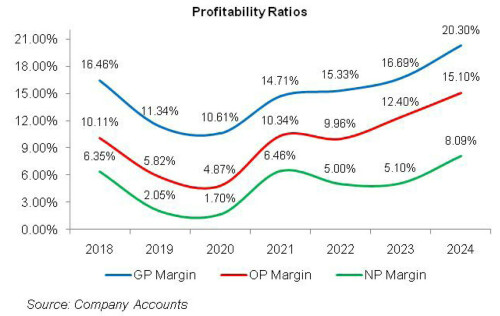
However, as the company was able to pass on the effect of cost hike to its customers, gross profit improved by 17.63 percent in 2022 with GP margin further rising to 15.33 percent. Operating expense shot up by 25 percent year-on-year in 2022 which was the effect of high payroll expense, freight charges as well as sales promotion expense incurred during the year.
Number of employees grew from 111 in 2021 to 118 in 2022. Operating profit registered 8.80 percent rise in 2022; however, OP margin fell to 9.96 percent. Finance cost soared by a huge 103.50 percent in 2022 which was mainly due to exchange loss amid drastic depreciation of Pak Rupee as majority of PPP’s raw material is imported.
High discount rate as well as increased borrowings also wreaked havoc on finance cost in 2022. This translated into 12.50 percent thinner bottomline in 2022. Net profit clocked in at Rs.61.74 million in 2022 with EPS of Rs.7.72 and NP margin of 5 percent.
With an impressive year-on-year rise of 41.46 percent, PPP’s net sales clocked in at Rs.1745.90 million in 2023. This was due to robust performance of both pro-labels and exercise books which registered sales growth of 31.61 percent and 58.68 percent respectively in 2023. Sales proceeds from plain paper and waste paper also increased during 2023 while sales proceeds from Ammonia paper fell.
Pak Rupee depreciation took its toll on the cost of sales of PPP as it uses imported raw materials particularly in the pro-label segment. However, price increase coupled with phenomenal volume resulted in a 54 percent rise in gross profit and GP margin burgeoning to 16.69 percent in 2023. Operating expense grew by 9.24 percent year-on-year on account of higher payroll expense, freight charges, utility charges and vehicle running expense incurred during the year. Operating profit rose by 76.17 percent year-on-year in 2023.
OP margin also climbed to 12.40 percent in 2023. Finance cost soared by 158.31 percent year-on-year in 2023 due to high discount rate as well as exchange loss borne during the year. Short-term borrowings also increased during the year to meet working capital requirements. PPP posted bottomline growth of 44.20 percent in 2023. Net profit stood at Rs.89.03 million in 2023 with EPS of Rs.11.13 and NP margin of 5.10 percent.
In 2024, PPP’s topline grew by 10.39 percent to clock in at Rs.1927.28 million. The topline growth came on the back of 14.22 percent growth in the sale of exercise books, 7.8 percent growth in the sale of pro-labels and 3.6 percent growth in the sale of photocopy paper.
Conversely, sale of sensitized paper posted 2.8 percent year-on-year decline in 2024. The sale proceeds of pro-labels grew during the year on the back of increase in prices, however, its volume fell due to decline in economic activity as well as intense competition in the market.
The company is also planning to shut down the production of sensitized paper as soon as it consumes its existing inventory and completely replace it with plotter/photocopy paper which has been showing reasonable growth in demand.
Decline in the prices of pulp in the international market coupled with stability in the value of Pak Rupee enabled PPP to drive up its gross profit by 34.31 percent in 2024 with GP margin attaining its optimum level of 20.30 percent. Operating expense surged by 13.18 percent in 2024 mainly on account of higher payroll expense due to market induced rise in salaries & wages.
Provision done for WWF, WPPF and ECL resulted in 159.45 percent escalation in other expense in 2024. Conversely, other income dipped by 26.98 percent due to high-base effect as the company recognized gain on the sale of fixed assets in the previous year.
PPP’s operating profit strengthened by 34.35 percent in 2024 with OP margin climbing up to 15.10 percent. Finance cost tapered off by 28.70 percent in 2024 due to considerably lower exchange loss, better cash flow management including recovery from customers. Net profit picked up by 75.12 percent to clock in at Rs.155.91 million in 2024. This translated into EPS of Rs.19.49 and NP margin of 8.1 percent.
Recent Performance (9MFY25)
During 9MFY25, PPP’s net sales contracted by 10.38 percent to clock in at Rs.1279.74 million. This was particularly triggered by a massive fall in the sale of exercise books. During 3QFY25, the sale of exercise books began to recover as the company greatly reduced the prices. Sensitized paper & photocopy paper also registered decline during the period. The sale of pro-labels remained intact at the last year level, however, posted a paltry rise in terms of volume. The drastic decline in the sale of paper was due to the prevalence of unorganized sector which is providing cheap paper at very low rates. Therefore, the company now focuses on institutional sales rather than market sales. Although the prices of pulp have decreased lately with Pak Rupee also showing vigor, lesser absorption of fixed cost due to low capacity utilization and reduction of prices of exercise books resulted in 26.72 percent fall in gross profit in 9MFY25 with GP margin slipping to 17.16 percent from GP margin of 20.98 percent recorded in 9MFY24. Operating expense surged by 11.30 percent in 9MFY25 apparently due to higher payroll expense. Lower provisioning done for WWF, WPPF and ECL appears to be the reason behind 80 percent shrinkage in other expense in 9MFY25. Other income improved by 126.62 percent in 9MFY25 seemingly due to higher profit from financial assets as the company’s bank deposits significantly mounted during the period. PPP registered 26.11 percent thinner operating profit in 9MFY25 with OP margin clocking in at 11.65 percent versus OP margin of 14.13 percent posted in 9MFY24. Lower discount rate and stronger Pak Rupee resulted in 35.53 percent drop in finance charges in 9MFY25. Net profit weakened by 21.69 percent to clock in at Rs.88.105 million. This translated into EPS of Rs.11.01 in 9MFY25 versus EPS of Rs.14.06 posted in 9MFY24. NP margin also deteriorated from 7.88 percent in 9MFY24 to 6.88 percent in 9MFY25.
Future Outlook
The company has significantly improved its operational efficiency and reduced waste by modernizing its exercise books production line. The machinery installed by PPP is one of its kinds in Pakistan and will play a pivotal role in enhancing the quality of the company’s products besides reducing its cost. The company is also investing in energy efficiency solutions to lower its energy cost. These initiatives will enable PPP to combat the competition from the unorganized sector.


























Comments
Comments are closed for this article.