


World Bank proposes export-finance products for Pakistan’s EXIM Bank
- Discussion also covered reforms to strengthen the Prime Minister’s Access to Finance initiative
The World Bank is collaborating with Pakistan to develop export finance and implement broad economic reforms aimed at boosting investment, exports, and private sector growth.
- Export-finance products for Pakistan's EXIM Bank.
- Improving investment climate and SME access to finance.
- Fiscal, revenue, and capital market reforms.
- Sectoral reforms in agriculture and pharmaceuticals.
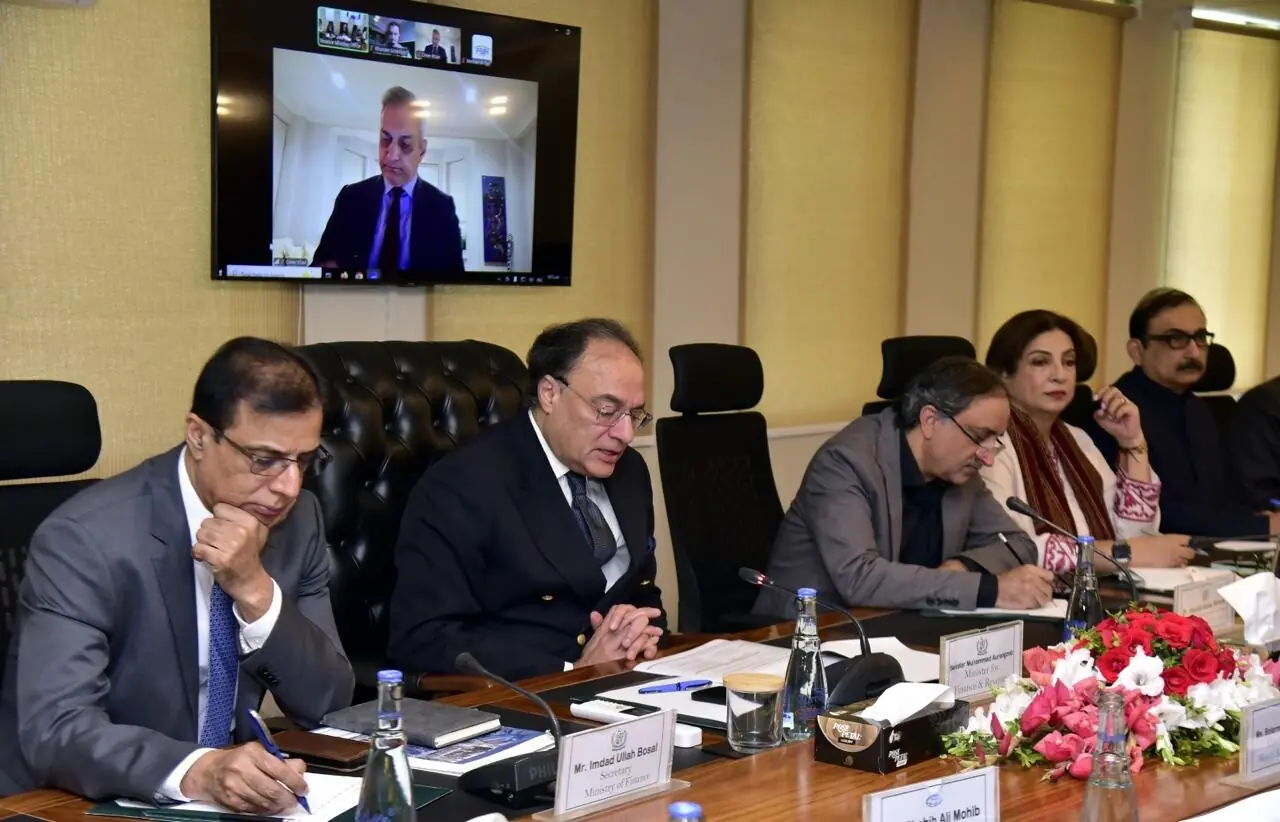

The World Bank has proposed developing export-finance products for the Export-Import Bank of Pakistan (EXIM Bank) to support incremental trade flows, as the government and global lender reviewed measures to boost investment, exports and private-sector growth.
The development came during a meeting between Finance Minister Muhammad Aurangzeb and a World Bank delegation led by Bolormaa Amgaabazar, Country Director, to review progress under the ongoing economic reform partnership and discuss implementation priorities across growth, jobs, fiscal management, revenue mobilisation, capital-market development, trade and investment, and institutional reforms, read a statement on Friday.
The meeting reviewed the World Bank’s support for Pakistan’s broader economic reform agenda, with particular emphasis on translating reform priorities into targeted, implementable actions and strengthening coordination among relevant ministries, provincial governments and implementing agencies.
The finance minister underscored the importance of moving from reform design to effective implementation, with a focus on practical measures capable of delivering measurable improvements in economic activity, investment, jobs and the overall business environment, read the statement.
The meeting discussed the proposed World Bank growth and jobs operation, including interventions aimed at improving the investment climate, access to finance, sectoral productivity and labour-market outcomes.
The World Bank outlined proposed measures relating to the investment framework, reduction of regulatory and business constraints, and access to finance for SMEs.
The discussion also covered reforms to strengthen the Prime Minister’s Access to Finance initiative, including a unified insolvency framework, factoring legislation and regulations to support SME financing, as well as measures to expand commercial financing and greater private-sector participation.
On sectoral reforms, the World Bank highlighted proposed interventions in pharmaceuticals and medical products, and agriculture, including improvements in seed registration, deregulation of selected commodities and strengthening of international accreditations to facilitate participation in international procurement and markets.
The meeting also reviewed initiatives to strengthen skills development and labour-market alignment, including improvements in the national vocational qualifications framework, greater international recognition of skills and development of formal overseas migration pathways supported by digital platforms.
Aurangzeb and the World Bank delegation reviewed implementation of the National Tariff Policy and ongoing analytical support for tariff reforms, including work relating to the automotive sector and future tariff reforms. The discussion emphasized the importance of supporting competitiveness, productivity, investment, exports and Pakistan’s greater integration into global value chains.
On fiscal and revenue reforms, the meeting reviewed World Bank technical assistance to strengthen tax-policy capacity, including support for the Medium-Term Revenue Strategy and revenue-policy modelling. Discussions also covered GST harmonisation, including greater alignment of rules, definitions and classifications for services, improved federal-provincial coordination and stronger data-sharing arrangements.
The meeting reviewed progress on agricultural income tax reforms, including implementation of amended provincial laws and rules and digital systems for registration, filing and payment. The importance of strengthening compliance and federal-provincial data sharing was also discussed.
The discussion further covered provincial property-tax reforms, including efforts to improve and harmonise property-valuation approaches, strengthen digital systems and progressively move towards more market-based valuation frameworks.
On domestic capital markets, the meeting discussed World Bank Group support for developing a roadmap for capital-market reforms through the Capital Markets Development Council, aimed at deepening domestic capital markets, broadening financing avenues and strengthening the ecosystem for investment and capital formation.
The meeting also reviewed World Bank support for public-sector efficiency and the government’s rightsizing agenda, including technical assistance to strengthen institutional effectiveness and improve the efficiency of public resources.
The finance minister highlighted the importance of strengthening debt-management capacity and domestic bond markets. Discussions covered ongoing technical cooperation on financial instruments for managing market risks, domestic bond-market development and strengthening investor-relations capacity.
The meeting also discussed the World Bank’s analytical support on Pakistan’s sovereign credit profile and the pathway towards further rating improvements.
The World Bank delegation also briefed the finance minister on analytical work on governance and institutional effectiveness, with discussions focused on practical and measurable reforms to strengthen government effectiveness, regulatory quality, transparency, accountability and the overall business environment.



























Comments