




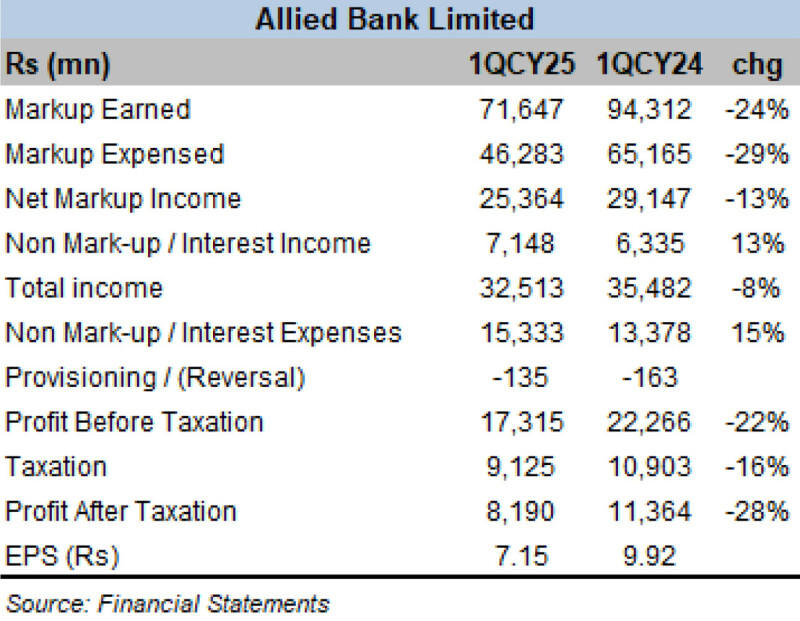
Allied Bank Limited (ABL) has announced its financial results for the first quarter of 2025, alongside an interim cash dividend of Rs4 per share. As anticipated, profitability has taken a hit—primarily due to a steep drop in average interest rates and further weighed down by a rise in the effective tax rate compared to the same period last year.
Unlike the previous quarter, where credit growth took centre stage, the latest quarter marks a return to the traditional investment-heavy balance sheet approach across the banking sector.
The brief surge in advances during 4QCY24 was largely driven by attempts to circumvent elevated tax penalties tied to the Advance-to-Deposit Ratio (ADR).
However, with the urgency subsiding, ABL’s ADR slipped sharply by 12 percentage points from December 2024, landing at 40 percent—the lowest level the bank has seen in at least 10 quarters. This comes after a temporary 8 percentage point rise in the preceding quarter.
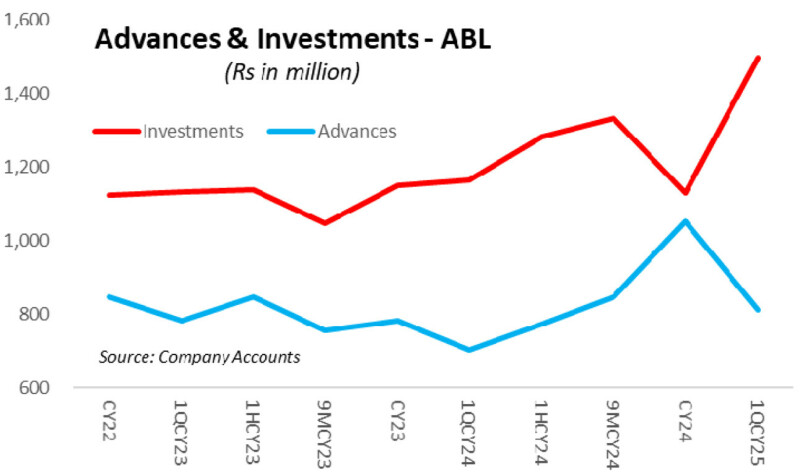
The loan portfolio contracted by Rs39 billion over the quarter, erasing the Rs204 billion expansion seen in 4QCY24. The 23 percent quarter-on-quarter decline in advances marks the most significant quarterly drop for ABL in recent times.
While this contraction is more pronounced than the industry average, it reflects a sector-wide pullback. Overall, banking sector advances fell 15 percent from December 2024, settling at Rs15 trillion. Interestingly, Non-Bank Financial Institutions (NBFIs), which hold just 8 percent of the sector’s total loan base, were responsible for nearly a third of the Rs2.4 trillion dip, driven by a short-lived spike in lending triggered by ADR concerns.
As credit growth cooled, banks—including ABL—redirected their focus toward government securities. ABL’s investments surged by Rs366 billion over the quarter, translating to a 32 percent jump—well above the 11 percent investment growth recorded industry-wide. The uptick, mainly in Pakistan Investment Bonds (PIBs) and Sukuks, pushed ABL’s Investment-to-Deposit Ratio (IDR) back into the 70s, its highest in six quarters.
On the funding side, ABL’s deposits saw a marginal 2 percent increase from December 2024, reaching Rs2 trillion. This trails the industry’s 5 percent growth during the same period. The deposit base continues to be anchored in current accounts, with a slightly improved CASA ratio compared to the year-ago period.
Robust growth in non-markup income played a key role in cushioning the bottom line. Fee and commission income remained strong, while capital gains more than doubled year-on-year—buoyed by favourable returns on Eurobonds and federal government securities. That said, operating costs rose sharply, with administrative expenses increasing by 15 percent year-on-year, well above the 1.5 percent average inflation during the quarter. Consequently, the cost-to-income ratio deteriorated significantly, crossing 45 percent.
Even as headline macroeconomic indicators—such as inflation, current account balance, and exchange rate—suggest relative stability, the real economy remains lethargic. Both agriculture and large-scale manufacturing (LSM) continue to struggle, casting a shadow on private sector credit demand for the remainder of the year—unless the ADR tax floor pressure resurfaces out of turn.























Comments
Comments are closed for this article.