



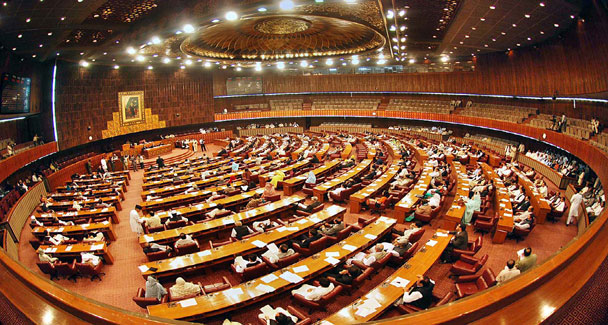
 ISLAMABAD: The National Assembly voted for the 20th Constitutional Amendment Bill, the media reported on Wednesday. Around 247 votes were in the “Aye” while there were no votes against.
On Tuesday, the National Assembly passed 20th Amendment Bill with consensus to validate election of 28 members of the Senate, National Assembly and Provincial Assemblies.
The House also adopted to lay down basis for an independent Election Commission, formation of Caretaker government for holding new elections and a provision to nominate members against reserve seats even after exhaustion of the already submitted priority list of the candidates by respective parties.Over 250 members of the House voted in favor of the various clauses of the bill and the amendments proposed in two clauses of the earlier framed bill.The amendments provided for reducing the number of a committee at provinces - the committee meant for appointing caretaker Chief Ministers and their cabinets at provinces for the fresh elections on completion of the tenure of any sitting government.
The amendment was brought in by the treasury and the opposition members with consensus as in Balochistan Assembly there are only three opposition members. In the earlier presented bill to the House there was provision to constitute eight-member committee with equal representation from the government and the opposition parties in respective provincial assemblies, to nominate caretaker Chief Ministers and the cabinets if the Leaders of the House and the Opposition in that assembly could have failed to do the same within stipulated time allocated to them under the 20th amendment.
The 20th amendment had provided for constituting an eight-member committee each at the federal and the provincial level to respectively nominate the Prime Minister and the Chief Ministers along with their respective cabinets.
But, due to less number of members of opposition in Balochistan Assembly (who are three), the total strength of the committees at provincial level was reduced providing that “if the members of the opposition are less than four (instead of already mentioned five members) in any assembly, then all of them shall be members of the committee.”
Furthermore, it has been provided that even if the respective committees or any of them failed to evolve consensus on a caretaker set up within three days, the matter will be referred to ECP for appointing a caretaker set up within two days in respective cases.
As explained in the 20th constitutional amendment bill, article 214 has been amended providing that the Chief Justice of Pakistan will administer oath to the new Chief Election Commissioner and the Chief Election Commissioner will administer the oath to newly appointed members of the Election Commission.
In amended article 215, the amendment provides for adopting the same procedure for extension in the tenure of members of ECP as specified for the Chief Election Commissioner. This amendment also provides that to remove a member of ECP, the procedure laid down in Article 209 regarding removal of Chief Election Commissioner or a Judge from the service, will be applicable.
Similarly another amendment in the same clause provides that to resign from his office, a member of the ECP shall have to send his resignation to the President. Earlier, this provision applied to the CEC only.
Under the amendment in article 216 of the Constitution, the proviso of not holding an office of profit will now also apply to the members of ECP like the CEC.
The amendment made in article 218 is one of the most important amendments in the bill as it provides for validating the election of 28 members of the Senate, National Assembly and Provincial Assemblies who were facing the threat of disqualification even after getting elected in by-elections across the country.
The Supreme Court had asked the ECP to prove the validation of their elections that were held at a time when the Commission was not complete and the CEC could not hold these elections after his powers were delegated to the Commission under the 18th amendment.
Therefore, the House adopted the amendment providing that “till such time as the members of the Commission are first appointed in accordance with the provisions of paragraph (b) of the clause (2) of Article 218 pursuant to the constitution (18th amendment) Act, 2010, and enter upon their office, the Commissioner shall remain charged with duties enumerated in paragraphs (a), (b), and (c).”
Moreover, through the 20th constitutional amendment the powers of the President and the Governors to appoint respective caretaker set up at federal as well as provincial level respectively, have been delegated to the Prime Minister and the Leader of the Opposition in National Assembly to nominate Caretaker Prime Minister and the Cabinet at federal level and subsequently to the Leaders of the Houses and the Leaders of the Opposition at provincial assemblies. In addition, Speakers at National Assembly and the Provincial Assemblies will constitute committees at federal as well as provincial assemblies to nominate a caretaker government, if the Leaders of the Houses and Leaders of the Opposition at federation and provinces, could have failed to reach a consensus to nominate a caretaker Prime Minister or the Chief Ministers along with their Cabinets. The amendment also provides that the members for the committee at federal level will be appointed by the Speaker from amongst the members of National Assembly or Senate or from both the Houses. The House also adopted that now the respective party leaders will be entitled to nominate their members against the seats reserved for minorities and women even after the earlier submitted list is exhausted. Previously, these party leaders were not entitled to nominate more members once their earlier submitted lists of members were exhausted.
























Comments
Comments are closed for this article.