


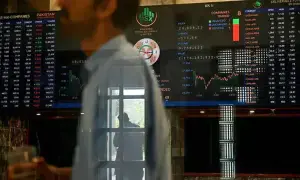
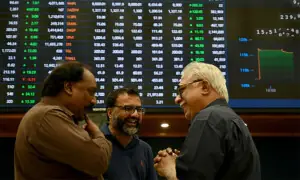
The Pakistan Stock Exchange recorded the single highest gain on Thursday subsequent to the calling off of the Islamabad lockdown by Pakistan Tehreek-e-Insaf (PTI) Chairman Imran Khan. The call was given in response to the apex court's direction to all parties to submit their terms of reference (ToRs) within two days; and in the event of a lack of consensus, a condition that had delayed the setting up of the commission to investigate the Panama Papers for the last seven months, the court would decide the ToRs. The business community in the country had understandably reacted negatively to the lockdown call as well as to the modus operandi of dealing with the lockdown by the federal and the Punjab governments that severely disrupted economic activity. And the gains in the KSE index in a single day amply reflect the views of the country's business community with respect to calls for protest. In this context, it is relevant to note that the call for lockdown by PTI was to some extent akin to strike calls by the productive sectors in protest against the levy of a specific tax and the response of the Ministry of Finance. For example, at present, the sale or resale of real estate has almost come to a standstill because of opposition by the stakeholders to the federal government's valuation of properties as indicated in the budget for the current year.
Be that as it may, the calls for dharnas/protests as well as the government's response need an urgent revisit. While no doubt the outcome of a prolonged political dharna anywhere in the country generates political uncertainty that, in turn, would automatically disrupt economic activity, yet the response of our governments, past as well as present, with reference to the modus operandi used to contain a protest also requires a revisit.
The usual method of containment has been setting up road blocks with containers, which also carry export and import items, and which are simply appropriated as and when required for a period that is determined by the appropriating authority. Thus a requisitioned container by the government implies that the exporters/importers are compelled to delay the already agreed date of delivery of a consignment which would, naturally, have serious repercussions on the economy. In terms of exporters any delay in scheduled transport of the goods may, in the worst case scenario, leads to the foreign client seeking other alternates internationally, or at best, jacking up the exporters' as well as importers' costs as the shipment does not reach the buyer on schedule. In a country where exports are already declining the approach to appropriate containers without recompense needs an urgent revisit.
The Karachi Chamber of Commerce and Industry told the government in no uncertain terms that "we are neither in favour of the sit-in nor against it. We are businesspeople who only demand an enabling business environment which has to be ensured by the government." During the recently completed 6.64 billion dollar International Monetary Fund-supported programme, the government of Pakistan was urged to formulate a strategy to promote ease of doing business, given our poor ranking on that score. The Ministry of Finance indicated that the strategy had been formulated - a strategy that was focused on one-stop shop - however one would urge the government to include a section on desisting from the peremptory appropriation of containers during sit-ins in the strategy.











Comments
Comments are closed for this article.