


Stocks edge higher on rising oil prices, but trade worries persist


NEW YORK: World stocks rose on Tuesday, supported by broad gains in Europe and rising oil prices, even though markets across Asia remained in the grip of trade turbulence.
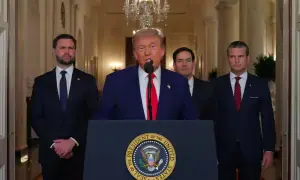
A July 6 deadline is looming for Washington to impose tariffs on $34 billion worth of Chinese goods that Beijing has vowed to match with tariffs on U.S. products. President Donald Trump also threatened on Monday to "do something" if the United States was not better treated by the World Trade Organization.
Prospects of a full-blown trade war and relentless yuan weakening - it has fallen 5 percent in the past two weeks and is near 11-month lows - reportedly forced China into intervention via state-run banks.
"It is by far the biggest (yuan loss) I can remember. Prudence suggests it has to be matched across Southeast Asia because of the competitive implications," said Bank of New York Mellon strategist Neil Mellor. "It generates a degree of instability in the market simply by virtue of its scale."
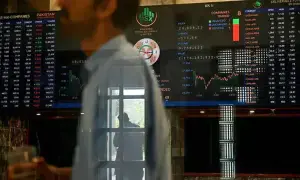
Among equity markets, Hong Kong dived as much as 3.3 percent to nine-month lows, hit also by U.S. curbs on China Mobile. Shanghai's bourse hit a two-year trough but closed higher as the yuan recovered.
The mood was more cheerful in Europe where a pan-European equity index rose 1 percent, the euro firmed and bond yields climbed after German Chancellor Angela Merkel struck a migration deal with her Bavarian conservative coalition partners.
In the United States, the Dow Jones Industrial Average rose 88.76 points, or 0.37 percent, to 24,395.94, the S&P 500 gained 7.04 points, or 0.26 percent, to 2,733.75 and the Nasdaq Composite added 2.71 points, or 0.04 percent, to 7,570.40.
"The big driver behind U.S. resilience is that tech has been strong," said Rory McPherson, head of investment strategy at asset manager Psigma. "Expectations are pretty high for the earnings season, with talk of 20 percent earnings growth year-on-year."
U.S. markets are set to close early for the Fourth of July holiday.
Energy stocks have been boosted by Brent crude's rise past $78 a barrel, McPherson noted. Europe's tech and energy sectors rose 0.5 and 1 percent respectively .
That helped MSCI's world index to rise 0.25 percent, inching further off 2-1/2 month lows hit last week.
While U.S. growth and company earnings seem unassailable, tit-for-tat tariffs from China and Europe may ultimately prove detrimental for American businesses and jobs.
U.S. bond yields rose slightly amid the easier mood but concern about the trade row has helped push the gap between two- and 10-year yields to the narrowest since 2007.
"Basically (the flat curve) is saying the underlying growth in the U.S. economy may not be as strong as the high short-term interest rates might warrant," McPherson said.
The dollar retreated 0.4 percent against a basket of currencies and the easing tensions in Germany helped the euro to gain 0.2 percent against the greenback.
Friday's monthly payrolls data should show labor markets remain tight, keeping the U.S. Federal Reserve's policy tightening on track.
"Notwithstanding the trade war concerns, the broader picture is the U.S. central bank still remains the most hawkish central bank among its peers and that should support the dollar for now," said Jane Foley, senior currency strategist at Rabobank.



















Comments
Comments are closed for this article.