


Economic stability: PM pledges to pass benefits on to people
- PM Shehbaz says next economic phase needs job-creating, production-boosting, export-led model beyond stabilisation measures
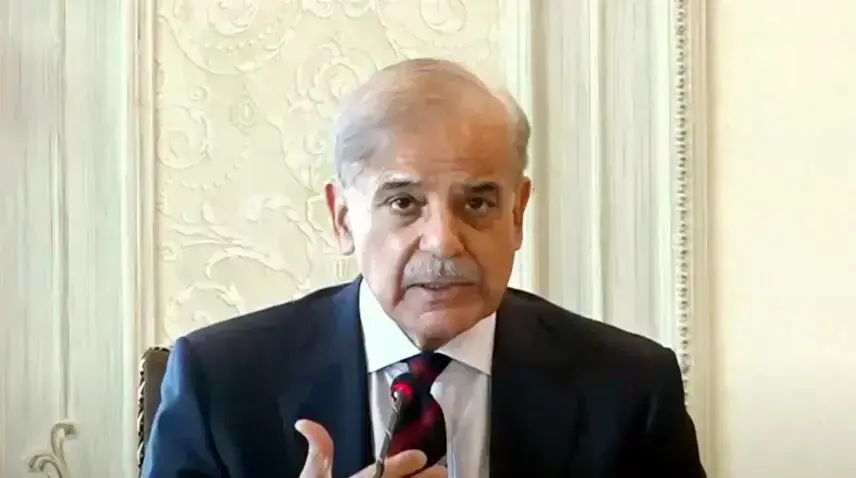

ISLAMABAD: Prime Minister Shehbaz Sharif on Thursday called for a shift from economic stabilisation to sustainable growth, with a focus on exports, productivity, employment and technology, as he highlighted improved foreign exchange reserves and Pakistan’s return to international capital markets.
Addressing a gong ceremony in Karachi through a video link to mark the listing of the Naya Nazimabad Apartment REIT scheme, the prime minister said the restoration of macroeconomic stability had been achieved through coordinated efforts by the government, financial institutions and other state institutions.
He said the next phase required an economic model capable of generating jobs, increasing production and expanding exports rather than relying primarily on stabilisation measures.
READ MORE: PM Shehbaz seeks greater investment in Pakistan from global financial giants
Sharif cited Pakistan’s recent USD3 billion Eurobond issuance, which attracted offers of USD6 billion, as evidence of renewed investor interest.
He said State Bank of Pakistan foreign exchange reserves had risen to around USD21.4 billion, with commercial banks holding a further USD5.5 billion.
He also pointed to higher workers’ remittances, growing IT exports and the performance of the Roshan Digital Account.
The prime minister said his recent meetings with international bankers and financial leaders in New York and London had indicated that global financial institutions were taking note of Pakistan’s implementation of structural reforms.
He referred to meetings with executives from Citibank, JPMorgan and Barclays, as well as the managing director of the International Monetary Fund, saying the reforms had helped create a more favourable environment for investment.
The prime minister said the government’s focus would now be on achieving growth through technology, employment generation, higher productivity and exports.
He pointed to incentives included in the federal budget for 2026-27 for exporters, manufacturers and industries, including construction, and said measures aimed at the construction sector were beginning to show results.
He also called for further development of the capital market and stock exchange, urging policymakers to study regional markets and improve their functioning.
He expressed concern over the performance of some protected industries, saying sectors that had benefited from subsidies and tariff protection needed to improve productivity and competitiveness.
“Import substitution” commitments, he said, should be accompanied by greater efficiency, modern machinery and higher productivity.
Finance Minister Muhammad Aurangzeb said private-sector participation was gaining momentum, citing Rs60 billion in housing-loan disbursements.
He said the government would continue to provide an environment conducive to private investment, adding that foreign companies, particularly from the United States, were showing interest in the Pakistani market after a period in which the economy had contracted.
The finance minister said the number of tax filers had risen to more than 5.7 million from 3.9 million last year, while tax collection targets had also been surpassed.
Businessman Arif Habib said Pakistan’s return to international capital markets after four and a half years had received a strong response from investors.
He said Pakistan’s sovereign rating had improved from CCC+ to B over the past two years, while the rupee had remained stable for three consecutive years.
According to Habib, State Bank reserves stood at around USD22 billion and total liquid foreign exchange reserves at about USD27 billion.
He said workers’ remittances continued to increase and that inflows through the Roshan Digital Account had risen by 58 per cent.
The ceremony was attended by the finance minister, State Bank Governor Jameel Ahmad, business leaders and senior corporate representatives.
Copyright Business Recorder, 2026


























Comments