


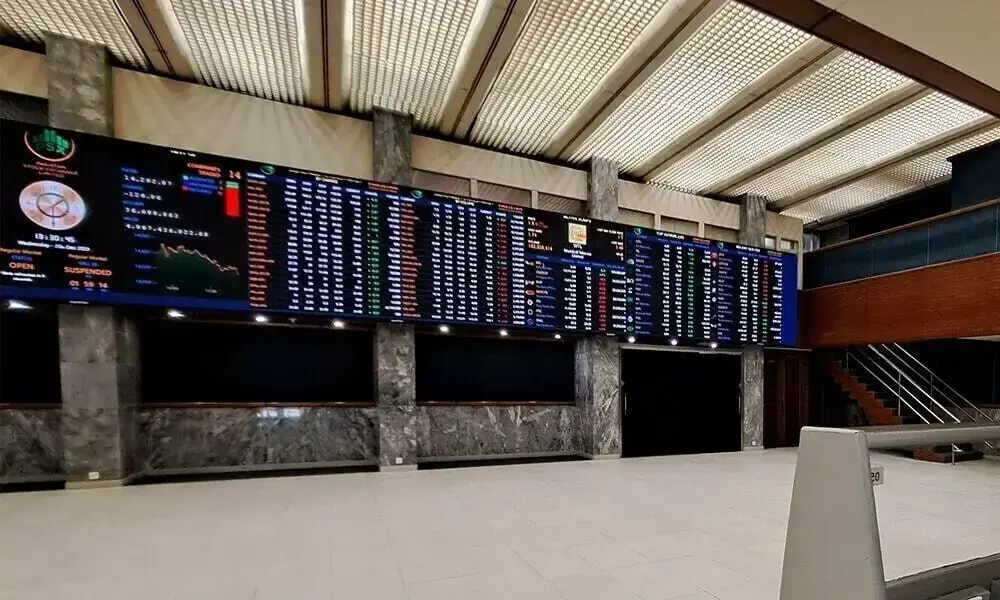

KARACHI: The Pakistan Stock Exchange (PSX) extended its bullish momentum during the week ended July 3, with the benchmark KSE-100 Index gaining more than three percent as easing geopolitical tensions in the Middle East, lower international oil prices and encouraging domestic macroeconomic indicators.
The benchmark KSE-100 Index climbed 5,800.93 points, or 3.2 percent, to close at 185,372.20 points, compared with 179,571.27 points a week earlier.
The BRIndex100 advanced to 20,445.76 points, registering a gain of 515.65 points during the week. Total turnover reached 3.02 billion shares, translating into an average daily turnover of approximately 604.93 million shares. Similarly, the BRIndex30 climbed to 75,179.51 points, posting a gain of 1,478.37 points. Weekly turnover stood at 1.79 billion shares, averaging approximately 357.46 million shares per trading day.
The rally was primarily driven by continued progress in US-Iran negotiations, which eased concerns over regional instability, while international Brent crude prices softened further to around USD71.8 per barrel, improving Pakistan’s external outlook and supporting investor sentiment.
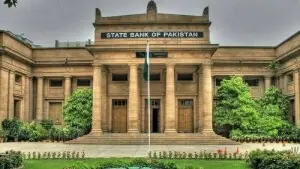
Analysts noted that positive macroeconomic developments also reinforced market confidence. Inflation continued its downward trajectory, with the State Bank of Pakistan reporting Consumer Price Index (CPI) inflation at 11.1 percent year-on-year in June 2026, bringing average inflation for the entire FY26 to 7.04 percent.
On the fiscal front, the Federal Board of Revenue (FBR) achieved its revised FY26 tax collection target by collecting Rs13.0 trillion, marginally exceeding the revised target of Rs12.98 trillion. Meanwhile, the growth in the central government’s debt stock slowed to 5 percent year-on-year, marking the slowest pace of debt accumulation witnessed in the past 15 years.
Investor confidence also received support from international markets after Barclays upgraded Pakistan’s sovereign debt outlook to “Overweight”, citing an improving macroeconomic outlook and lower global oil prices. In addition, the government raised Rs615 billion through the latest Pakistan Investment Bond (PIB) auction, where cut-off yields declined by 47 to 70 basis points across various maturities.
The State Bank’s liquid foreign exchange reserves also increased to US$16.53 billion, supported by inflows from multilateral lenders.
Despite the positive domestic developments, the report noted that Pakistan’s external sector remained under pressure. The country’s trade deficit widened 57 percent year-on-year to US$4.5 billion in June 2026. Consequently, the cumulative trade deficit for FY26 expanded 22 percent to USD39.4 billion, the highest level recorded in four years, as exports declined 6 percent while imports increased 8 percent during the fiscal year.
The strong rally substantially enhanced investor wealth. Total market capitalization rose 3.1 percent to Rs20.76 trillion, compared with Rs20.13 trillion a week earlier, representing an increase of approximately Rs628.27 billion. In dollar terms, market capitalization increased 3.2 percent to USD74.65 billion from USD72.37 billion.
Market activity remained robust throughout the week. Average daily turnover (ADTO) in the ready market increased 7.1 percent to 864.99 million shares, compared with 807.97 million shares in the preceding week. Average daily traded value climbed 27.7 percent to Rs47.66 billion, while average daily turnover in dollar terms rose to USD171.33 million from USD134.19 million, reflecting improved liquidity and sustained investor participation.
Trading activity remained concentrated in a few major sectors. The technology and communication sector accounted for 12 percent of total traded volume, followed by commercial banks (11 percent), oil marketing companies (8 percent), Investment Banks (7 percent) and Power (6 percent), while the remaining 55 percent was contributed by other sectors.
Commercial Banks emerged as the best-performing sector during the week, advancing 6.3 percent, followed by textile composite (4.7 percent), technology and communication (4.6 percent) and pharmaceuticals (3.3 percent). other sectors posting gains included chemicals (2.5 percent), engineering (2.5 percent), cement (2.5 percent), exploration and production (1.8 percent), Fertilizer (1.6 percent), Power (1.6 percent), Food (0.6 percent) and Refineries (0.2 percent). In contrast, Automobile Assemblers declined 0.2 percent, while Oil Marketing Companies slipped 0.5 percent.
Among individual stocks, IIBFL emerged as the week’s top performer, gaining 17.9 percent to close at Rs271.37, followed by TPLRF1 (13.1 percent), Pakistan Telecommunication Company Limited (PTC) (11.9 percent), United Bank Limited (UBL) (10.8 percent), JVDC (8.8 percent), Meezan Bank Limited (MEBL) (8.1 percent) and Askari Bank Limited (AKBL) (7.6 percent).
On the downside, K-Electric was the worst-performing stock, falling 5.8 percent to Rs8.24, alongside Service Industries (5.8 percent), Mehmood Textile Mills (5.5 percent), Pakistan Aluminium Beverage Cans (PABC) (4.1 percent), Sui Northern Gas Pipelines (SNGP) (3.6 percent), Thal Limited (3.4 percent) and Millat Tractors (2.5 percent).
Analysts said improving geopolitical conditions, easing oil prices and strengthening domestic economic indicators continued to underpin investor confidence.
They added that market direction in the coming weeks would largely depend on further progress in regional diplomacy, corporate earnings announcements and the sustainability of Pakistan’s improving macroeconomic fundamentals.
Copyright Business Recorder, 2026











Comments