


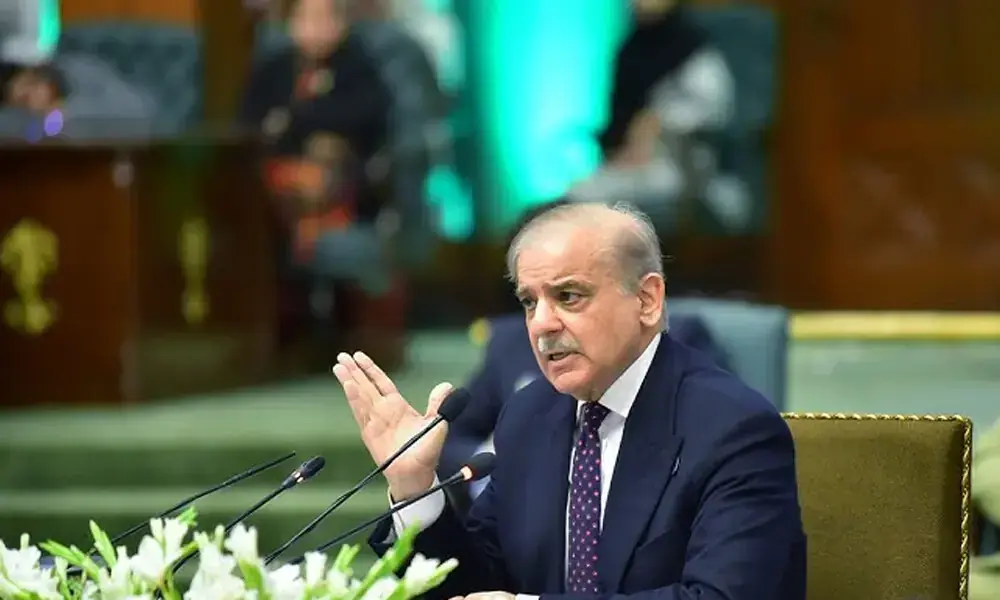

ISLAMABAD: Prime Minister Shehbaz Sharif on Tuesday clarified that Iran’s ballistic missile programme was not part of an Islamabad-facilitated memorandum of understanding (MoU) between Tehran and Washington, cautioning against what he described as attempts by “spoilers” to misrepresent the understanding and undermine fragile diplomatic progress in the region.
The clarification by the prime minister was also endorsed by Iranian President Masoud Pezeshkian, who reaffirmed that Iran’s ballistic missile programme was not included in the MoU and would not be part of any future agreement.
Addressing a joint press conference with Iranian President Masoud Pezeshkian during the Iranian leader’s official visit, the prime minister said the understanding reached through indirect negotiations did not include any reference to ballistic missiles at any stage of the discussions.
“There were no discussions on ballistic missiles, and therefore there is no reference to them in the memorandum,” he said, adding that Iran, like any sovereign state, had the right to maintain defensive capabilities.
He warned that misinterpretation or politicisation of the agreement could jeopardise progress achieved through sensitive diplomatic engagement.
“We should not allow confusion or misunderstanding to derail what has been achieved,” he said, urging restraint in public commentary at a time of heightened regional tensions.
The prime minister said Pakistan would continue to support mediation efforts aimed at reducing tensions in the Middle East, stressing that any escalation in the region could have consequences extending beyond its immediate borders.
He also noted that regional stability was closely linked to Iran’s internal security situation.
“Iran’s success is our success, and Iran’s failure is our failure,” he said, describing Pakistan and Iran as countries bound by geography, history, and cultural ties.
The prime minister said the Islamabad MoU involving Iran and the US was a “significant step” and noted that Pakistan had played a facilitating role alongside other regional partners, including Qatar, Saudi Arabia, and Turkiye.
He acknowledged the contribution of Chief of Defence Forces (CDF) and Field Marshal Asim Munir in supporting diplomatic efforts.
The prime minister said he would travel to Tehran next week to pay respects to the late Iranian supreme leader Ayatollah Syed Ali Khamenei and to reaffirm Pakistan’s solidarity with the Iranian people.
Sharif said technical-level discussions following the MoU were expected to help advance stability in the region and expressed hope that continued engagement could prevent further escalation.
He said it was a matter of relief that a broader conflict had been avoided, which he said could have drawn in multiple countries across the region.
He reiterated Pakistan’s appreciation for Iran’s trust in Islamabad’s role as a facilitator in the process, describing the engagement as sincere and aimed at supporting peace efforts.
About delegation level talks earlier in the day, the prime minister said the talks were held in a “cordial and constructive atmosphere,” describing the engagement as reflective of longstanding ties between the two countries.
He said Pakistan and Iran had consistently supported each other during difficult periods. “Recent developments have further demonstrated the enduring strength of this partnership,” he said. He characterised the meeting as part of what he called a broader effort to strengthen bilateral cooperation and regional understanding.
He added that both sides had reaffirmed their commitment to expanding ties in areas of mutual interest.
Copyright Business Recorder, 2026


























Comments