


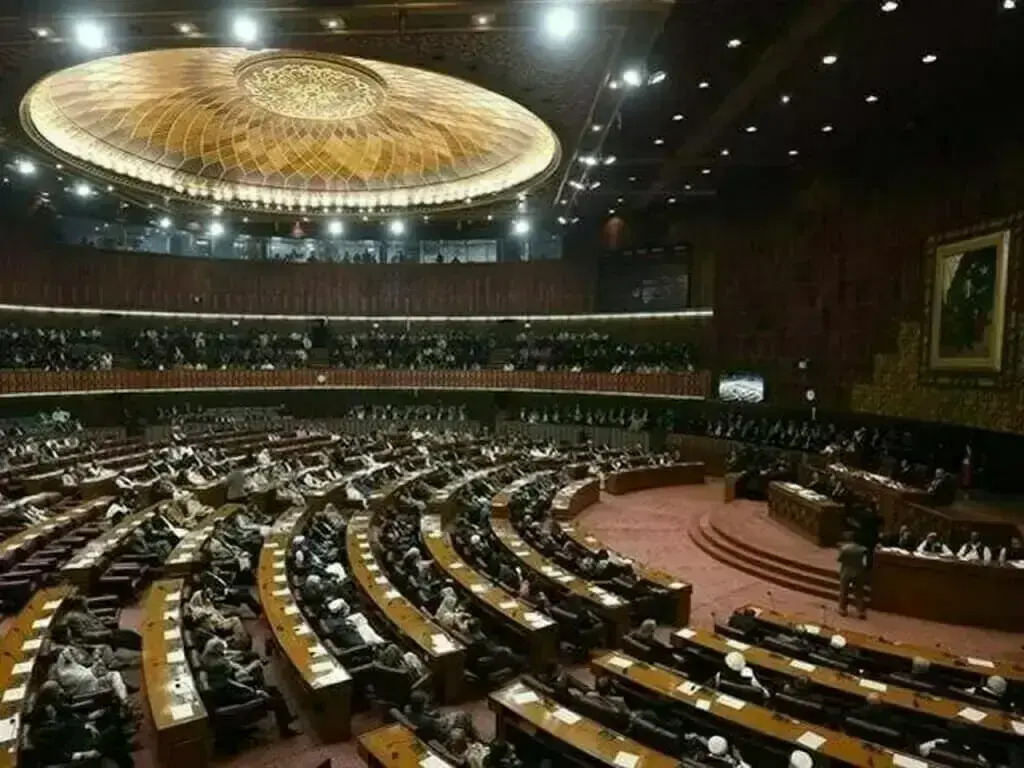

ISLAMABAD: The National Assembly witnessed a heated clash over Federal Budget 2026-27, with opposition calling it “anti-poor” amid inflation and debt fears, while the government defended it as reform-driven, agriculture-focused, and macroeconomic stabilisation under tight external constraints.
The ongoing budget debate, marked by sharp exchanges, political undertones and repeated references to electoral legitimacy, saw acting PTI chairman Barrister Gohar Ali Khan lead the opposition’s charge, while Minister for National Food Security Rana Tanveer Hussain mounted a forceful defence of the government’s agriculture-centred economic strategy.
Taking part in the budget debate, Barrister Gohar opened his remarks by lamenting what he called a strained and mistrustful parliamentary atmosphere, saying the House had failed to begin its proceedings on a constructive footing.
Welcoming what he described as an overture for dialogue by Prime Minister Shehbaz Sharif, he questioned the apparent stagnation in negotiations and sought clarity on what was holding the process back.
He also reiterated the opposition’s demand for access to jailed PTI founder Imran Khan, keeping political grievances firmly on the table alongside the budget debate.
He also raised the issue of internal parliamentary tensions, criticising the suspension of MNA Iqbal Afridi and arguing that elected members should not be sidelined in such a manner.
On the budget itself, Gohar dismissed it as structurally indifferent to lower-income groups, arguing that it offered “nothing for the poor” and would likely intensify inflationary pressures.
He warned that essential commodities – including wheat flour, electricity and medicines – would become more expensive in the coming months, further squeezing already strained household budgets.
Despite the presence of the Benazir Income Support Programme (BISP), he argued, poverty indicators continued to worsen.
In one of the more politically charged moments of his speech, he responded to remarks by Defence Minister Khawaja Asif, questioning whether the minister’s “conscience was not burdened” by the events surrounding the 8 February elections, which he again characterised as deeply controversial.
He further alleged that around 100 PTI members had been disqualified and replaced through what he described as engineered judicial and electoral processes.
Responding for the government, Rana Tanveer Hussain defended the budget as a “balanced and reform-oriented” package that had been positively received by the business community despite difficult fiscal space under ongoing IMF-linked arrangements.
He stressed that agriculture remained the “centre of gravity” of the government’s economic strategy, both for growth and food security.
He outlined an ambitious reform agenda for the sector, including mechanisation, seed regulation, institutional restructuring and expansion of value-added exports.
Cooperation with Chinese agricultural institutions, he said, was helping modernise the Pakistan Agricultural Research Council (PARC) and develop climate-resilient seed varieties suited to changing environmental conditions.
Providing details of regulatory action, he told the House that the government had reviewed the seed sector after taking office in 2024, cancelling licences of around 450 companies found involved in irregularities out of nearly 1,100 registered firms.
A new National Seed Regulatory Authority, he said, had been established to tighten oversight and ensure certified inputs for farmers.
He also said that the “Zarkhaiz Scheme”, under which small farmers owning less than 25 acres would be provided collateral-free loans, while tenant farmers and sharecroppers would also be eligible through personal guarantees.
The State Bank of Pakistan (SBP), he added, had been directed to ensure that agricultural credit actually reached smallholders rather than being captured by large agribusinesses.
He noted that long-delayed National Seed Policy and Biotechnology Policy had finally been approved after nearly four decades of administrative stagnation.
Highlighting diversification efforts, he said the olive sector had emerged as a surprise success story, generating exports worth $80 million, with ambitions to scale this to $1 billion in the coming years.
He also announced a district-level development initiative targeting 10 underdeveloped districts, offering direct financial support, livestock assistance and Rs15,000 per acre in input subsidies.
He said farmers’ producer organisations would be encouraged to form cooperatives to cut costs and improve machinery access, noting 95pc are smallholders, alongside a 60pc subsidy on agricultural machinery to boost mechanisation.
He said no new agriculture taxes were imposed and fertiliser supply remained stable despite global disruptions, while highlighting Punjab’s Kissan Card for around 800,000 farmers, Sindh’s Rs52 billion allocation, KP’s Rs26 billion package, and Balochistan’s focus on storage and value addition.
PPP MNA Shazia Marri highlighted her party’s alignment with the Charter of Democracy and pointed to the BISP as a globally recognised model of social protection and women’s empowerment. However, opposition voices remained unconvinced.
Rana Ansar Muttahida Qaumi Movement-Pakistan (MQM-P) criticised the budget for inadequate attention to women’s welfare and said the proposed seven per cent salary increase was insufficient amid persistent inflation.
Khurram Shahzad of PPP called for urgent reforms in public education, warning that deteriorating infrastructure and teacher training gaps were undermining learning outcomes.
Naz Baloch, another PPP MNA, pressed for stronger investment in climate resilience and information technology, describing both as essential pillars of future employment generation.
PML-N’s Riazul Haq supported relief measures for the construction sector but cautioned that Pakistan required sustained growth of six to seven per cent to ensure long-term economic stability.
PTI’s Shafqat Abbas dismissed the economic and agriculture strategy as ineffective in delivering meaningful relief.
Mahreen Razzaq Bhutto of PPP urged a reduction in non-development expenditure to expand the Public Sector Development Programme (PSDP), while endorsing increased allocations for BISP.
Muhammad Numan of PML-N, however, supported the budget, calling it growth-oriented and focused on reviving both agriculture and industry, with potential to generate employment for young people.
Zain Qureshi, viewed as a controversial figure within PTI ranks and previously linked to internal disputes over the 26th Constitutional Amendment in October 2024, rejected the budget as “anti-poor”, saying macroeconomic stabilisation had come at the expense of rising social distress.
He said this was the fifth budget under Prime Minister Sharif, yet growth had remained stuck between two and three per cent.
He claimed poverty had risen from 21 to 23 per cent, unemployment was worsening, and nearly 700,000 young people were leaving the country each year in search of opportunities abroad.
He also questioned the value of international praise for Pakistan’s leadership, including remarks attributed to US President Donald Trump, asking what tangible benefit such endorsements brought to ordinary citizens.
He further claimed Pakistan had accumulated more debt in four years than in the previous seven decades combined, citing rising electricity tariffs, ballooning circular debt and inefficiencies in the power sector.
Lawmakers from both the treasury benches and the opposition joined the ongoing budget debate, turning the proceedings into a heated exchange of accusations and counterclaims, with rhetoric often overshadowing substantive policy discussion as political fault lines deepened on the assembly floor.
Copyright Business Recorder, 2026




















Comments