


Quetta bombing: terrorism continues to pose a grave threat
A horrific suicide bombing in Quetta underscores Pakistan's persistent terrorism threat, fueled by militant resurgence and external interference, demanding a comprehensive strategy addressing both violence and underlying grievances.
- Devastating Quetta suicide bombing and its civilian casualties.
- Resurgence of militant violence in Balochistan and Khyber Pakhtunkhwa.
- Allegations of foreign interference and India's destabilizing role.
- Baloch nationalist claims of political exclusion and underdevelopment.
- Comprehensive strategy combining force with addressing public grievances.
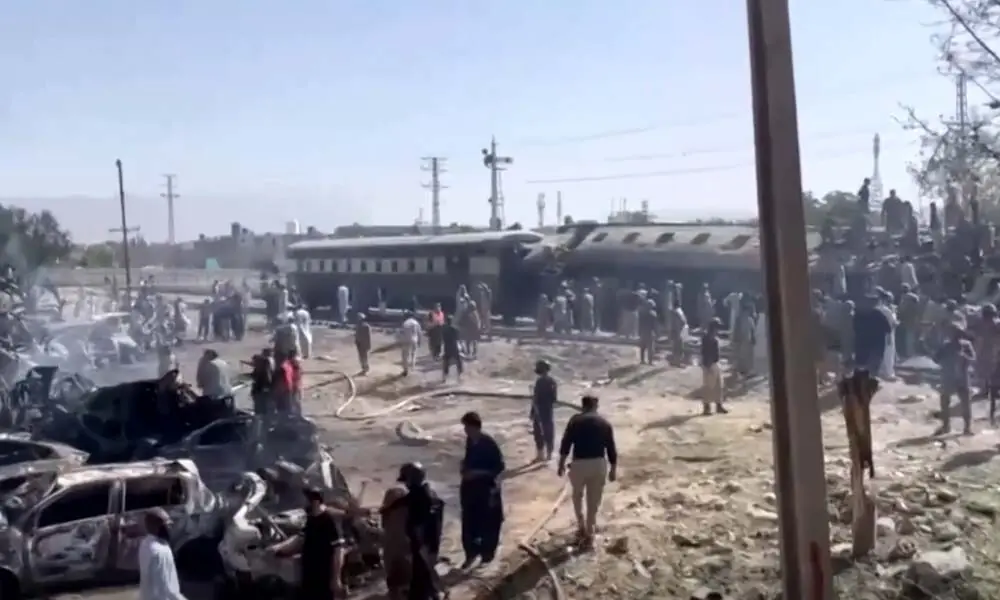
EDITORIAL: The horrific suicide bombing near the Chaman railway crossing in Quetta on Sunday is yet another grim reminder that terrorism continues to pose a grave threat to Pakistan’s peace and stability.
The attack, in which an explosives-laden vehicle rammed into a crowded shuttle train carrying passengers to Quetta railway station, claimed at least 30 lives, including women and children, while injuring dozens more.
The devastation extended far beyond the railway tracks. Nearby homes were destroyed, roofs collapsed, and entire neighbourhoods were shaken by the intensity of the blast. The fact that most victims were ordinary civilians – passengers, pedestrians, and local residents – underlines the sheer brutality and indiscriminate nature of this act of terror.
The banned Balochistan Liberation Army (BLA) quickly claimed responsibility, once again exposing the dangerous resurgence of militant violence in Balochistan and Khyber Pakhtunkhwa. The attack also revived painful memories of the March 2025 Jaffer Express tragedy, which resulted in the killing of 33 terrorists and several hostages during a militants’ siege.
Taken together, these incidents point to a deeply worrying escalation in insecurity, particularly in regions bordering Afghanistan, where militant networks continue to find space for organisation, movement, and support.
The Human Rights Commission of Pakistan has rightly expressed alarm over the deteriorating security situation, pointing out that civilians, workers, passengers, and law enforcement personnel are increasingly vulnerable to violence and attacks on public infrastructure.
There is little doubt that hostile external forces exploit Pakistan’s internal vulnerabilities for strategic advantage.
Pakistan has repeatedly maintained, with verifiable evidence, that India supports separatist and militant elements to destabilise the country, especially in Baluchistan. In the current regional climate, marked by heightened tensions after “Operation Sindoor,” these concerns have gained greater significance.
However, while foreign interference may aggravate the problem, it cannot alone explain the persistence of insurgency and unrest in that province. A pressing question is why militant narratives continue to find sympathy, fear, or silence among sections of the local population.
This is where the state must recognise a hard truth: no single solution can serve as a universal key to ending terrorism and insurgency in Baluchistan. Relying exclusively on force may suppress violence temporarily, but it cannot eliminate the underlying grievances that militants exploit.
At the same time, a purely conciliatory approach without ensuring the writ of the state won’t work. Complex and deeply-rooted challenges demand a balanced and multidimensional response.
Baloch nationalist leaders, meanwhile, have repeatedly argued that alienation in the province stems from political exclusion, enforced disappearances, underdevelopment, and the lack of local ownership over natural resources. Whether one agrees fully with these claims or not, they cannot simply be dismissed.
Pakistan certainly needs stronger intelligence coordination, more effective border management, and decisive action against terrorist networks. But it also needs sincere political dialogue and inclusion, accountable governance, and economic justice for the neglected regions.
Terrorism cannot be defeated by military means alone; nor by negotiations alone.
Only a comprehensive strategy – one that combines firmness against terrorism with efforts to address legitimate public grievances – can break the cycle of violence that continues to haunt the province and threaten national stability.
Copyright Business Recorder, 2026

























Comments