


A national policing template?
PERA's data-led governance model in Pakistan demonstrates how real-time dashboards can transform operational data into actionable intelligence, offering a template for improving national policing and resource allocation despite transparency challenges.
- PERA's successful data-led governance model.
- Potential for data-driven policing in Pakistan.
- Overcoming data transparency and reporting issues.
- Transforming operational records into management intelligence.
- Efficient resource allocation through data insights.


Management is all about timely decision-making with the available resources at hand. Data is therefore an essential component of management, but the real test lies in how that data is acted upon. In the public sector, especially in Pakistan, this is where governance often breaks down.
The First Information Report, or FIR, is the single most important document through which information is converted into legal and administrative action. Yet Pakistan’s system often struggles to turn these data inputs into effective crime prevention, resource allocation or performance management. As a result, many decisions still read like guesses dressed up in formality.
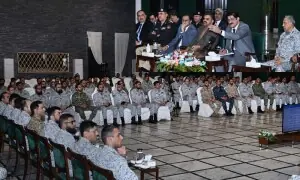
A recent visit to the Punjab Enforcement and Regulatory Authority (PERA) command room offered an unusual counterpoint, rare for public offices in Pakistan.
On a single screen, Punjab’s map opened out from division to district and then to tehsil level. A top-down approach had been developed, where a city could be zoomed in on to examine enforcement statistics in real time. Each click revealed another layer of detail: unresolved cases, fines collected, appeals, response times, field activity and action taken on whistleblower reports.
Pakistan has built the data layer, but has yet to build the analytical layer that turns operational records into management intelligence.
The same metrics appeared for every unit, side by side, refreshed continuously. The dashboard is planned to go in the public domain, which itself is an unusual choice for an enforcement body in the region.
Numbers and statistics help connect the dots. Managers worldwide rely on data to make informed decisions, allocate resources and shape strategy. Public management needs the same discipline.
PERA’s dashboard is an ambitious effort to bring this principle into enforcement by transforming scattered records into management intelligence. Two enforcement stations, for example, with similar populations and caseloads but different fine collections immediately become conspicuous.
A tehsil or enforcement station with repeated unresolved cases becomes difficult to ignore. At the district level, recoveries, fines and disposal rates can guide internal rewards, corrective action and better resource allocation.
I have closely examined PERA’s performance since its inception in December 2024. The output numbers tell their own story. The authority’s most recent operational report places anti-encroachment raids at over 268,000 province-wide, including more than 66,000 in Lahore, with roughly 28,000 kanals of state land recovered through 550 dedicated operations.
Price control activity has run to over 3.4 million inspections, leading to Rs390 million in fines, 3,421 shops sealed and 7,745 arrests. The pace of formal prosecution has also accelerated: PERA registered 125 FIRs in the whole of 2025 and 328 in the first four months of 2026 alone.
Each operation is logged, tied to field reporting and made visible through the dashboard. Reports flow from PERA’s leadership to the Chief Minister at district level, with the option to drill deeper into tehsils and enforcement stations.
This means political and administrative attention now lands on specific units, specific delays and specific outcomes.
The larger digital implication of PERA’s model lies outside its formal mandate. Many assume that Pakistani police forces are too under-digitised for a data-led accountability system, where senior officers can track crime, performance, delays and officer-level outcomes through live dashboards. That assumption no longer holds.
Punjab Police’s Police Station Record Management System, built by the Punjab Information Technology Board, has been operational in all 714 stations since 2017, with over 2.3 million FIRs logged. The Criminal Record Management System maintains digitised offender profiles linked to NADRA. The Anti-Vehicle Lifting System holds nearly 100,000 cases, while the Complaint Management System tracks citizen appeals against police personnel.
A data-led policing model has its own drawbacks, and the greatest obstacle is transparency itself.
If this much data already exists, where does the real problem lie? The answer may be that Pakistan has built the data layer, but has yet to build the analytical layer that turns operational records into management intelligence.
Following PERA’s example becomes ever more relevant for national policing. The possibility of live tracking, updated by every police station, can work wonders for crime prevention. Take the example of vehicle thefts. If mapped by thana, time and recovery route, the statistics can give an accurate picture of active gangs, weak police checkpoints and stolen-vehicle markets.
Domestic violence complaints, studied over time, can point toward pockets of social distress, repeat offenders and patterns of substance abuse.
Narcotics FIRs, when mapped across localities, can expose peddling routes, distribution points and areas where enforcement is either weak or compromised. Cases involving illegal storage, hoarding or warehouse raids can reveal how informal supply chains are operating beneath the surface of the formal economy. Thus, a police station with repeated citizen appeals, delayed investigations or complaints against the same personnel becomes an important indicator of public grievance and inefficiency.
That is when management can step in and take corrective action. This would mark a shift from instinctive anecdote to pattern recognition.
There is, however, a caveat with this approach. A data-led policing model has its own drawbacks, and the greatest obstacle is transparency itself. If reporting at any level is selective, especially at the grassroots level, the system quickly becomes loose-ended.
Pakistan’s FIR system has long suffered from selective registration, virtually denying justice by delaying complaint recognition. A dashboard, no matter how tech-savvy, cannot serve its purpose unless statistics are honestly reported. This is why any national policing dashboard must also track refusal-to-register complaints, helpline records, citizen applications, appeal patterns and supervisory interventions.
In this sense, PERA’s whistleblower channel offers an important lesson. Independent inputs are necessary because official records alone can sometimes reflect institutional convenience rather than ground reality.
PERA’s design appears to take this risk seriously. The authority has initiated 1,377 disciplinary proceedings against its own personnel, including punishments of fine, censure and forfeiture of approved service.
Of the 126 court cases filed against PERA since inception, 84 have already been disposed of, which suggests that its enforcement operations are landing within legal tolerance rather than triggering a litigation backlash. A dedicated internal affairs function is planned for the authority’s next phase. None of this guarantees ground-level honesty in reporting, but it does shift the institutional culture in a measurable direction, and away from the standard pattern in which enforcement bodies investigate everyone except themselves.
For this template to be transposed onto policing, three elements would need to move in parallel. Body cameras, already standard in PERA operations, would have to become standard in policing too, both as evidentiary protection for officers and as a procedural check on field misconduct. The HR and disciplinary architecture of the police force, much of it still operating on rules drafted in a different century, would need updating to make data-led accountability legally workable. And the dashboard itself would have to sit somewhere with the political weight to compel weekly attention from senior officers. Thus, these three complement each other, with each strengthening the others.
Punjab’s growing fiscal stress makes the case for digitisation even stronger. Punjab is an expensive province to run, and policing alone consumes a significant share of public resources. The province’s FY26 budget runs to Rs5.335 trillion, with Rs200 billion allocated to policing alone. PERA’s own recoveries through fines, e-challans, retrieved land and auctioned hoardings are already approaching Rs1 billion in measurable value within its first eighteen months.
More vehicles, more buildings, more personnel and more allowances do not always produce better enforcement. Effective policing through a data-led system could help allocate scarce resources with far greater precision.
Resources can thus be allocated more efficiently to areas where crime is more prevalent, with data helping decision makers in real time. If one police station has high pendency despite adequate staffing, the problem may be management rather than manpower. This distinction becomes even more important in provinces that are financially constrained. Data can help the state spend intelligently instead of spending blindly.
These ideas are not without precedent. New York’s CompStat and India’s CCTNS show how crime data can be turned into accountability through sustained review. Pakistan is not starting from zero either; PSRMS already operates across Punjab, Sindh, KP and Balochistan.
The technical backbone for a national policing dashboard is partly in place. What remains missing is leadership, discipline and the analytical layer that turns provincial records into comparative accountability.
PERA’s lasting contribution may therefore lie less in its raid count or land recoveries, and more in proving that data-led public administration can work in Pakistan. The infrastructure exists. What remains is a question of decision.
The article does not necessarily reflect the opinion of Business Recorder or its owners.
The writer is an economist and an educationist























Comments