BR100 Decreased By (-0.4%)
BR30 Decreased By (-0.65%)
KSE100 Decreased By (-0.29%)
KSE30 Decreased By (-0.22%)
AGHA 6.56 Decreased By ▼ -0.11 (-1.65%)
BECO 4.40 Increased By ▲ 0.05 (1.15%)
BML 55.89 Decreased By ▼ -0.28 (-0.5%)
BOP 30.05 Decreased By ▼ -0.07 (-0.23%)
CNERGY 12.75 Decreased By ▼ -0.23 (-1.77%)
CSIL 5.21 Decreased By ▼ -0.10 (-1.88%)
FCCL 51.00 Decreased By ▼ -0.65 (-1.26%)
FFL 14.43 Decreased By ▼ -0.06 (-0.41%)
FNEL 1.22 Increased By ▲ 0.01 (0.83%)
KEL 5.97 Decreased By ▼ -0.09 (-1.49%)
KOSM 5.58 Decreased By ▼ -0.26 (-4.45%)
LOTCHEM 26.15 Decreased By ▼ -0.02 (-0.08%)
MLCF 90.33 Decreased By ▼ -0.90 (-0.99%)
NBP 161.45 Decreased By ▼ -2.74 (-1.67%)
NCPL 52.55 Decreased By ▼ -0.63 (-1.18%)
NPL 57.98 Decreased By ▼ -1.14 (-1.93%)
OGDC 315.40 Increased By ▲ 2.01 (0.64%)
PACE 9.70 Decreased By ▼ -0.07 (-0.72%)
PAEL 34.73 Decreased By ▼ -0.51 (-1.45%)
PIBTL 14.23 Decreased By ▼ -0.48 (-3.26%)
PPL 221.00 Decreased By ▼ -0.36 (-0.16%)
PRL 90.89 Decreased By ▼ -0.33 (-0.36%)
PTC 59.25 Increased By ▲ 0.06 (0.1%)
SSGC 23.39 Increased By ▲ 0.09 (0.39%)
TBL 8.65 Decreased By ▼ -0.10 (-1.14%)
TELE 7.40 Decreased By ▼ -0.21 (-2.76%)
TPL 21.00 Decreased By ▼ -1.03 (-4.68%)
TPLP 12.02 Decreased By ▼ -0.54 (-4.3%)
TREET 21.33 Decreased By ▼ -0.40 (-1.84%)
TRG 54.35 Decreased By ▼ -1.44 (-2.58%)
By

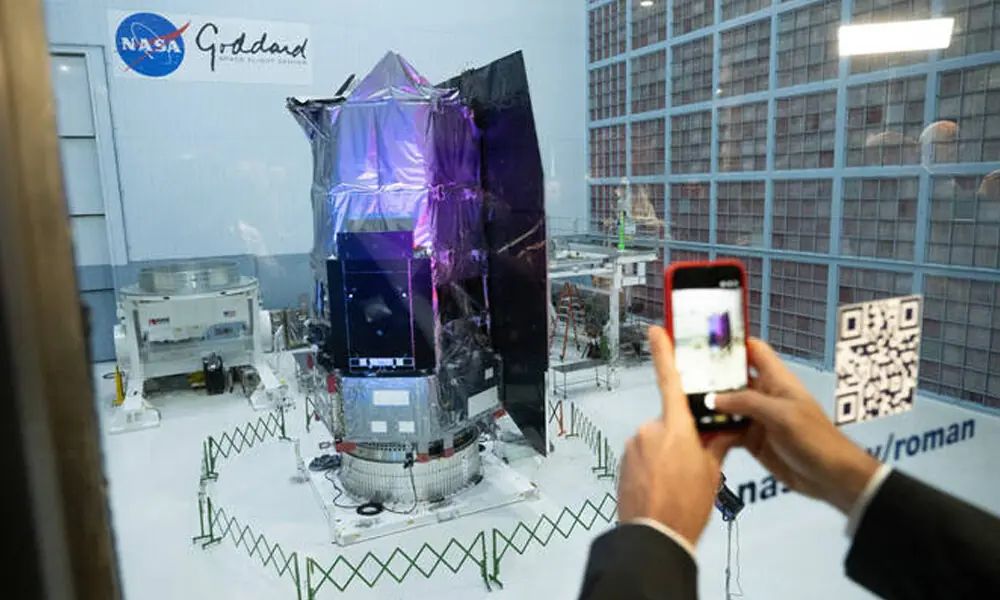
UNITED STATES: NASA unveiled a new telescope on Tuesday to scan vast swathes of the universe for planets outside our solar system and probe the mysteries of dark matter and dark energy.

The Roman space telescope is expected to discover tens of thousands of planets, possibly offering clarity abut how many could be out there.

“Roman will give the Earth a new atlas of the universe,” NASA administrator Jared Isaacman told a news conference at the Goddard Space Flight Center in Maryland, where the telescope went on display.

The 12-metre (39-feet), silvery contraption with massive solar panels will be transported to Florida ahead of a launch into space aboard a SpaceX rocket planned for September at the earliest.

Roman, which took more than $4 billion and over a decade to build, is named after astronomer Nancy Grace Roman, nicknamed the “Mother of Hubble” for her role in developing the landmark space telescope.

Thirty-six years after Hubble launched into space, revolutionizing astronomical observations, NASA hopes Roman will help to shed light on questions that remain unresolved.

Comments

200 characters remaining