



Less than a week into the US-Israel-Iran war, Pakistan was among the first countries to hit the panic button, preemptively raising petroleum prices. Some called it excessive, others deemed it necessary. A month in, Pakistan still seems to be pressing panic buttons, only they are the wrong ones.
Seemingly, the country’s petroleum stocks remain within a comfortable range. Yet talks of various forms of lockdowns are emerging, and schools are already shut. All this while crude oil prices have largely stayed below $100/bbl for the past two weeks. With negotiations limited to media speculation, and one party categorically denying any talks, oil prices are unlikely to retreat soon.
The Strait of Hormuz remains virtually closed. Even if the war ends tomorrow, it will take time for production levels to normalize. Already, there are discussions of a new “Strait Premium” as Iran has effectively demonstrated its ability to choke a fifth of global oil transport.
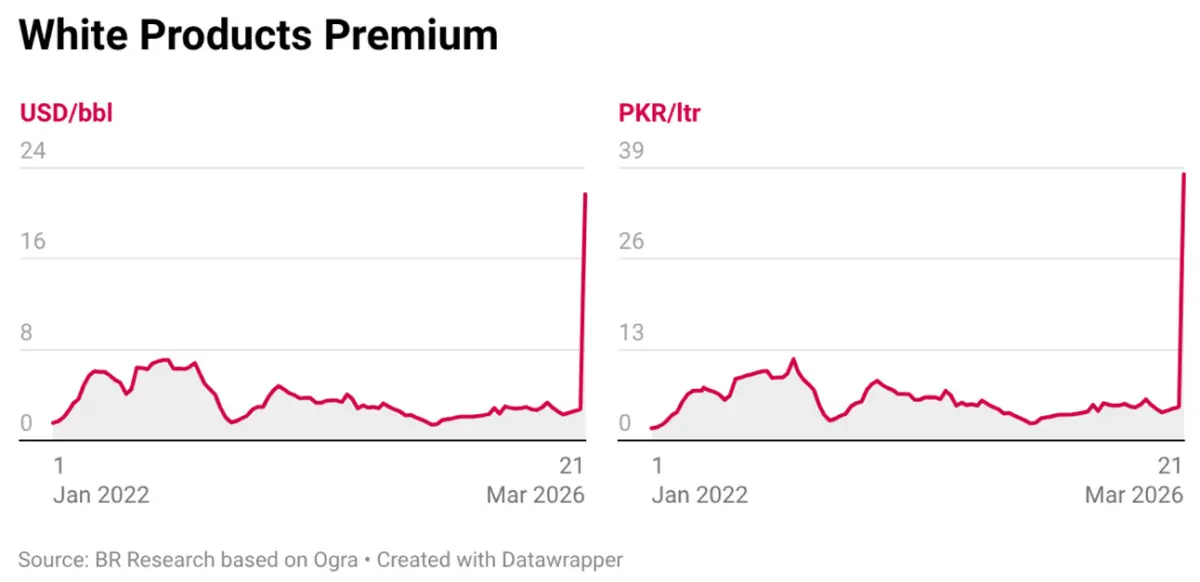
In this backdrop, Pakistan authorities have, for three weeks running, opted not to pass on rising oil prices. Everyone running the show today had vehemently opposed subsidizing petroleum back in 2022 and rightly so. What was disastrous then risks being disastrous now. With premiums on white oil soaring to $21/bbl (Rs38/ltr), nearly ten times the 10-year average, and benchmark prices at all-time highs, Pakistan is absorbing a colossal Rs176/ltr on HSD and Rs78/ltr on gasoline in lieu of Price Differential Claims (PDC).
Petroleum Levy (PL) remains at Rs105/ltr for HSD and Rs55/ltr for gasoline. That still leaves a gap of Rs94/ltr. Even if demand falls sharply, say from 1.4 billion litres a month to 1 billion, the net subsidy would hit Rs100 billion monthly. And that is before accounting for PL revenue. Pakistan simply does not have the fiscal cushion to absorb a shock of this magnitude. No amount of “austerity” can cover it. Even a planned 10 percent cut in development spending will not make room beyond a month.
Hoping the war ends seems to be the plan, but hope is not a strategy. Government officials now call the move “measured,” the same approach that was deemed “catastrophic” four years ago. If the war extends another month, the government will create a fiscal hole that will be hard to fill and will still have to raise prices substantially. It is time better sense prevail, or perhaps Islamabad understand the following better: THANK YOU FOR ATTENTION TO THIS MATTER!

























Comments
Comments are closed for this article.