


United Nations liquidity crisis undermining peacekeeping operations, Pakistan warns
- Asim says UN peacekeeping remains indispensable instrument for maintaining international peace
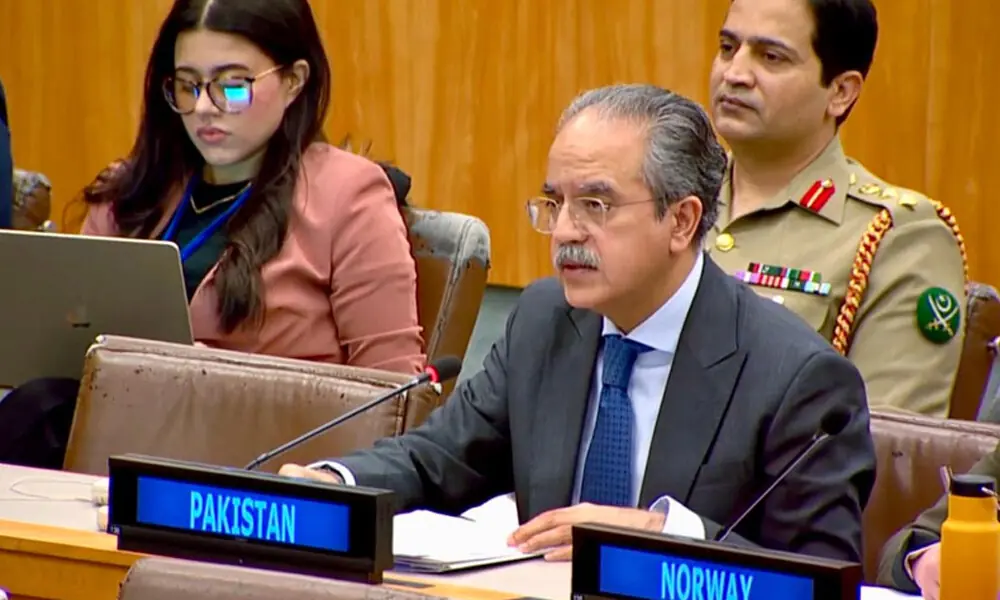

Pakistan has warned that the United Nations liquidity crisis is undermining peacekeeping operations.
Speaking at the opening of the Special Committee on Peacekeeping Operations, Pakistan’s Permanent Representative to the UN Ambassador Asim Iftikhar Ahmad said that the United Nations liquidity crisis is directly undermining peacekeeping operations by reducing patrols, mobility and field presence, with serious consequences for mandate delivery, protection of civilians, deterrence against violence and the safety and security of peacekeepers.
He said UN peacekeeping remains an indispensable instrument for maintaining international peace and security. He said it is facing mounting political, operational and financial pressures that require collective reflection and action.
Recalling Pakistan’s long-standing contribution to peacekeeping, the ambassador said that Pakistan hosts one of the oldest peacekeeping missions, the United Nations Military Observer Group in India and Pakistan. He noted that Pakistan has been among the largest and longest serving troop contributors for over six decades, with over 250,000 Pakistani peacekeepers having served in 48 missions across the four continents.
He paid rich tribute to 182 Pakistani peacekeeping personnel, who have made the ultimate sacrifice under the UN flag.
Asim cautioned that if financial commitments wane and missions continue to contract without clear strategic direction, the readiness of troop contributing countries to maintain forces earmarked for UN deployment could also be affected, including standby arrangements, rapid deployment capabilities and specialised units.
Describing reform as necessary, the Pakistan’s permanent representative said that peacekeeping must become more agile, focused and better equipped to address evolving threats, including through technology and stronger partnerships.
He said protection of civilians, deterrence against violations, and ceasefire monitoring and verification remain foundational tasks, and that lack of political progress should not be used as a pretext for withdrawing missions.
The UN peacekeeping chief warned on October 15 last year that the “indispensable” role played by peacekeepers was facing challenges due to budget cuts, as funding shortfalls translate into troop reductions.
“We do not have a choice but to implement these reductions, which are due to the partial non-payment by some states,” Under-Secretary-General for Peace Operations Jean-Pierre Lacroix told representatives from 32 UN troop-contributing countries.
“The international community is divided,” he said in New Delhi. “As a result, the appetite for collective responses to crises is diminishing.”





















Comments
Comments are closed for this article.