



December’s hourly electricity profiles tell a quieter but more consequential story than the solar-heavy distortions seen earlier in the year.
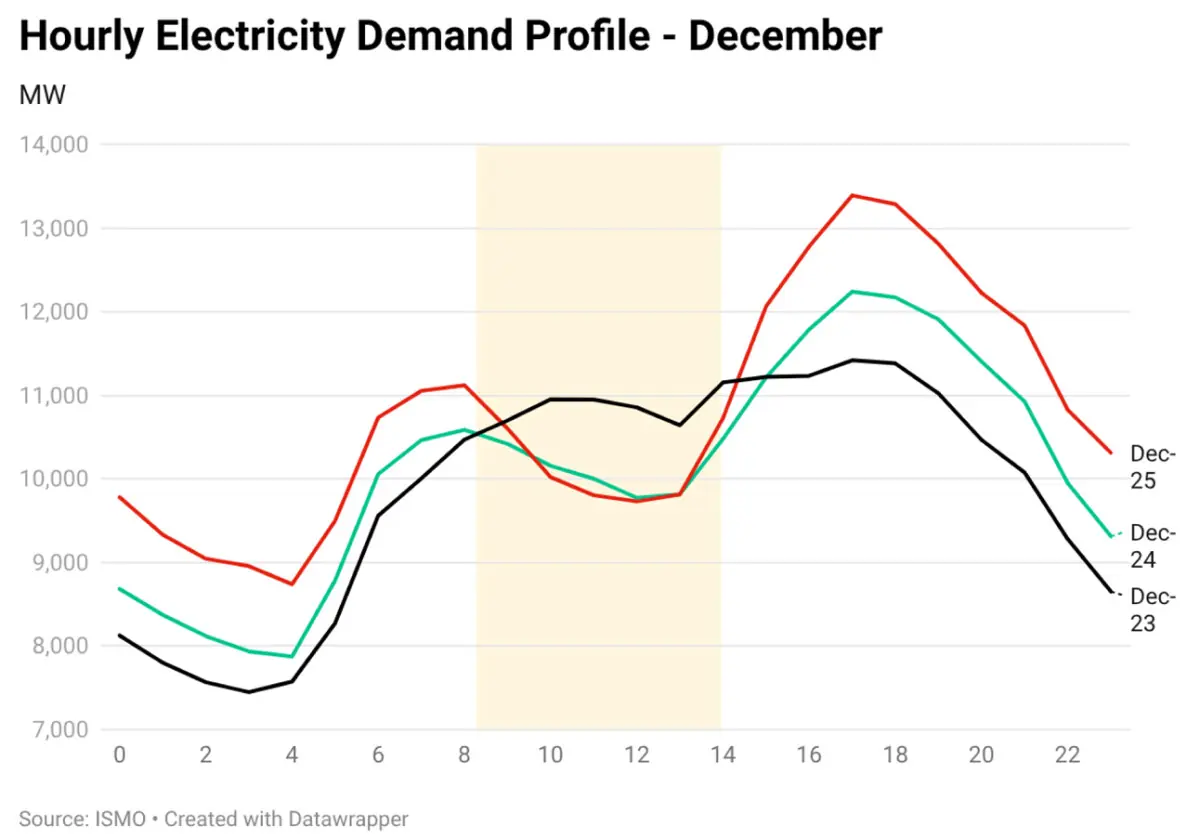
Unlike October, where rooftop solar hollowed out midday demand, the December curves point to something else entirely: a structurally higher demand baseline, driven overwhelmingly by industry’s return to the grid.
Across all hours of the day, electricity demand in December 2025 sits materially above both December 2024 and December 2023.
The uplift is not confined to the evening peak or weather-sensitive hours. It is visible from early morning through late night, indicating load that is continuous, predictable, and industrial in nature rather than residential or seasonal.
This shift aligns closely with policy. The government’s reversal of the captive power regime under the IMF programme has forced energy-intensive industries back onto grid electricity. Preliminary estimates suggest grid-based industrial demand has risen by as much as 40 percent year-on-year.
December’s demand curve reflects this adjustment in real time, with flatter intraday volatility and a higher floor across working hours.
Generation has responded accordingly. Unlike earlier months, where midday generation was squeezed by falling demand, December shows a more synchronized rise in both demand and supply.
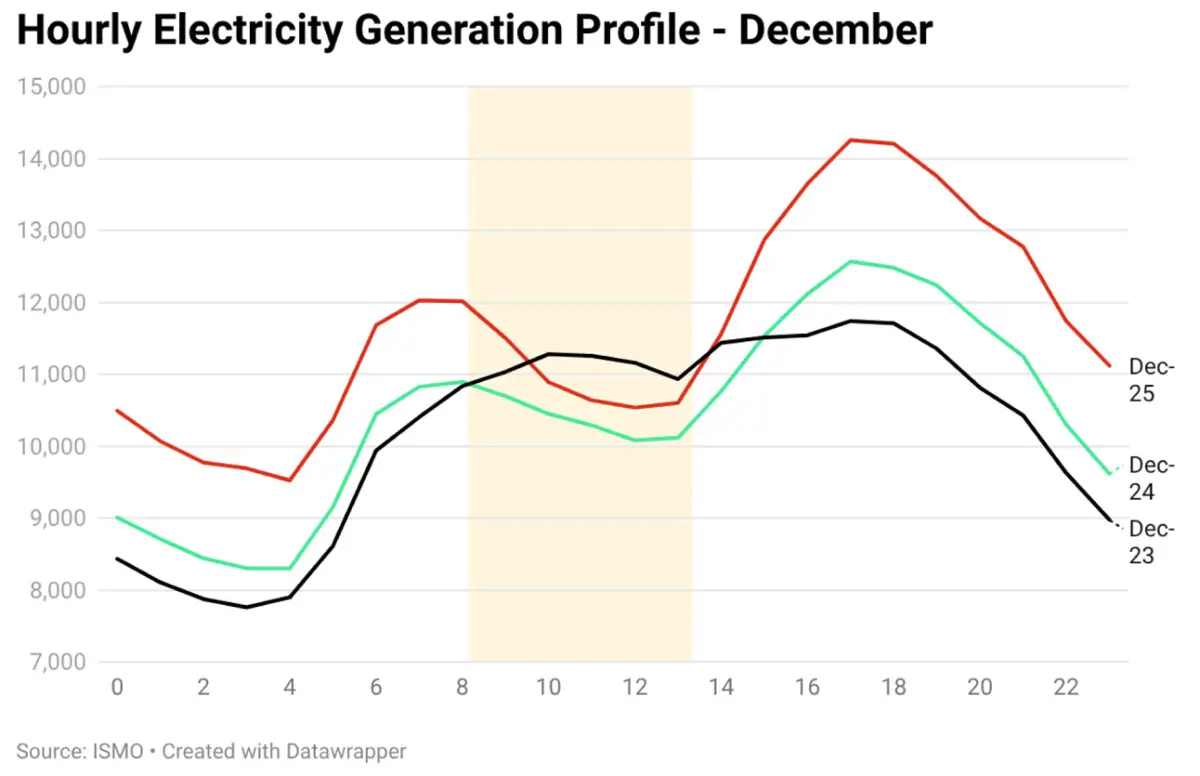
The gap between the two curves remains largely contained, suggesting that the system has so far been able to accommodate the additional load without visible stress events or extreme ramping requirements. This is not flexibility at work, but spare thermal capacity being called back into service.
The evening peak remains pronounced, particularly in December 2025, but its growth is incremental rather than abrupt. What stands out more is the elevated afternoon and early evening plateau compared to prior years. This is consistent with industrial operations extending beyond daylight hours, especially in sectors shifting away from gas and furnace oil toward grid electricity.
For policymakers, the implications are significant and cut against recent assumptions. The narrative that Pakistan’s power problem is primarily one of shrinking demand is now incomplete. Demand has not only returned, but it has also returned in a form that improves capacity utilization, stabilizes load factors, and potentially strengthens disco revenues if collection holds.
Yet this also complicates planning. A grid increasingly shaped by industrial demand cannot be managed with blunt price signals or ad hoc fuel switching policies. Reliability, predictable tariffs, and transmission adequacy become central once again. Any slippage in supply availability, fuel logistics, or plant maintenance now carries higher economic costs than it did when demand was eroding.
December’s data suggests that Pakistan may be entering a new phase of its power cycle. Solar has bent the curve in summer months, but winter demand is now being pulled upward by policy-driven industrial load. Planning models must reconcile both realities simultaneously: midday softness in summer and sustained, higher baseload in winter.
The power curve has not just bent. It has thickened. Whether policy adjusts to manage this heavier, more industrial system will determine if the grid regains financial and operational coherence or simply trades one imbalance for another.
























Comments
Comments are closed for this article.