



After a six-year hiatus, Pakistan’s Household Integrated Economic Survey (HIES) has returned, and with it a sobering statistical portrait of the country’s deepening human development crisis.
What many had sensed intuitively: shrinking real incomes; rising poverty; and, widening inequality, is now backed by hard numbers. The data confirm that the prolonged spell of high inflation and low growth has hollowed out the living standards of ordinary Pakistanis.
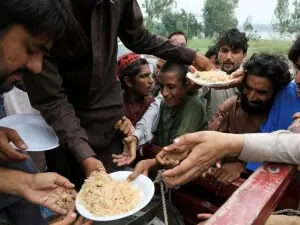
Perhaps the most distressing finding lies in food security, or the lack of it. The share of food-insecure households has surged from 15.9 percent in 2018 to 2019 to a staggering 24.4 percent in 2024 to 2025.
Put simply, one in every four Pakistani families now struggles to meet basic nutritional needs. Nothing signals national distress more clearly than an empty kitchen.
Urban Pakistan, once relatively shielded from rural deprivation, is catching up in all the wrong ways. Food insecurity in cities has more than doubled to 20.6 percent, while the rural rate, though still higher at 26.7 percent, is rising more slowly.
Even those technically above the food insecurity line are eating less and eating worse. Per capita consumption of staples, from wheat and milk to poultry and eggs, has dropped. Households are now spending a larger share on cheap carbohydrates such as wheat and sugar, and less on quality proteins such as beef and mutton. This shift is ominous in a country already battling an epidemic of type-2 diabetes.
READ MORE: Govt unveils first-ever digital Household Integrated Economic Survey
Equally alarming is the plunge in educational spending. Average household expenditure on education has fallen from 4 percent to just 2.5 percent of total spending. The long-standing failure of public education left private schools to fill the gap.
Now, even that escape route is narrowing. The erosion of both nutrition and education imperils the productivity of Pakistan’s young population, the very foundation of its economic future.
Behind these trends lies a broader breakdown in savings and investment. Real household income, measured in dollar terms, has fallen by 3.4 percent over six years, while expenditures edged up by 4 percent, shrinking household savings by an astonishing 66 percent. With less to save, there is less to invest, and weaker investment means slower productivity growth.
Pakistan’s economy, already skewed toward consumption, is consuming itself. That consumption, increasingly, depends on external lifelines. Remittances now account for 7.8 percent of household income, up from 5 percent in 2018 to 2019.
Meanwhile, income from gifts and assistance, including government programmes such as the Benazir Income Support Programme (BISP), has more than doubled to 4.6 percent. Dependency, even when born of necessity, erodes dignity.
The structure of earnings is telling. Self-employment has shrunk from 24.7 percent to 21.7 percent, suggesting that small and micro enterprises, the backbone of any vibrant economy, are withering.
The share of wage employees has risen, but without the growth in productive jobs that might make this a healthy transition. The inequality embedded in these shifts is striking. Real income for the bottom quintile has collapsed by 45 percent, compared to just a 6 percent decline for the top.
In such an environment, talk of export-led growth or supply-side revival sounds delusional. The “stability” so often boasted of in official circles is hollow, a fragile surface calm masking a human development emergency. The masses have paid dearly for this chimera of macroeconomic order.
And yet, while lives and livelihoods burn, the state builds underpasses and bridges to nowhere. Federal funds are flowing toward asphalt rather than opportunity. What Pakistan needs is not more concrete, but more capacity in its people, its institutions, and its shared sense of purpose. Without a redirection of scarce public spending toward employment generation and inclusive growth, the road will, quite literally, lead nowhere.
Rome is burning, and those at the helm are admiring the roads. As the economist Amartya Sen once observed, “Development is freedom.” But freedom, in Pakistan today, is out of reach for far too many.
Copyright Business Recorder, 2026
Ali Khizar is the Director of Research at Business Recorder. His Twitter handle is @AliKhizar






















Comments
Comments are closed for this article.