


Cost of living crisis: Are Pakistanis eating less to pay for power bills?
- Share of household spending on food has fallen from 43% to 37% in last 20 years

Are Pakistanis eating less to keep the lights on? A 20-year comparison of household spending patterns suggests a troubling shift. As electricity, gas and housing costs have increased, Pakistani households appear to be reallocating their budgets away from food and other essentials.
The data shared by Bilal I Gilani, Executive Director at Gallup Pakistan, revealed a cost-of-living crisis in Pakistan, which is being driven not just by weak incomes but by policy-driven increases in fixed expenses.
“A 20-year comparison of Pakistan’s household consumption shares (2005-2025) reveals a structural shift with serious implications for welfare and policy,” said Gilani on social media, while sharing a table of Pakistani household consumption patterns during the last 20 years.
The table, sourced from the government’s recently released Household Integrated Economic Survey (HIES) 2024–25, revealed troubling indicators.
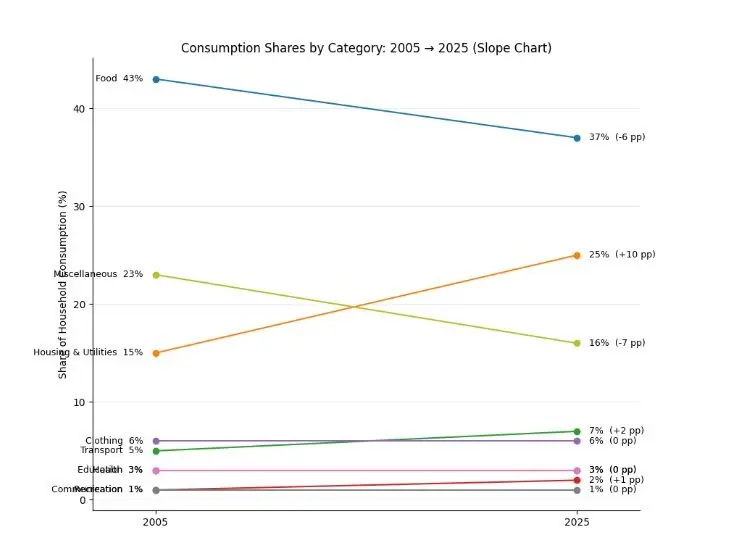
“The most worrying change is food. Its share of household spending has fallen from 43% to 37%,” said Gilani.
He noted that the decline is not because food items have become cheaper or less important, but because “households are cutting back on consumption—a pattern that can fuel undernourishment, especially among children and women”.
“Pakistan’s cost-of-living challenge is no longer just about income growth. It is about how public pricing, taxation, and subsidy decisions reshape household budgets—often in ways that squeeze nutrition first.”
At the same time, housing and utility expenses have surged from 15% to 25% of household budgets, making the single largest increase across all categories, he noted.
Gilani shared that the increase is driven largely by electricity and gas bills, rents, and related charges, “which are increasingly shaped by taxes, administered prices, and subsidy withdrawals rather than household choice”.
“In other words, households are reallocating spending away from food to pay fixed, policy-driven costs,” said Gilani.
Moreover, transport and communication expenses have also increased, reflecting rising fuel prices and the growing need for connectivity.
On the other hand, education, health, and recreation remain flat, “suggesting that rising fixed costs are crowding out human-capital and quality-of-life spending”, he said.
The government on Thursday unveiled the first-ever fully digital HIES 2024–25, a landmark data milestone that reveals sharp improvements in literacy, internet access, and immunisation while offering policymakers an unprecedented evidence base for economic and social planning.




















Comments
Comments are closed for this article.