


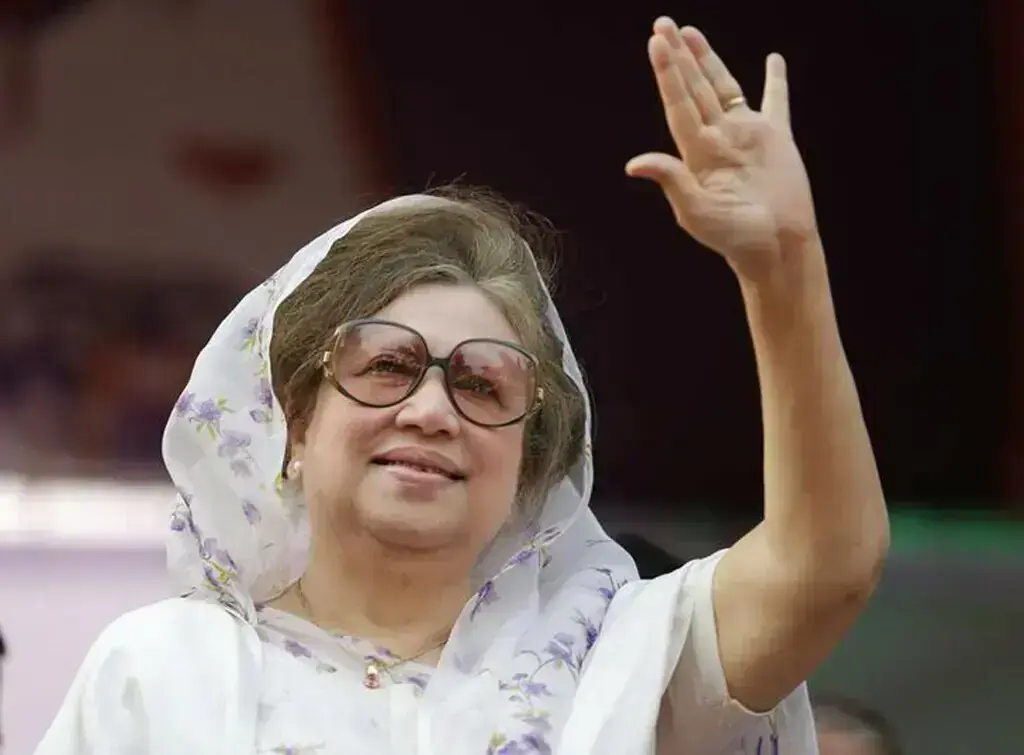
EDITORIAL: The scale of the turnout at Khaleda Zia’s funeral was itself a political statement. Millions lining Dhaka’s streets, a three-day state funeral, flags at half-mast and a city brought to a standstill spoke not just to respect for a former prime minister, but to the depth of her political imprint and the uncertainty surrounding Bangladesh’s next phase. In death, as in life, Khaleda Zia has become a marker of transition.
She was never a consensus figure. Her politics were confrontational, her rivalry with Sheikh Hasina unforgiving, and her years in power did not deliver the institutional consolidation many had hoped for. Yet it is impossible to write Bangladesh’s modern political history without acknowledging her central role in restoring parliamentary democracy in 1991. After prolonged military rule, that transition mattered. It reintroduced electoral competition, civilian authority and the idea that governments could be changed through the ballot, however imperfectly that promise was later realised.
What her passing removes is not just a personality but a form of restraint. Even weakened by prosecutions, imprisonment and long periods away from active politics, Khaleda Zia remained a pole around which opposition politics organised itself. With her present, confrontation had limits. The rivalry was bitter, but it was familiar. Without her, those limits are less clear, especially at a time when Bangladesh is emerging from the fall of an elected government and navigating a transitional phase under a caretaker administration preparing the ground for fresh elections expected in early 2026.
This context matters. Bangladesh’s political system is under strain, institutions are bruised, and public trust has been unevenly distributed after years of disputed polls and polarised governance. The interim arrangement under Muhammad Yunus has enjoyed a measure of public confidence precisely because it is seen as temporary and corrective. But transitions are inherently unstable. Leadership voids invite miscalculation, and the absence of figures who once absorbed pressure increases the risk of escalation, not least within parties now forced to confront succession without the benefit of a unifying anchor.
Khaleda Zia’s legacy, therefore, is less about what she achieved at the end than about the political grammar she helped establish. She normalised mass participation after authoritarian interruption. She demonstrated that opposition politics could survive intense pressure. And, crucially, she embodied an era in which politics, however abrasive, still revolved around recognisable civilian leaders rather than faceless contests between institutions.
For Pakistan, her death carries both emotional and strategic resonance. Islamabad has described her as a friend, and that characterisation is not without substance. Under Khaleda Zia and the BNP, Bangladesh maintained a comparatively softer posture towards Pakistan, particularly on war-era issues, and was open to trade and pragmatic engagement. That did not erase the weight of 1971, nor could it. But it did create space for a functional relationship that avoided constant symbolic confrontation.
That space may now reopen. With Sheikh Hasina ousted last year and a caretaker government in place, there are cautious signs of warming ties. Pakistani representation at Khaleda Zia’s funeral was noted, and official condolences were carefully worded but meaningful. Still, any reset must proceed with restraint. Bangladeshi society remains deeply sensitive to history, and overt gestures risk backfiring. The only viable path forward is a low-key, pragmatic one: trade, connectivity, people-to-people contacts and regional cooperation without rhetorical excess.
This is as much about Bangladesh’s stability as it is about bilateral relations. A politically fractured Bangladesh is bad for its own citizens and for the region. Elections conducted with credibility, a political opposition that can reorganise without imploding, and institutions that learn from recent upheavals are essential if the country is to move beyond cyclical crisis. Khaleda Zia’s absence makes that task harder, not easier.
Her funeral crowds were a reminder that legitimacy in South Asia still draws heavily from mass politics, not just institutions on paper. Whether Bangladesh can translate that sentiment into a more stable political order will define the post-Khaleda era. For neighbours like Pakistan, the imperative is clear: respect the moment, avoid historical grandstanding, and engage where interests align. In a region short on steady hands, pragmatism is not a choice; it is a necessity.
Copyright Business Recorder, 2026

























Comments
Comments are closed for this article.