


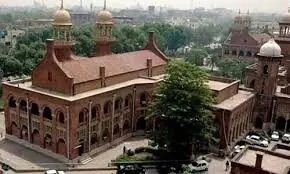

LAHORE: The Lahore High Court has held that any attempt to convert mosque-dedicated land into commercial premises, particularly without statutory sanction, constitutes not only a breach of allotment but an impairment of the religious trust and a violation of the fiduciary obligations attached to such property.
The court passed this order on a petition of government of Punjab through secretary education against Darul Haq Trust.
The government approached the court against the respondent Imam Masjid who commenced construction of commercial shops on a portion of a government’s property for a high school on the basis of allegedly false and forged documents.
The court restrained the respondent permanently from further encroachment, construction, or use of the land for purposes other than a mosque, as specified in the allotment letter.
The court held that the petitioners are entitled to take all lawful measures to ensure that the land is used solely for its allotted purpose.
The court set aside the impugned judgments of the lower courts wherein petitioner’s suit for declaration along with permanent injunction was dismissed, observed that the impugned decrees cannot be sustained in the eye of law.
The court observed that the mere assertion that commercial activity was intended to generate funds for the mosque cannot, by any legal standard, cure or retrospectively validate a construction or transaction that is patently ultra vires the allotment terms.
Such acts cannot be regularized through equitable pleas, financial necessity, or administrative convenience, the court added.
The court also observed, even if maintenance of a mosque is a legitimate objective, it does not, and cannot in law, justify a permanent conversion of publicly- dedicated land into commercial premises where the allotment explicitly prohibits such conversion.
The court remarked that a mosque once established or dedicated and its appurtenant land acquires a perpetual and inalienable character.
The conversion of land devoted to a religious or public purpose into commercial use amounts to an infringement of the proprietary and possessory rights and a breach of the public interest in reserving land dedicated for communal use, the court added.
The court said, where land dedicated for a religious or public purpose carries with it the character of a “purpose trust” in the constitutional and equitable sense, wherein the beneficiary is not an individual but the community at large.
Such dedication imposes inherent limitations on user, flowing from the doctrine that property impressed with a public purpose cannot be treated as private dominion nor subjected to commodification inconsistent with the original dedication, the court remarked.
The court observed, the inquiry in such cases is not merely proprietary but structurally fiduciary, requiring heightened scrutiny to prevent erosion of community interests and to preserve the normative continuity of the public trust.
The courts are, therefore, mandated to intervene where public-purpose property is subjected to unauthorized transformation, for failure to do so would erode the rule of law and encourage private individuals to unilaterally redefine the contours of public property, the court emphasized.
The courts, must apply a stricter standard of review when allegations are made of commercial exploitation or deviation from its sacred purpose, the court added.
The court said, any deviation, unless expressly permitted by competent authority and supported by cogent legal sanction, is ultra vires the trust purpose and void.
The court observed that from a public-policy perspective, allowing commercial structures to stand on land expressly reserved for a mosque would set a dangerous precedent, effectively inviting encroachment upon purpose lands across the province.
Any such tolerance would undermine the integrity of governmental allotments and compromise the orderly management of public assets, the court concluded.
Copyright Business Recorder, 2025

























Comments
Comments are closed for this article.