


E-challan: is Karachi paying higher fines than Dubai?
- Data comparison reveals a significant disparity in the relative financial burden of traffic fines between the two cities
The Sindh government last month launched the Traffic Regulation and Citation System (TRACS) - an AI-powered e-ticketing initiative which uses High-Definition cameras to detect traffic violations. The system has drawn massive criticism from citizens for charging “exorbitant fees” as they believe the electronic system has been introduced without any empathy for the humungous population of Karachi.
Karachi vs Dubai
If a parallel is drawn between the average income of Karachiites and those living in Dubai, a gigantic foundational difference between the gross domestic product (GDP) per capita in Dubai (UAE) and Karachi (Pakistan) can be seen.
The UAE’s GDP per capita is $51,350 and Pakistan’s is $1,710, as per the International Monetary Fund (IMF) GDP per capita list for 2025.
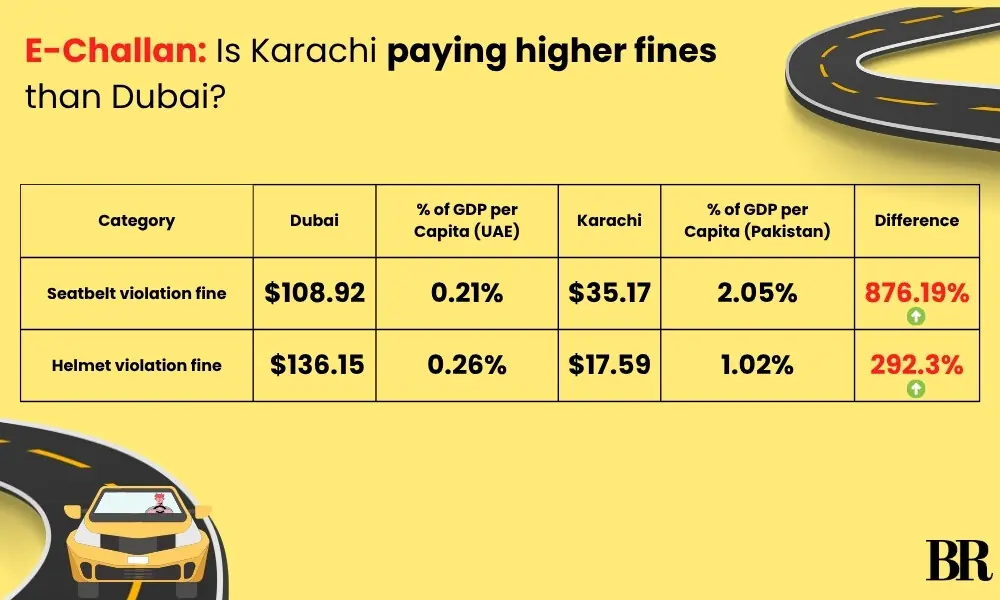
Traffic challan fee for failing to wear a seatbelt in Dubai is AED 400 ($108.92), which is 0.21% of the UAE’s per capita income. An e-challan fee for the same violation in Karachi is Rs10,000 ($35.17), amounting to 2.05% of Pakistan’s per capita income - a 876.19% difference comparing to Dubai.
Moreover, the challan fee for failure of a motorcyclist to wear a helmet in Dubai is AED 500 ($136.15) - 0.26% of their per capita income. Meanwhile the e-challan fee being charged from citizens for the same violation in Karachi is Rs5,000 ($17.59), which is 1.02% of their per capita income - a 292.3% difference comparing to Dubai.
This data comparison reveals a significant disparity in the relative financial burden of traffic fines between the two cities, despite the fines in Karachi being much lower in US dollar terms.
The fines in Karachi have disproportionate financial burden on citizens. When traffic fines are compared as a percentage of per capita income, the penalty in Karachi places a significantly heavier burden on the average Pakistani citizen than the corresponding fines in Dubai on the average UAE resident.
It is not a big deal for affluent people to pay the fees but for the people hardly making both ends meet, this can devastate their daily lives - a number of netizen wrote such comments on social media platforms.
Karachi’s e-challan controversy
Amid prevailing unemployment and frequent payment of below minimum wage throughout the city, scores of residents of the metropolis have resorted to finding some solace in part time or full time jobs in delivery or online ride hailing services.
However, the provincial government believes the imposition of fines through e-challans will not only help in controlling traffic but also keep people away from risks such as not wearing the seatbelt, overspeeding, riding without helmets, and driving in the wrong direction.
The traffic regulation system was inaugurated by Sindh Chief Minister Murad Ali Shah at the end of October this year. It is currently operational on major arteries of Karachi like Shahra-e-Faisal, with plans for city-wide expansion and eventually to other districts in the province.
The system has been introduced as part of the Karachi Safe City Project. A total number of 1,076 cameras have been installed on main thoroughfares in the first phase, which will be increased to 12,000 in three phases.
As per a report, the Sindh Police issued fines exceeding Rs100 million within just three days of the launch.
Apart from some technical defects reported in the system, the fines the government has imposed on residents of the port city are also disproportionate with regard to their capacity to bear them.
People believe that they are being charged fees equivalent to that of a developed city and are provided facilities almost nonexistent. Roads are damaged with abundance of potholes and frequent patches, functional street lights are scant and signals on many places are dysfunctional.
The article does not necessarily reflect the opinion of Business Recorder or its owners.
The writer is Head of Politics Desk at Business Recoder (Digital)


























Comments
Comments are closed for this article.