


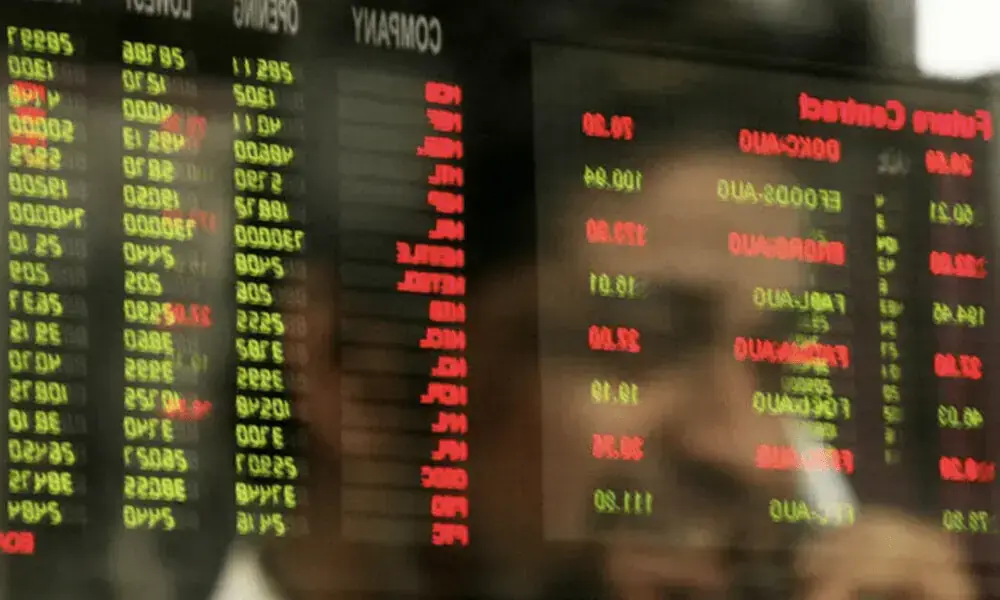

KARACHI: The Pakistan Stock Exchange ended the week on November 14 with strong gains despite persistent geopolitical uncertainty, as the KSE-100 Index rose 2,342.29 points or 1.5 percent to close at 161,935.19.
The benchmark continued its upward trajectory due to robust performance in fertilizer, cement and exploration and production stocks, as the fertilizer sector in particular benefited from reports of the ECC approving a shift from costly RLNG to Mari gas—an adjustment expected to ease subsidy pressure and stabilize urea prices. The recovery across these sectors supported the overall market, estimating weekly increases of 6 percent in fertilizers, 3 percent in cement and 1 percent in E&Ps.
BRIndex100 opened the week at 16,755.52 and closed at 17,051.28 with a total weekly turnover of nearly 2.98 billion shares, while its average daily turnover was approximately 596 million shares. BRIndex30 moved from an opening level of 53,380.84 to settle at 54,272.13, posting a cumulative weekly turnover of about 1.88 billion shares, resulting in an average daily turnover of approximately 376 million shares.
However, analysts observed that investor sentiment remained cautious as tensions between Pakistan and Afghanistan escalated following Kabul’s announcement of a planned ban on Pakistani imports within three months. They added that key policy and financing developments also shaped market expectations, noting that the IMF executive board will meet on December 8 to review the release of the US$1.2 billion third tranche.
It further highlighted that the government is pursuing around USD1 billion in policy-based financing from the World Bank and ADB, preparing for a Eurobond issuance next year and planning to launch a US$250 million Panda bond by year-end. According to the report, Pakistan posted a budget surplus of Rs2.1 trillion in 1QFY26, equivalent to 1.6 percent of GDP.
Trading activity remained subdued as ready market average daily volumes slipped to about 770 million shares, while average daily traded value hovered near USD126.54 million or Rs35.53 billion.
Despite the slowdown in activity, market capitalization increased 0.8 percent to Rs18.43 trillion or about USD65.67 billion from Rs18.28 trillion.
Sectoral contributions remained concentrated in key industries. AHL Research stated that fertilizers, cement and E&Ps were the largest contributors to the weekly gains, with Fauji Fertilizer Company, Engro Fertilizers, Maple Leaf Cement, Pakistan Petroleum and Pioneer Cement among the biggest positive movers. On the downside, National Bank of Pakistan, SEARL, Systems Ltd., Pakistan State Oil and Millat Tractors were listed as major negative contributors.
Foreign investors offloaded USD12.20 million worth of equities during the week, particularly in the banking, cement and E&P sectors. Local investors absorbed most of the selling, led by banks and DFIs, followed by companies and broker proprietary desks, while mutual funds emerged as the largest domestic sellers.
Macroeconomic indicators remained steady. The latest Treasury bill auction raised around Rs493 billion against the Rs550 billion target, with yields broadly unchanged. Pakistan’s foreign exchange reserves ticked up to USD14.52 billion, and the rupee traded close to Rs280.72 against the US dollar. AHL Research reported that Roshan Digital Account gross inflows reached US$11.31 billion by October, with USD1.90 billion repatriated and US$7.26 billion utilized in the local economy.
Sector-specific data showed continued improvement in several industries. Automobile sales in October rose sharply year-on-year to 17,300 units, taking cumulative four-month sales up 46 percent. Net metering’s share in total power generation increased by 57 basis points year-on-year in September. JS Research also noted that the government revived offshore oil and gas exploration through the award of 23 blocks, the first such initiative in 18 years.
AHL Research said Pakistan continues to trade at attractive regional valuations, with the KSE-100’s price-to-earnings ratio still below its long-term average and its dividend yield near historical norms.
Both AHL and JS Research indicated that the market’s near-term direction will depend on upcoming macroeconomic data and developments related to Pakistan’s IMF program. They added that easing geopolitical tensions and clarity on external financing could determine whether the current positive momentum continues.
Copyright Business Recorder, 2025




















Comments
Comments are closed for this article.