


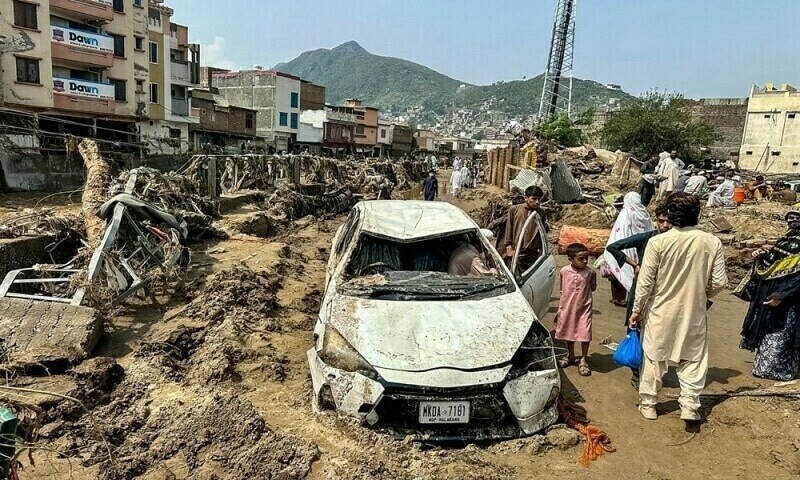
EDITORIAL: When the prime minister stood before flood victims and conceded that lessons from 2022 had gone unheeded, the admission cut to the core of the problem: governance failure. The devastation in Buner and across Khyber Pakhtunkhwa, where hundreds of lives have been lost and entire villages destroyed, cannot be explained away by torrential rain alone. It stems from a system that ignores science, flouts its own rules, and consistently fails to hold violators accountable.
Construction on riverbanks and flood plains is not an act of God, it is an act of man. Hotels and homes in known hazardous zones did not build themselves. They were sanctioned, or at the very least tolerated, by officials who turned a blind eye to the risk. The prime minister has rightly called this a “human blunder.” The harder question is why it continues unchecked, and why, even after disasters strike, no one is punished.
The pattern is depressingly familiar. Each round of floods produces the same cycle of pledges, relief cheques, and solemn vows of reform. Then inertia sets in, vested interests reassert themselves, and the memory fades until the next catastrophe. Laws already exist to regulate construction and land use. Environmental and disaster management authorities are mandated to stop encroachments and protect floodplains. Yet the rules are not enforced, permits are granted under political or commercial pressure, and the costs are borne by the poorest communities.
That is the governance failure at the heart of this crisis. It is not simply about capacity or resources. It is about will. If the state can mobilise its machinery against tax defaulters or petty encroachments in cities, it can just as well enforce bans on construction in flood-prone zones. If it can prosecute ordinary citizens for minor violations, it can certainly act against the well-connected interests whose illegal projects magnify natural disasters into human carnage. That it does not speak to selective application of the law.
The prime minister has now promised meetings with provincial governments on disaster preparedness, reforestation, and construction regulation. These are necessary conversations, but they are not enough. The public has heard such promises before. What matters is enforcement and accountability. Have the hotels and structures that collapsed into rivers in 2022 been rebuilt in the same places? Were those who authorised them ever investigated? Unless these questions are answered with action, declarations from the top amount to little more than rhetoric.
The need for deterrence is urgent. Without exemplary punishment for violations, and without institutional mechanisms that insulate planning from political interference, every monsoon will bring more preventable death and destruction. Reforestation campaigns and disaster drills are valuable, but they cannot compensate for a state that refuses to enforce its own writ. The law must apply as rigorously in Buner and Swat as it does in Islamabad or Lahore.
Natural disasters are unavoidable, but their consequences are shaped by choices. Pakistan has chosen, time and again, to let influence and corruption dictate where people build, how forests are felled, and whether safety codes are enforced. That choice has left hundreds dead and thousands displaced once again. To say lessons were not learned is true, but it is also incomplete. Lessons were deliberately ignored. Unless this cycle is broken with concrete action and accountability, the prime minister’s words will serve as nothing more than another entry in the long catalogue of unheeded warnings.
Copyright Business Recorder, 2025


















Comments
Comments are closed for this article.