




Pakistan’s ranking in the Human Development Index (HDI) 2025 stands at a sobering 168 out of 193 countries, with a value of 0.544, categorizing it among nations with Low Human Development. This marks a significant fall of 19 positions from its previous standing—one of the steepest declines globally—highlighting a sharp reversal in developmental momentum.
The core indicators reveal a troubling picture: life expectancy is 67.6 years; expected years of schooling are just 7.9; mean years of schooling are a mere 4.3; Gross National Income per capita stands at $5,501; the inequality-adjusted HDI drops further to 0.392; and the Gender Inequality Index is at a concerning 0.536. These statistics point to long-standing patterns of underinvestment in key sectors such as education and health, persistent income inequality, and a structural economic fragility that remains unaddressed.
Pakistan fares poorly even within its own region. Among South Asian peers—India, Bangladesh, and Sri Lanka—Pakistan consistently ranks lowest across nearly every human development metric, from income and life expectancy to gender equity and educational attainment.
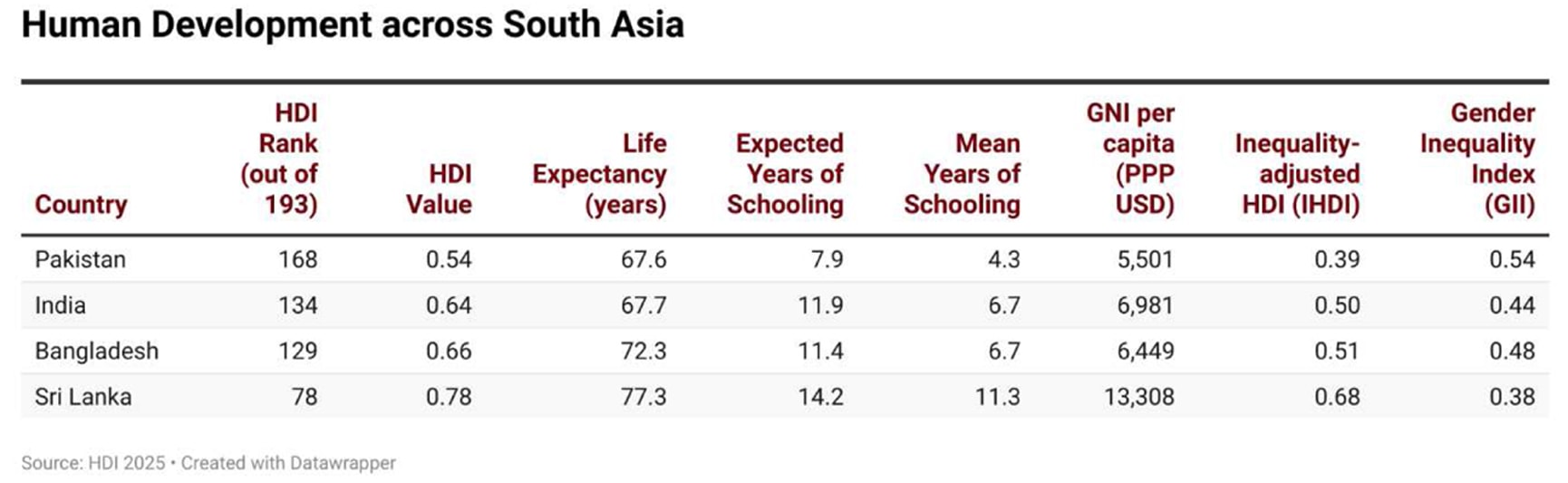
The broader South Asian region also faces development challenges, with high inequality contributing to an average 30 percent loss in human development potential. Pakistan’s loss is even more severe. Gender disparities remain pronounced, as evidenced by one of the region’s worst GII scores, and its education system lags far behind, with school expectancy rates at the bottom of the regional scale.
Healthcare performance too shows stagnation, with only marginal gains in life expectancy despite a growing population and evolving health demands.
The 2025 Human Development Report underscores that development progress is fundamentally a function of policy choices, not inevitability. Countries that have advanced on the HDI ladder have done so through consistent, strategic investments. For instance, Sri Lanka, despite economic instability, has ensured near-universal access to education and healthcare.
Other nations such as Vietnam has embraced digital tools to extend public services, empowered marginalized populations, and built inclusive welfare systems to spur HDI growth. These examples show the power of deliberate, equity-focused policy decisions in driving transformative development.
Pakistan can draw valuable lessons from these global and regional success stories. It must reorient its national development strategy toward people-centred outcomes rather than GDP growth alone. That begins with prioritizing foundational investments in education and healthcare, particularly in underserved areas.
It also requires confronting inequality directly by enacting fiscal reforms that ensure wealth redistribution and equitable access to services. Addressing gender disparity must be a core priority, supported by policies that promote female participation in education, work, and governance. Moreover, strengthening institutional capacity through better governance, digital innovation, and transparent service delivery will be key to sustained progress.
Pakistan’s low HDI performance is not a reflection of its potential but rather the consequence of critical decisions delayed or ignored.
The global experience, including from within South Asia, shows that when people—not just productivity or profit—are at the centre of policy, development follows. As the 2025 Human Development Report makes clear, technology may be the enabler, but human agency is the true driver of progress. For Pakistan to move forward meaningfully on the HDI scale, it must make the choice to put human development at the heart of its national agenda.

























Comments
Comments are closed for this article.