


NASA astronauts head home on SpaceX capsule after drawn-out space station stay
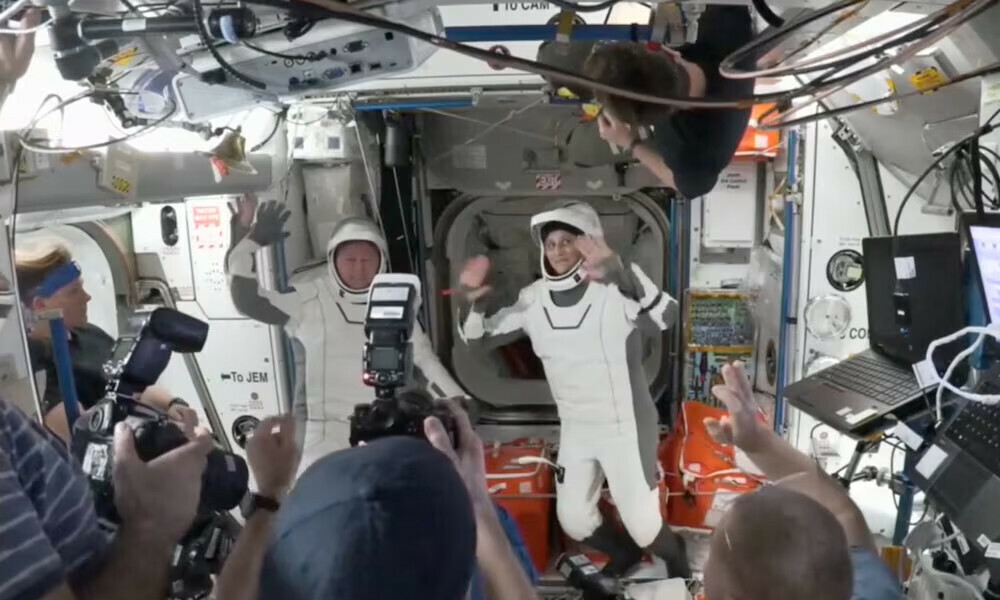

WASHINGTON: NASA astronauts Butch Wilmore and Suni Williams departed the International Space Station early on Tuesday morning in a SpaceX capsule for a long-awaited trip back to Earth, nine months after their faulty Boeing Starliner craft upended what was to be a roughly week-long test mission.
Wilmore and Williams, two veteran NASA astronauts and retired US Navy test pilots, strapped inside their Crew Dragon spacecraft along with two other astronauts and undocked from the orbiting laboratory at 1.05 a.m. ET (0505 GMT), embarking on a 17-hour trip to Earth.
The four-person crew, formally part of NASA’s Crew-9 astronaut rotation mission, is scheduled for a splashdown off Florida’s coast later on Tuesday at 5:57 p.m. ET.
Wilmore and Williams’ homecoming caps an end to an unusual, drawn-out mission filled with uncertainty and technical troubles that have turned a rare case of NASA’s contingency planning - as well as failures of Boeing’s Starliner spacecraft - into a global and political spectacle.
The astronaut pair had launched into space as Starliner’s first crew in June for what was expected to be an eight-day test mission.
But issues with Starliner’s propulsion system led to cascading delays in their return home, culminating in a NASA decision last year to have them take a SpaceX craft back this year as part of the agency’s crew rotation schedule.
The mission has captured the attention of US President Donald Trump, who upon taking office in January called for a quicker return of Wilmore and Williams and alleged without evidence that former President Joe Biden “abandoned” them on the ISS for political reasons.
SpaceX CEO Elon Musk, a close adviser to Trump, echoed his call for an earlier return.
SpaceX’s Crew Dragon is the United States’ only orbital-class crew spacecraft, which Boeing had hoped its Starliner would compete with before the mission with Wilmore and Williams threw its development future into uncertainty.
The astronauts will be flown to their crew quarters at the space agency’s Johnson Space Center in Houston for several days of health checks, per routine for astronaut returns, before NASA flight surgeons approve they can go home to their families.
Living in space for months can affect the human body in multiple ways, from muscle atrophy to possible vision impairment.
Upon splashing down, Wilmore and Williams will have logged 286 days in space - longer than the average six-month ISS mission length, but far short of U.S. record holder Frank Rubio. His continuous 371 days in space ending in 2023 was the unexpected result of a coolant leak on a Russian spacecraft.
Williams, capping her third spaceflight, will have tallied 608 cumulative days in space, the second most for any U.S. astronaut after Peggy Whitson’s 675 days. Russian cosmonaut Oleg Kononenko set the world record last year at 878 cumulative days.
Replacement crew
Swept up in NASA’s routine astronaut rotation schedule, Wilmore and Williams could not begin their return to Earth until their replacement crew arrived, in order to maintain adequate U.S. staffing levels, according to NASA.
Their replacements arrived on Friday night - four astronauts as part of NASA’s Crew-10 mission briefly put the station’s headcount at 11.
“We came prepared to stay long, even though we planned to stay short,” Wilmore told reporters from space earlier this month, adding that he did not believe NASA’s decision to keep them on the ISS until Crew-10’s arrival had been affected by politics.
Astronaut crew docks with space station to replace ‘Butch and Suni’
“That’s what your nation’s human spaceflight program’s all about,” he said, “planning for unknown, unexpected contingencies. And we did that.”
Wilmore and Williams have been doing scientific research and conducting routine maintenance with the station’s other five astronauts. Williams had performed two six-hour spacewalks for maintenance outside the ISS, including one with Wilmore.
The ISS, about 254 miles (409 km) in altitude, is a football field-sized research lab that has been housed continuously by international crews of astronauts for nearly 25 years, a key platform of science diplomacy managed primarily by the U.S. and Russia.
Williams told reporters earlier this month that she was looking forward to returning home to see her two dogs and family. “It’s been a roller coaster for them, probably a little bit more so than for us,” she said.


























Comments
Comments are closed for this article.