




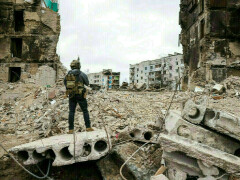
KYIV: Ukraine suffered sweeping blackouts and water supplies were cut to large parts of Kyiv on Monday after another wave of Russian missile strikes on key infrastructure.
The Ukrainian army’s commander in chief, Valeriy Zaluzhnyi, said on Telegram that Russia had launched 55 cruise missiles and dozens of other munitions at “civilian targets” across the country, days after Russia blamed Ukraine for drone attacks on its fleet in the Black Sea.
Presidential adviser Oleksiy Arestovich early Tuesday called the bombardment “one of the most massive shellings of our territory by the army of the Russian Federation”.
But he noted on the same platform that thanks to improved air defences, “the destruction is not as critical as it could be”.
Though the army said many of the missiles had been shot down, Prime Minister Denys Shmygal said the strikes had still caused power cuts in “hundreds” of areas across seven Ukrainian regions.
Several blasts were heard in the capital Kyiv.
The city’s mayor, Vitali Klitschko, said later on Monday that 40 percent of consumers had been left without water, while 270,000 homes had no electricity.
In the west of Kyiv, an AFP journalist saw more than 100 people with empty plastic bottles and containers waiting to collect water from a park fountain. Ukrainian Foreign Minister Dmytro Kuleba said on Twitter: “Instead of fighting on the battlefield, Russia fights civilians.”
Ukraine’s battered energy infrastructure would be repaired with equipment from 12 countries, Kuleba said in a separate statement.
The Russian army confirmed it had carried out cruise missile strikes and said they had all reached their intended targets.
In Moldova, the government said a Russian missile shot down by Ukrainian air defences fell on the village of Naslavcea in the north of the country, but without causing any injuries.
‘Cold winter ahead’
Three missiles struck a site to the north of Kyiv, a soldier close to the target told AFP.
In a nearby town, Mila Ryabova, 39, told AFP she was woken by between eight and 10 “powerful explosions”.
Russia and Ukraine swap around 50 prisoners of war
“We were together with my family, preparing my daughter for school, but now there is no electricity in our house and at school,” said Ryabova, a translator.
“But we are worrying and talking about opportunities to move abroad, because there is a cold winter ahead. We may not have electricity, heat supply.”
Previous strikes this month have already destroyed about a third of Ukraine’s power stations.
Meanwhile, UN nuclear watchdog the International Atomic Energy Agency (IAEA) again raised concerns about the situation around Ukraine’s Zaporizhzhya Nuclear Power Plant, saying in a statement that a landmine explosion had cut power to one of its reactors.
“In a further sign of the precarious situation in the area of the ZNPP, the IAEA team said there had been shelling in the vicinity of the plant in recent days, following a period of reduced military activity,” the watchdog said.
Kyiv, which invited the IAEA inspectors, has counter-alleged that Moscow might itself use a dirty bomb in a “false flag” attack.
Grain deal
Monday’s strikes came after Russia pulled out of a landmark agreement that allowed vital grain shipments via a maritime safety corridor.
The July deal to unlock grain exports signed between warring nations Russia and Ukraine – and brokered by Turkey and the United Nations – is critical to easing the global food crisis caused by the conflict. But Russia announced Saturday it would suspend its participation in the deal after accusing Kyiv of a “massive” drone attack on its Black Sea fleet, which Ukraine labelled a “false pretext”.
Kremlin spokesman Dmitry Peskov warned that continuing grain exports without Russian participation was “hardly feasible”.
The Russian defence ministry said Monday that it wanted “additional commitments” from Ukraine not to use the grain exports corridor for military purposes.
In his evening address Monday, President Volodymyr Zelensky said the grain deal breakdown was “clear evidence that Russia will continue to oppose itself to the entire international community”, adding it was “very important now to prevent this global destabilisation”.
Russian President Vladimir Putin, meanwhile, repeated the accusation that Ukraine used the grain corridor for the attack, saying Kyiv had put civilian ships in danger, and calling on it to guarantee “that there will be no threat to the safety of civilian vessels”.
Despite Russia’s decision to suspend its participation, at least 10 cargo ships loaded with grain and other agricultural products left Ukrainian ports Monday, according to a marine traffic website.
“Civilian cargo ships can never be a military target or held hostage. The food must flow,” Amir Abdulla, UN coordinator for the Black Sea Grain Initiative, said on Twitter.





















Comments
Comments are closed for this article.