



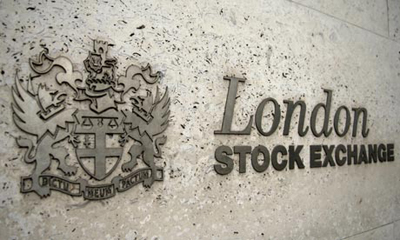
 LONDON: London's stock market finished with a small gain Wednesday on the eve of Britain's most unpredictable election in living memory, while eurozone stocks managed to rise despite the euro spiking higher.
London's benchmark FTSE 100 index eeked out a 0.09 percent gain to 6,933.74 points despite fears the election could result in weeks of brinksmanship as the two major parties struggle to cobble together workable coalitions.
"The topsy-turvy markets seen in recent weeks have been personified perfectly today, with the FTSE 100 oscillating with little sense of direction," said analyst Josh Mahony at IG Markets in London.
"With only one day to go until election day, markets have shown the same kind of indecision that is plaguing the 25 percent of undecided UK voters."
Meanwhile the CAC 40 in Paris rose 0.15 percent to 4,981.59 and the DAX in Frankfurt climbed 0.20 percent to 11,350.15 points, despite the euro shooting above $1.13.
Eurozone stock markets had tumbled Tuesday as the euro spiked on fears of an early end to the European Central Bank's quantitive easing (QE) stimulus programme and angst over Greece's ability to reach a deal with creditors and stay in the euro.
Sentiment on Greece was improved after Athens made a 200 million euro interest payment to the International Monetary Fund Wednesday.
The bigger challenge is an 800 million euro payment next week, which has sparked concerns of a possible Greek default and catastrophic exit from the euro.
In foreign exchange trade, the European single currency advanced to $1.1332 from $1.1185 late in New York on Tuesday.
The euro rose to 0.7444 British pence from 73.68 pence Tuesday, while the pound gained to $1.5229 from $1.5181.
"The strong upward momentum for the euro against the dollar remains intact with rising crude oil prices fuelling a shift in inflation expectations," said Derek Halpenny, currency analyst at Bank of Tokyo-Mitsubishi UFJ.
The ECB in March launched a 60-billion-euro per month bond buying QE programme to avert the risk of dangerous deflation and kick start growth in the eurozone. It is supposed to last through September 2016.
But with prices now rising again in the eurozone, and a rebound in oil prices ensuring they will likely continue to do so, investors see a possibility for the ECB to let up on the stimulus, which has weakened the euro.
The dollar has also been weakening as investors see the US Federal Reserve likely holding rates at record lows for a while longer after the US economy hit a soft patch in the first quarter of this year.
Weak US hiring figures released Wednesday led the euro to gain further ground against the dollar.
Payrolls firm ADP estimated the US added just 169,000 private sector jobs in April, the second month in a row under 200,000, as the petroleum sector downturn continued to pinch the labour market.
The "disappointing ADP payrolls number today compounded the feeling that (US Federal Reserve chief) Janet Yellen and co will be increasingly likely to hold off on interest rates for the time being," said IG Markets's Mahony.
The Fed holding off on raising interest rates would normally be good news for stocks, but Yellen poured cold water on equites when she said Wednesday that US stock market valuations were "quite high" and pose "potential dangers" to financial stability.
Yellen, discussing lessons from the 2008 financial crisis at a conference co-hosted by the International Monetary Fund, noted that the current risks to financial stability are "moderated, not elevated."
But, she said, "equity market valuations are at this point quite high.
"There are potential dangers there," she said, but added there was no rapid credit growth and "no signs of a financial bubble."
After opening up, the Dow Jones Industrial Average was down 0.43 percent to 17,851.13 points in midday trading.
The broad-based S&P 500 slid 0.17 percent to 2,086.00, while the tech-rich Nasdaq Composite Index shed 0.19 percent to 4,929.95.
Alexion Pharmaceuticals announced it would buy Synageva BioPharma for $8.4 billion, creating a bigger player in treatments for rare diseases.
Asian stocks lost ground Wednesday as China's market declined, with Shanghai falling 1.62 percent.
Sydney fell 2.3 percent, Seoul dropped 1.3 percent and Hong Kong shed 0.41 percent.
Tokyo was closed for a holiday.

























Comments
Comments are closed for this article.