




Arab Light crude oil has so far averaged $40/bbl. If that stays the same for another 10 days – the government will have to increase prices by Rs30/ltr or 39 percent over June. This is how unsustainable June petrol prices were. That is assuming the ex-refinery prices stay at 12-month average of Rs7.5 per liter for petrol – and not Rs17/liter between March and April.
It is difficult to see the government sending petrol back over Rs100/ltr in less than three months. That is where the Petroleum Levy (PL) will come into equation. Expect the PL to be slashed from the recent high of its maximum limit of Rs30/ltr. The prices will still rise substantially because of the anomaly that Jun petrol pricing was. And that is where the PL collection target budgeted for FY21 appears a number based on whims (see: Islamabad’s Petroleum Levy daydream, published Jun 15, 2020).

How difficult is the task? The first taste of it will be known in a couple of weeks. Here is an attempt at scenario and sensitivity of petroleum prices and PL collection at different rates of international crude oil price and petroleum demand. The first scenario where the government can hope of achieving the rather lofty Rs450 billion PL target – meets at an average Rs25/ltr PL on both petrol and HSD – with 10 percent increase in demand from the baseline current scenario of 17 billion liters in FY20.
Only at the maximum limit of Rs30/ltr for both the key petroleum products will the PL collection target be met – even at reduced demand from FY20 levels. International crude oil ahs bounced back since the April lows – and the likes of EIA have forecasted an average $50/bbl for the next six months of 2020. If $50/bbl becomes the base – PL even at Rs20/ltr would mean petrol price north of Rs100/ltr. Should the government insist on Rs30/ltr for PL – petrol (and HSD) prices will remain over Rs100/ltr – in all scenarios ranging from $40/bbl to $60/bbl.
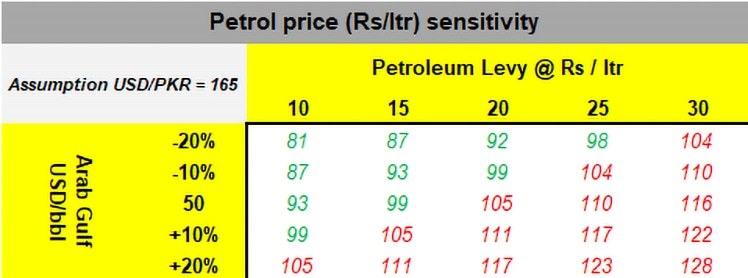
Bear in mind the key assumption is that the rupee will hold strongly against the greenback for the entire year and would not budge pass 165. Those looking for a decline in GST to make room for maximum PL may have a point. But try doing that under the IMF’s nose, where no petroleum sales tax SROs were agreed upon and have been adhered to. The sales tax target for FY21 is no less steep and petroleum GST makes the biggest chunk of them all. The government would have done well to achieve anything close to Rs350 billion in PL – given the uncertainty surrounding demand.










Comments
Comments are closed for this article.