



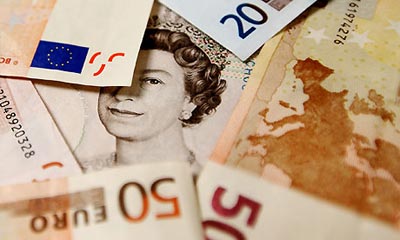
 LONDON: Sterling recovered from an eight-month low against the euro on Friday as some investors such as macro funds sold into the common currency's recent rally and booked profits before the year end.
Gains for the British pound were likely to be capped by uncertainty about UK recovery and expectations that the Bank of England may have to ease monetary policy early next year.
The euro was last down 0.5 percent on the day at 81.80 pence, having earlier risen to 82.25 pence, its highest since mid-April.
Traders saw near-term resistance at 82.43, the high reached on April 18, and a sustained break above that level could see the euro reach 82.765 pence, the high hit on April 10.
"There seems a bit of a euro selloff as we approach year end," said a London-based spot trader. "Below 81.70 pence, a few positions may be squeezed, but a sustained move down is unlikely."
The pound's drop against the euro helped push its trade-weighted index to a two-month low of 83.1, and analysts expect sterling to underperform against the euro in coming weeks.
"Sterling will struggle against the euro as a UK recovery will be uneven and inflation will be high next year," said Simon Smith, chief economist at FXPro. "For investors looking to preserve capital, sterling will not be the safe-haven that it was during the euro zone debt crisis."
For much of 2012, investors seeking to flee the euro zone debt crisis headed for the perceived safety of UK gilts, which are liquid and triple-A rated. But high inflation can erode the value of an asset, making the investment a bit unattractive.
Britain is also struggling to meet its own targets on reducing a high debt burden thanks to poor growth.
UK data last week revealed a rise in public borrowing, and there are worries its own rating could come under threat next year. Retail sales were sluggish while consumer confidence fell sharply in December, adding to concerns the economy could deteriorate in the coming months and push the Bank of England to ease monetary policy more.
Those factors are likely to weigh on sterling in the near term.
In contrast, sentiment towards the euro zone is improving and the region is once again seeing some inflows from investors. The European Central Bank's pledge to buy peripheral euro zone bonds has helped, driving many speculators and investors to pare short bets against the single currency before the year end.
The euro has gained across the board this month, hitting an eight-month high against the dollar and a 17-1/2 month high against the yen. It slipped from those levels on Friday, but for the year it has gained nearly 2 percent against the dollar and over 14 percent against the yen.
Against the dollar, sterling was slightly higher on the day at $1.6115, with gains likely to be limited by worries about the US budget impasse.
Expectations that Congress will fail to reach a deal before Jan. 1 to avert the "fiscal cliff" of $600 billion of spending cuts and tax hikes are likely to buoy safe-haven flows into the more liquid US dollar in the near term.
"Markets tend to favour the dollar in times of uncertainty and thus the pair is likely awaiting the news on the fiscal cliff," said Joshua Mahony, analyst at Alpari.
"The sharp incline of the 100-day moving average should soon provide cable support in the coming days should the price fall any lower."
Center>Copyright Reuters, 2012

























Comments
Comments are closed for this article.