



I have always welcomed debate on matters of public consequence, and Dr Nadeem ul Haque, to his great credit, is equally open to argument. It is in that spirit that I take up his piece in this newspaper —“Banks-based economy not a growth economy” (23 September 2026), which engaged with my article in Profit, Same Banks, Different Field.
Much of it I agree with: Pakistan’s financial system is bank-centric to an unhealthy degree, its capital markets shallow, its pension pools tiny, and savers deserve a menu, not a monopoly. On this, Dr Haque, Mr Shahid Kardar and I are of one mind.
But the article also levels a series of charges against banks and the State Bank, some resting on facts that need correcting, some more populist than precise. Let me take them one by one, beginning with the arithmetic, because everything else must be tested against it.
- “Banks lend at almost exactly the rate anyone would”
This is the one point on which we agree, and it is the foundation of everything else. My Profit article asked how much Pakistani banks would lend if they operated on their neighbours’ field. Put each neighbour on Pakistan’s field, a money supply more than a quarter of which is cash, an economy barely half documented, and a sovereign absorbing three-fifths of bank assets, and every one of them lends at roughly Pakistan’s level (Chart 1). Dr Haque accepts the arithmetic and then calls “different field” an admission rather than a defence. It is neither; it is a diagnosis. If the field explains the behaviour, the field is the problem.
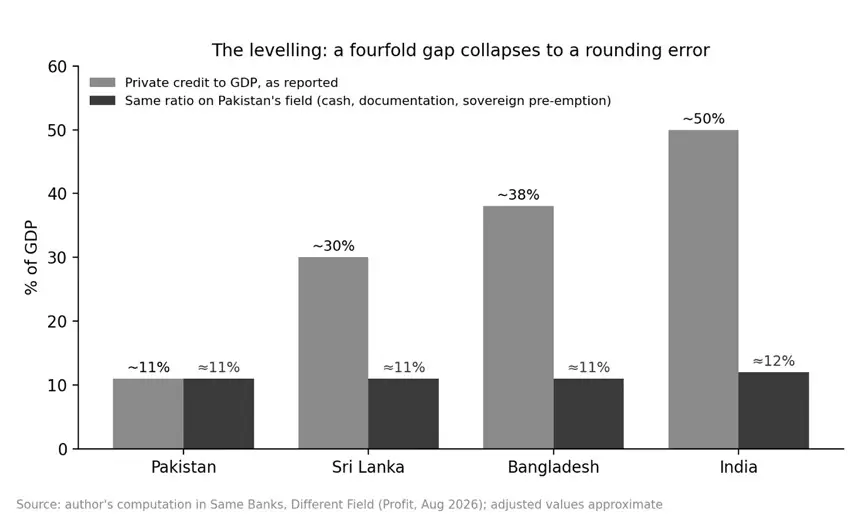
Chart 1: Private credit to GDP, as reported and on Pakistan’s field
- “A cartel, supervised rather than disciplined; entry is club-based; FX runs only through banks”
Dr Haque, being a responsible intellectual, I am sure uses the word as a metaphor for a sector that has grown comfortable. Even as a metaphor it does not survive the facts. A cartel is a small, closed club that keeps newcomers out and coordinates what it charges. Pakistan has more than thirty scheduled banks, eleven microfinance banks and five digital banks licensed in 2023; RBS, HSBC, Barclays and Citi’s consumer franchise chose to leave, which no member of a rent-rich club ever does; the floor on savings deposits is set by the State Bank, lending is priced off a published interbank benchmark, and the yield on government paper is set in the state’s own auction, where banks bid against each other. When the largest borrower is also the price-setter, there is nothing left for a cartel to coordinate. Nor is entry club-based: five digital licences were issued in 2023 under published, risk-based criteria, and foreign exits alongside domestic mergers are what a contestable market looks like. And foreign exchange running through banks is not a Pakistani annexation; interbank FX is a dealer-bank market in every financial centre on earth, while retail FX here runs through licensed exchange companies that the State Bank has spent three years strengthening. The indictment fails.
- “Banks bought the competition; NBFIs were forced to shrink”
The data say otherwise. Mutual fund assets stood at a record Rs 4.3 trillion in January, up from about Rs 3.5 trillion a year earlier; an industry being strangled does not post record after record. The largest managers are bank-sponsored, but so are India’s: SBI, ICICI and HDFC own its largest fund houses. Every such subsidiary here was licensed by the SECP, not the State Bank, and roughly half of the twenty licensed managers, including Atlas, Lakson, Lucky and Pak-Qatar, have no bank parent. And a money-market fund facing a sovereign that pays double digits will buy that paper whoever owns it.
- “A spread of 7.82 against India’s 2.71”
A gross spread says little until one looks inside it. Four things widen Pakistan’s number before a rupee of profit is earned. Adjust for the four and the gap closes: the tax wedge alone accounts for over a percentage point, reserve costs for about half a point, the credit-cost differential for at least another, and the deposit-mix effect for much of the rest, leaving an underlying spread within touching distance of India’s 2.71. The levelling that closes the credit gap closes the price gap too.
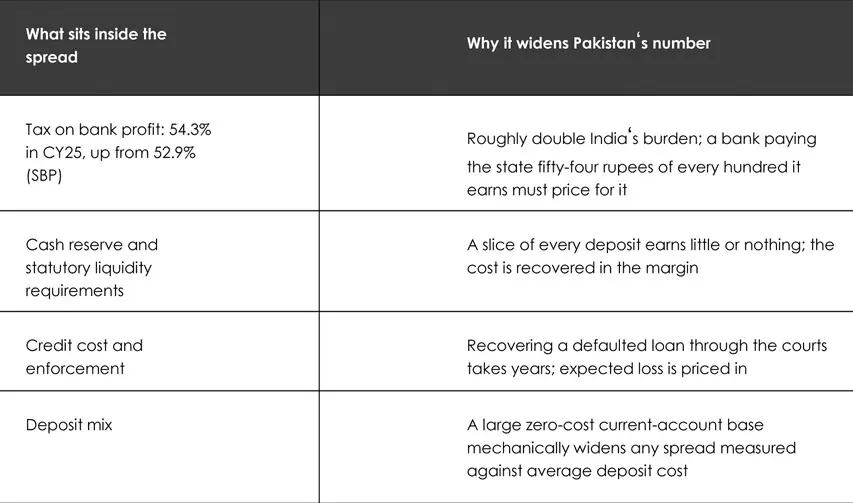
Table 1: Decomposing the lending-deposit spread
- “Profitability reflects pricing power, not productivity”
The profit story is the rate story. Net interest margins fell from about 5.8 to 4.5 percent in a single year as the policy rate came down from twenty-two percent, and the State Bank’s own review records profitability moderating in each of the last two years. A cartel’s profits do not track the policy rate; a banking system’s do. Return on equity tells the same story, and it bears on entry. It peaked in the mid-twenties when the policy rate stood at twenty-two percent and inflation ran higher still, so in real terms capital barely held its value, and it is now falling toward the low-to-mid teens where Indian banks sit, 13.5 percent last year on the RBI’s own count. If barriers to entry were protecting excess returns, global banks would have fought to get in rather than queued to leave; a risk-adjusted return this ordinary is what a contestable market produces. Strip out the tax and reserve costs in Table 1 and no regulator anywhere would call the residual pricing power.
- “Allocative failure: three-fifths of assets in government paper”
This is not an allocation banks made; it is the residual the fiscal position leaves. Last year the government borrowed from banks more than four times what the entire private sector received. Dr Haque himself quotes Mr Kardar that the state’s financing need, arguably for all the right reasons, is the most important explanation for the system’s shape. Blaming the banks for the size of the sovereign’s claim is blaming the reservoir for the size of the dam.
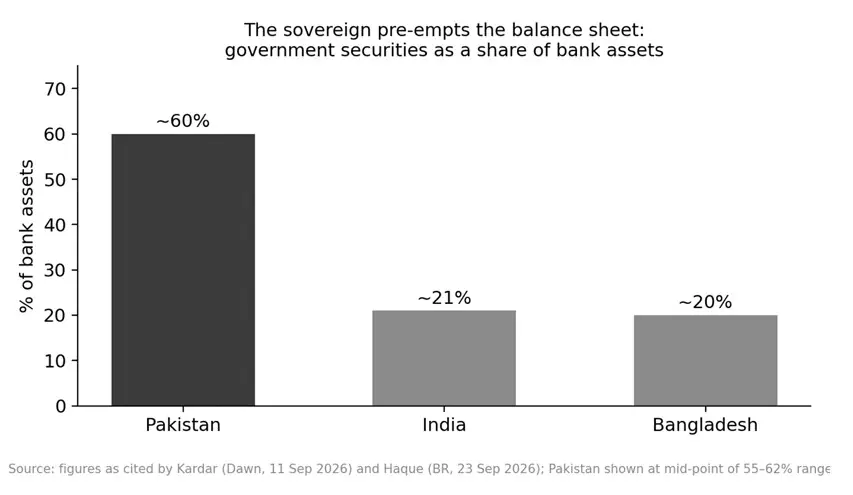
Chart 2: Government securities as a share of bank assets, Pakistan and peers
- “SBP injects liquidity, banks lend it back to the state; SBP is financing fiscal dominance”
This inverts the sequence. The government finances its deficit in the market, and every auction drains liquidity from the banking system into the treasury’s account. Open market operations replace what the government has withdrawn, at the policy rate, against collateral: the price of ending the old, direct fiscal dominance, not a new form of it. The stock is large because the deficit is large.
Nor is this peculiar to Pakistan. In the week Dr Haque’s article appeared, Bloomberg reported that London banks had drawn nearly £129 billion in a single week from the Bank of England’s repo facility at 3.75 percent to buy gilts yielding 5.4 percent, and the Bank said it welcomes the practice as normal liquidity management. What London treats as plumbing working as designed, we are asked to treat as a cartel, on a far thinner spread.
Money is, in any case, fungible. A rupee raised through an open market operation sits in the same pool as a rupee of deposits, and a bank with a documented, bankable borrower in front of it will lend it whichever door it came through. Banks lend to every borrower they can see and park the remainder in the only asset left. Funding was never the constraint; documentation was.
- “No origination effort; managing a low-risk franchise”
Banks cannot lend to what they cannot see. Pricing risk requires audited accounts, tax returns and a traceable cash flow, and most Pakistani businesses choose to stay below the tax radar. That choice is theirs, not the banks’. Where the field has been levelled, the same management shows what it does: in three years The Bank of Punjab has delivered interest-free credit to around a million farmers and interest-free mortgages to hundreds of thousands of families, with recovery close to complete, because the province shared the risk and the borrowers were documented on the way in. Demand was never the problem; de-risked supply was.
- “Fees rise unchecked, clearing is slow and banks earn float; and the innovation is only better plumbing for the same pipe”
Most bank charges are capped or scheduled by the State Bank and published; Raast transfers are free by regulation. Slow clearing described Pakistan a decade ago. Today Raast settles in seconds, 1Link transfers are near-instant and cheques clear next day. There is no float on a payment that settles before the customer has put the phone down. The numbers show how far the counter has emptied: digital transactions have grown six-fold since FY19 while counter transactions have stood still, and more than nine in ten retail payments are now made digitally.
(To be continued tomorrow)
Copyright Business Recorder, 2026
The writer is President and CEO of The Bank of Punjab


























Comments