


Balochistan unrest: APC demands ‘truth and reconciliation commission’

ISLAMABAD: In an unusually united political front, major opposition parties on Wednesday launched a blistering attack on the state’s handling of Balochistan, warning that years of violence, neglect and deepening alienation had pushed the province towards a dangerous breaking point.
The warning came in the declaration issued at an all-parties conference (APC) organised by Balochistan chapter of Pakistan Tehreek-e-Insaf (PTI), where opposition leaders demanded a truth and reconciliation commission to confront decades-old grievances and end what they described as a continuing cycle of mistrust, resentment and unrest.
The conference demanded the immediate recovery of missing persons and called for a serious political dialogue, accusing “non-representative” governments and failed policies of aggravating instability in the province.
The participants also demanded the release of former prime minister Imran Khan, rights activist Dr Mahrang Baloch, Ali Wazir, Shah Mahmood Qureshi, Dr Yasmin Rashid, Imaan Mazari and other political prisoners.
The declaration called for an impartial national commission to investigate terrorism incidents, meaningful political engagement at federal and provincial levels, an end to what it termed the misuse of laws, including the Defence of Pakistan Act, and insisted that strengthening democracy was the only sustainable solution to the Balochistan crisis.
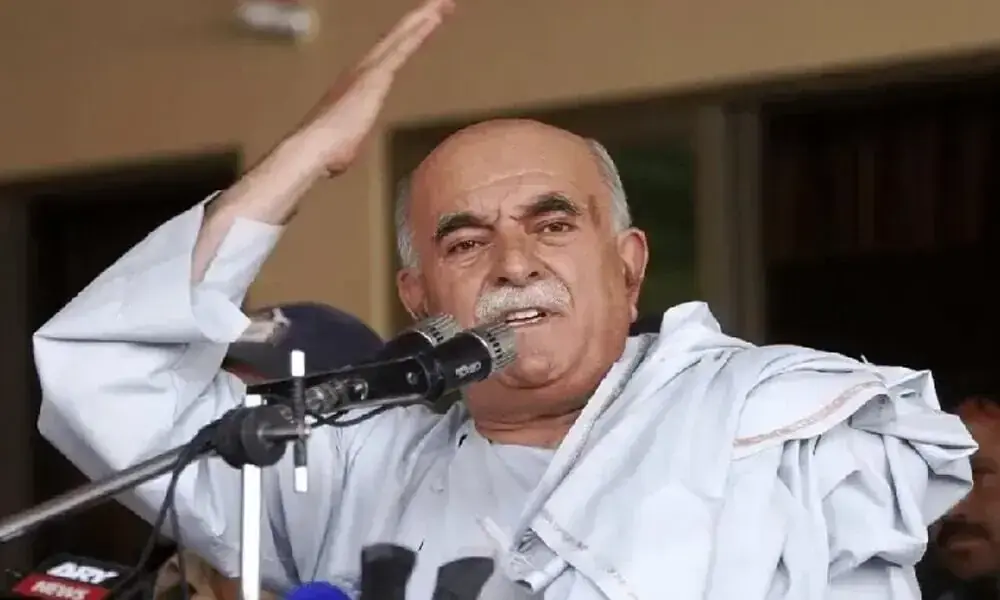
Addressing the conference, PTI-backed opposition leader in National Assembly Mahmood Khan Achakzai launched a sharp criticism of intelligence agencies, questioning their ability to prevent repeated security failures despite their extensive powers.
“Intelligence agencies can find a needle in dirty water, but why has there been failure from Bajaur to Khyber and Quetta,” he asked.
He said state institutions were fully capable of identifying those responsible for violence but had failed to stop repeated crises.
He added that Pashtuns and Baloch had been struggling for their rights since the era of Emperor Akbar.
He condemned what he called the stereotyping of Pashtun identity, arguing that cultural symbols such as the turban and beard were increasingly being unfairly associated with terrorism. “Injustice increases hatred, and eventually the matter reaches terrorism,” he said.
Former prime minister Shahid Khaqan Abbasi criticised what he described as a politics built on “hatred and hostility”, warning that the state’s approach towards Balochistan had created fears that the province’s grievances would eventually be pushed out of national debate.
He said the growing frustration among young people – including MPhil and PhD scholars and doctors from respected families – reflected the depth of the crisis and the failure to address their concerns.
Abbasi argued that Balochistan’s problems could not be solved through force or bullets, calling instead for dialogue, negotiations and sustained political engagement.
PTI leader Asad Qaiser accused the government of bypassing parliament on critical national decisions, saying Pakistan’s challenges could only be resolved through a legislature that reflected genuine public opinion.
Calling parliament a “rubber stamp”, he said the deaths of police personnel kidnapped in Balochistan exposed government failures and demanded greater powers for provincial police institutions.
Acting PTI chairman Barrister Gohar Ali Khan said his party had been denied adequate representation in Balochistan despite winning elections.
He called for accountability and institutional reforms, urging political forces to unite against militancy and warning that continued terrorism threatened to derail development efforts.
Jamaat-e-Islami Pakistan leader Maulana Shakir said worsening conditions in Balochistan were producing a growing human tragedy, with increasing numbers of orphans, widows and deaths.
He warned that poverty and unemployment were pushing young people towards crime, claiming the province’s situation had deteriorated beyond even that of Jammu and Kashmir and the Gaza Strip.
Jamiat Ulema-e-Islam-Fazl (JUI-F) leader Maulana Salahuddin Ayubi criticised what he described as the weakening of democratic processes, alleging that economic interests were shaping policies aimed at controlling resources while border communities continued to suffer.
He said the closure of the Chaman border had failed to stop violence while inflicting serious damage on trade and worsening economic losses.
National Party Senator Jan Muhammad Buledi praised PTI for holding the conference, saying Balochistan had produced major national political figures but that the province’s sacrifices were repeatedly forgotten once political parties gained power.
He argued that Balochistan’s limited representation and influence in the National Assembly reflected a broader political imbalance and stressed that the crisis was fundamentally political, not merely a security matter.
Asghar Khan Achakzai, president of the Awami National Party (ANP) Balochistan, alleged that terrorism was being used as a tool to control resources and weaken constitutional protections for marginalised communities.
Mustafa Nawaz Khokhar of Tehreek-e-Tahaffuz-e-Aain-e-Pakistan (TTAP) warned that weakened democratic institutions and declining state authority were creating space for a “conflict economy” and the expansion of drug trafficking.
The conference ended with a forceful call for political reconciliation, democratic reforms and a comprehensive strategy to tackle Balochistan’s security, economic and governance challenges.
The declaration demanded an end to enforced disappearances, withdrawal of cases against political workers, recovery of missing persons and recognition of Balochistan’s rights over its natural resources.
Copyright Business Recorder, 2026

























Comments