


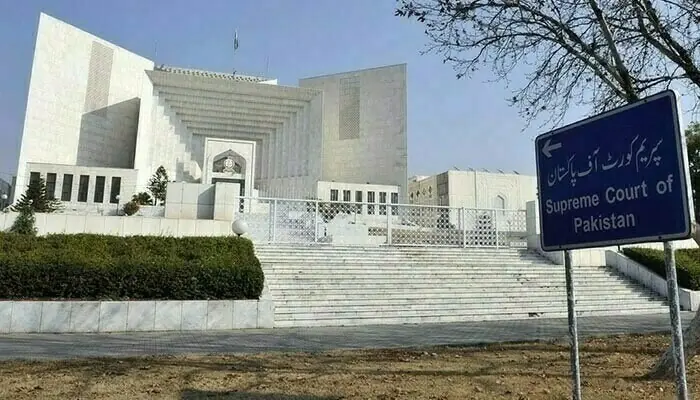

ISLAMABAD: The Supreme Court of Pakistan stated that a woman who has lawfully obtained ‘khula’ and has observed the prescribed period of ‘iddat’ is fully entitled in law to contract a subsequent marriage of her own choosing.
“That right is neither contingent upon the approval of her former husband nor subject to his continuing moral or legal supervision. Any attempt to criminalise or delegitimise the exercise of that right through false or baseless litigation amounts to an abuse of the process of the court. It also constitutes a serious affront to the dignity and autonomy of the woman concerned, which the courts are bound to protect against misuse of legal processes,” added the judgment, authored by Chief Justice of Pakistan Yahya Afridi, who headed a three-judge bench.
The judgment clarified that there is no dispute about the legality of khula, but was perturbed by the persistent refusal of Sultan, the divorced husband (the petitioner), to accept the lawful exit of the respondent from marriage, and the manner in which legal process has been weaponised against her for exercising that right.
The judge of the Family Court-I, Peshawar vide decree dated 13.09.2014, dissolved the marriage between the respondent and the petitioner based on khula, in lieu of the respondent’s dower. However, the petitioner objected to the grant of khula, and despite the decree of khula, refused to accept the finality of the dissolution of marriage. He also branded the respondent a woman of “loose character”, clearly in the hope of puncturing her credibility.
He filed an application under Section 22-A of the Code of Criminal Procedure, 1898, before the Justice of Peace, Peshawar, seeking registration of a criminal case against the respondent on the assertion that the respondent was still his lawful wife and had entered into a second nikah during the subsistence of the first. He also went as far as to allege that the sister of the respondent was also in nikah with the same man, thereby further impugning the validity of the second marriage of the respondent.
The judgment said that once the court is satisfied that reconciliation is not feasible and that the claimed right/need of the wife to dissolve the marriage is genuine and settled, khula operates as a complete and valid mode of dissolution of marriage, carrying full legal effect. In this sense, it stands within the legal framework as a right of exit available to the wife, corresponding in its own sphere to the right of talaq available to the husband, both reflecting the principle that marriage is not intended, in both religion and law, to become an insufferable or inescapable bond.
It also said, “the litigation that is initiated or sustained with the object of gendered harassment, humiliation, or reputational harm must also be viewed as abuse against women.”
The SC has repeatedly warned that the process of law is not to be employed as an instrument of harassment, humiliation, or coercive pressure, particularly against women and other vulnerable persons. Yet, the recurrence of such conduct compels the Court to reiterate, yet again, that where legal process is invoked in disregard of clear judicial guarantees, it is not merely the individual litigant who is wronged, but the integrity of the justice system itself that stands compromised, thereby obligating the Court to intervene decisively.
The apex court expected that the courts across the country remain vigilant against the misuse of legal process in matters arising after the dissolution of marriage, particularly where allegations are advanced that carry the potential for grave reputational and social harm to women.
The Court dismissed the petition with costs quantified at Rs500,000, payable by the petitioner to the respondent within thirty days, failing which the same shall be recoverable through execution proceedings before the Family Court concerned.
Copyright Business Recorder, 2026


























Comments