


‘India goes against World Bank guarantee by holding IWT in abeyance’
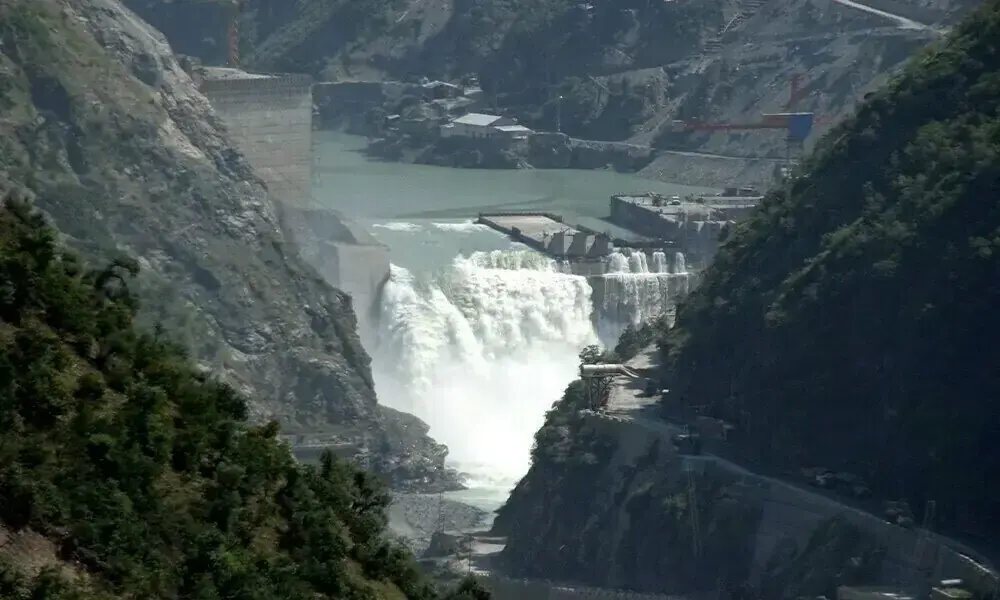

PESHAWAR: Former Ambassador Manzoorul Haq here Sunday said that India has gone against international commitment and World Bank guarantee after holding Indus Water Treaty (IWT) in abeyance.
Talking to APP, he said that repeated violations of IWT by India has threatened inviolability of international treaties and inter-state relations and fascist Modi regime should be made accountable for it.
He said holding of IWT in abeyance by India in April last year has put peace of the subcontinent into jeopardy, and repercussions of another war between two nuclear powers, especially on water, will reach beyond borders.
IWT, mediated by the World Bank in 1960, divides control of the Indus basin rivers between the two nuclear-armed neighbours.
He accused India for illegally putting the treaty in abeyance in April last year, warning that unilateral illegal actions over the transboundary waters could heighten tensions and pose risks to regional peace and stability.
The treaty grants Pakistan rights to the Indus basin’s western rivers namely Indus, Jhelum, and Chenab for irrigation, drinking, and non-consumptive uses like hydropower, while India controls the eastern rivers of Ravi, Beas, and Sutlej.
He accused New Delhi of material breaches of the IWT that may have consequences for regional stability, citing unusual, abrupt variations in the flow of Chenab river from April 30 to May 21 and from December 7 to December 15 last year.
“These variations in water flows are of extreme concern for Pakistan as they point to unilateral release of water by India into River Chenab. India has released this water without any prior notification or any data- or information-sharing with Pakistan as required under the treaty,” he said.
This water manipulation by India occurs at a critical time in Pakistan’s agricultural cycle and directly threatens the lives and livelihoods as well as food and economic security of its citizens.
Ambassador Manzoor who served at Saudi Arabia said that India’s most recent illegal action clearly exemplifies the weaponization of water to which Pakistan has been consistently drawing the attention of the international community.
He shared that Indian unlawful actions prompted the Indus Water Commissioner to write a letter to his Indian counterpart, seeking clarification on the key matter as provided under the IWT.
Pakistan expected that India must respond to the queries raised by Pakistan’s Indus water commissioner clearly, refrain from any unilateral manipulation of river flows, and fulfill all its obligations in letter and spirit under the IWT provisions.
Dr Ejaz Khan, former chairman international relations department at University of Peshawar said that India can’t hold in abeyance IWT unilaterally and had lost all grounds after historic ruling of International Court of Arbitration at The Hague.
He accused India of consistently trying to undermine the IWT by building various dams, including Kishenganga and Ratle hydro power projects illegally, which sets a very dangerous precedent.
India had subverted the treaty’s own dispute resolution mechanism by refusing to participate in the Court of Arbitration and neutral expert proceedings. Dr Ejaz said that India is pursuing a deliberate strategy to sabotage the well-established arbitration process under the treaty provisions and exposed millions of people in Pakistan to starvation and hunger.
The South Asian neighbours have been arguing over hydroelectric projects on the shared Indus river system for decades, with Pakistan complaining that India’s planned hydropower dams will cut its flows and will ruin agriculture.
In August last year, the Court of Arbitration declared that India shall “let flow” the waters of the western rivers for Pakistan’s unrestricted use.
He reiterated that the Indus Waters Treaty is a binding legal instrument that has made an invaluable contribution to peace and stability of South Asia and cannot be withdrawn unilaterally.
He said that restricting water was tantamount of exposing millions of people to hunger and starvation in Pakistan.
The experts said that IWT violation, on the one hand, threatens the inviolability of international treaties and on the other, it poses serious risks to regional peace and security, principles of good neighbourhood, and norms that govern inter-state relations.
They expressed the hope that the International Community and World Bank will immediately step in by forcing fascist Indian Govt to withdraw its unlawful and unilateral decisions and allow unrestricted flow of water in western rivers.

























Comments