


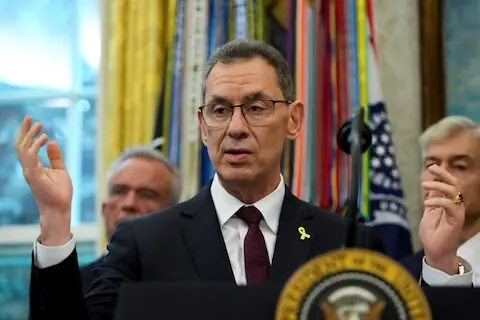

NEW YORK: Pfizer Chief Executive Albert Bourla said on Tuesday that the U.S. pharmaceutical industry needs to collaborate with China’s, where speedy processes have vaulted it to 30% of global drug development over the past decade.
“In biopharma, China’s dramatic speed, cost and scale have triggered a shift in the global competitive landscape,” Bourla said, speaking at the National Committee on U.S.-China Relations Gala in New York.
He said the country currently has around 1,200 novel drug candidates, compared with 10 years ago when there was about 60.
The remarks come as U.S. President Donald Trump has targeted top economic rival China with a cascade of tariff orders on billions of dollars of imported goods that he says is aimed at narrowing a wide trade deficit, bringing back lost manufacturing and crippling the fentanyl trade.
The U.S. House of Representatives also passed a bill last year that aimed to restrict U.S. business with Chinese pharmaceutical companies.
The measure ultimately did not pass the Senate, but a new version of the bill was reintroduced earlier this year.
Nonetheless, U.S. and European drug companies have also looked to China to replenish their drug pipelines, despite the trade war between Beijing and Washington.
Earlier this year, Pfizer struck a deal to license an experimental cancer treatment from China’s 3SBio Inc paying $1.25 billion upfront and up to another $4.8 billion if developmental milestones are met.
“Chinese biotech firms accounted for nearly 1/3 of all large pharma drug licensing deals last year, a major shift in where innovation is sourced,” Bourla said.
He added that Chinese biopharmaceutical companies are able to recruit patients for clinical trials 2 to 5 times as quickly as U.S. companies.

























Comments
Comments are closed for this article.