



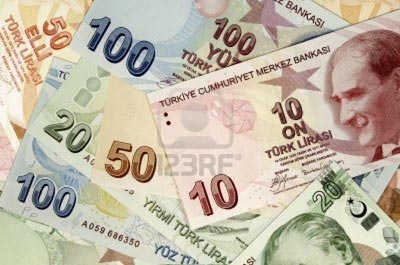
 ANKARA: Turkey's currency plunged to new lows on Tuesday after the central bank held key interest rates unchanged, bowing to what analysts said was pressure from the government as it battles a deepening political crisis.
The bank's move had been widely expected after the government ruled out any hike in rates despite the lira's rapid decline since a corruption scandal broke last year.
And embattled Prime Minister Recep Tayyip Erdogan, on a two-day visit to Brussels to try to advance Turkey's EU membership talks, hailed it as the "right decision".
The bank said after its monthly policy meeting that it was holding its key overnight rate at 7.75 percent, its one-week repurchasing or repo rate at 4.5 percent and its borrowing rate at 3.5 percent.
However, it gave itself room for manoeuvre, saying it would raise interbank rates to nine percent on "additional monetary tightening days".
The lira swiftly tumbled to a new record low of 2.2659 against the dollar but recovered slightly to close at 2.2575, but remained at a low of 3.0583 to the euro.
The Istanbul stock exchange closed 0.84 percent higher on the news at 66,318.69 points.
The lira has sunk to new lows almost daily this year as Erdogan grapples with the most serious crisis of his 11-year rule and has lost well over 20 percent since May.
'Bank caved in to pressure'
The central bank has been under pressure from Erdogan's Islamic-leaning government not to raise interest rates in order to boost growth and keep inflation in check ahead of key local elections on March 30.
Instead, it has been using its foreign currency reserves to shore up the currency, selling about $17.6 billion last year.
But Erdogan insisted: "The central bank is an independent institution. It is tied neither to me, nor any of my ministers."
The lira has been on a sharp downward spiral since mid-December when police launched an anti-corruption probe that has embroiled members of Erdogan's inner circle.
Most analysts had expected the bank to hold fire on any rate increases despite market pressures.
Economy Minister Nihat Zeybekci on Monday dismissed any likelihood of a hike "because it would be an inconclusive step and put a permanent burden on our economy".
Observers said the bank had caved in to government pressure and some speculated that it may nevertheless be forced to hike rates after the local elections.
"Today's move adds to what is already a muddled monetary policy framework and will raise further questions about the credibility of the central bank," London-based Capital Economics said, warning that the lira was likely to come under further pressure.
Inan Demir, chief economist at Istanbul-based Finansbank, said Tuesday's decision would not provide any respite for the lira.
"On the contrary, we continue to see further depreciation until we see (the central bank) forcefully defending the currency," he said.
The currency is being pummelled not only from the political crisis but also Turkey's need for cheap funding to cover its external liabilities, making it vulnerable to US monetary policy tightening.
Economists have highlighted Turkey's yawning current account deficit, currently at over 7.0 percent of gross domestic product, as a key concern.
While the government has insisted its growth target of four percent for 2014 remains intact, many are more pessimistic.
The London-based European Bank for Reconstruction and Development cut its projection for Turkey to 3.3 percent for this year from a previous estimate of 3.6 percent.
"Growth in Turkey is likely to moderate somewhat... reflecting monetary tightening and an increase in financing costs linked to higher political risks which are pulling growth back," the EBRD said.
"Nevertheless, domestic demand is still expected to grow, albeit at a slower pace, and net exports may benefit from a recent depreciation of the currency."
Turkey's Deputy Prime Minister Ali Babacan warned last week that inflation might be higher than the 5.3 percent forecast for 2014, compared with 7.4 percent last year.

























Comments
Comments are closed for this article.