



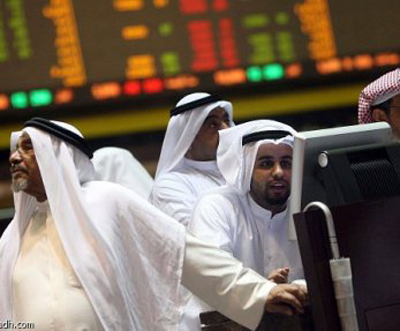
 DUBAI: Gulf investors moved to perceived safer havens in the region, as news of a $93 billion handout by the Saudi king eclipsed concerns over military action in Libya.
Saudi King Abdullah offered $93 billion in handouts on Friday and boosted his security and religious police forces, opting for a mixture of carrot and stick to stave off unrest rocking the Arab world.
The Saudi stock index had climbed 4.7 percent at 0830 GMT, with most stocks surging in early trade. Bourses in Gulf states UAE and Qatar also rose more than 2 percent.
Kuwait's index edged higher, despite Etisalat scrapping its $12 billion deal to buy a controlling stake in Kuwaiti telecoms group Zain.
Zain dropped 2.9 percent.
An exodus of businesses from unstable North African markets may eventually help relatively safer Gulf markets of UAE and Qatar, analysts say.
"Local institutions and foreign buyers in the region are on a lookout for markets away from political tensions.....UAE and Qatar provide such an environment," Samer al-Jaouni, general manager of Dubai-based Middle East Financial Brokerage Co, said on Sunday. Dubai bluechips Emaar Properties and Arabtec led the advance in Dubai, gaining 3.2 percent and 5.7 percent by 0720 GMT. The index climbed 2 percent to 1,502 points.
Qatar's benchmark gained 2 percent, led by heavyweight Industries Qatar that climbed by 3 percent.
The bourse moved a step closer to acquiring emerging market status from index compiler MSCI on Thursday by adopting a standard international settlement system for stock trading.
"Foreign investors are pumping funds into Qatar as they see it as a safe haven in the region. Markets like Dubai and Doha will look to benefit from the unrest around." said al-Jaouni.
Saudi Arabia's index is expected to be in positive territory for the whole week on the latest $93 billion handout by King Abdullah. This was in addition to the $37 billion announced last month to ease social tensions.
"In combination, both the stimulus plans in Saudi, will have some positive impact on the ground in the short-term," said Akber Naqvi, fund manager at Al Masah Capital in Dubai.
Saudi Basic Industries Corp advanced by 5.4 percent and Al-Rajhi Bank climbed 5 percent.
TENSIONS CONTINUE
European and US forces unleashed warplanes and cruise missiles against Muammar Gaddafi's troops in the biggest Western military intervention in the Arab world since the invasion of Iraq in 2003.
Tension also continued in other Gulf Arab states like Bahrain where troops cracked down on mainly Shi'ite protesters in the oil-producing region last week.
However, the markets showed little reaction to the attacks in Libya.
"Regional markets have priced in what's happening in Libya," said Naqvi said.
"Investors have been discounting a civil-war kind of situation there for a while. More important for the region is what's happening in Bahrain and we are watching that situation closely."
Bahrain's five-year credit default swaps have doubled since January as the unrest gripped the Arab world, hitting 355 basis points on Tuesday, their highest level since July 2009.
The yield on Bahrain's Islamic bond maturing in 2014 jumped to a one-year high of 4.5 percent from 3.0 percent, after the Gulf state declared a state of emergency last week
Bahrain's main opposition groups have eased their conditions for talks to end a crisis that has drawn in neighbouring Gulf armies and raised tensions in the oil exporting region.




















Comments
Comments are closed for this article.