



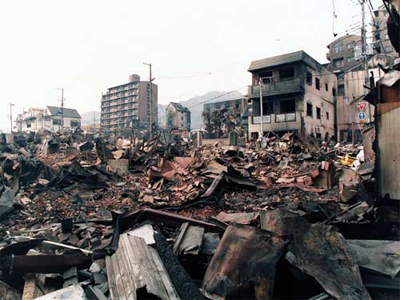
 SYDNEY: Japan's horrific earthquake and aftermath look likely to have more than a minor impact on regional economies not only from slower exports, reduced tourist flows and declining capital inflows, but more importantly from the disruption to imports from Japan.
The full implications of shuttered production lines and rolling power cuts can so far not be estimated accurately given the massive uncertainties over the still unfolding situation. However, the degree of risk to the various economies can be roughly estimated. Meanwhile, the upward trends in energy and food prices should continue, suggesting that central banks will need to tighten monetary policy further despite Japan's disasters as it remains too loose almost everywhere in the region.
For countries in this region, the direct impact to growth will come from weaker exports to Japan and the likelihood of a disruption to imports from there, with resulting negative implications for domestic production as stocks of parts are run down.
The regional supply chains set up over the past couple of decades have seen labour-intensive production shifted out of Japan (and Korea, Singapore and Taiwan to a lesser degree) and into countries like China, Malaysia, Thailand and Vietnam. When things flow smoothly, the gains in efficiency more than make up for the need to transport semi-finished goods and parts around the region. But if things gum up, the knock-on effects can be severe.
Beyond cars and consumer electronics, Japan makes essential high-technology or highly engineered parts for any number of goods; companies have often kept this technology and production in Japan to maintain competitive advantage, so if output is lost from the one or two factories making the component, production will come to a halt for those goods using it as an input. Car production in Thailand, electronics manufacturing in the Philippines and Taiwan, and more general manufacturing in China are examples of areas that look at risk.
Korea and Taiwan, with a similar pattern of export goods to Japan, look best placed to benefit from any cuts to Japanese exports, as other commentators have noted.
However, looking at the import balance as well, the outlook is not so clearly positive. While consumers will often be able to substitute products from Korea or Taiwan (e.g., Korea's car makers should continue to gain market share from Japanese producers, but that was a trend already well underway), companies will often not be able to.
Although Korea and Taiwan compete with Japan across a broad selection of goods, they are also highly dependent on imports from Japan: fully 20.7% of Taiwan's imports and 14.9% of Korea's come from there, many of these essential intermediate goods. Taiwan's import dependence on Japan is the region's highest, so it looks most at risk from extended disruption to production in Japan.
Other countries are also highly dependent on Japanese imports: Thailand follows Taiwan at 20.6%, then Indonesia at 15.6%, China at 12.6% (plus more goods shipped via Hong Kong), Malaysia at 12.5% and the Philippines at 12.3%. By contrast, export dependence on Japan is relatively low across the region: the highest is Australia at 18.9% followed by Indonesia at 16.3%, but both of these are energy exporters who are likely to benefit from the partial shutdown of Japan's nuclear industry.
Only 6.2% of Korea's exports, and 6.6% of Taiwan's, go to Japan, and the ratio is not much higher for most others in the region. So direct losses from lower exports to Japan are likely to be modest, particularly compared to the high risk from disruptions to import flows.
On this basis, then, Taiwan and Thailand look most at risk from extended disruptions in Japan, followed by Indonesia, Korea, China, Malaysia and the Philippines. Least affected are New Zealand and Australia, with relatively small manufacturing bases and the lowest shares of imports from Japan.
This potential for disruptions to domestic production from Japan's disaster, as well as the direct hit to exports and likely damage to tourism, suggest that monetary authorities should be cautious at this point. On the other hand, the clear and present danger from rising food and energy prices needs to be met with tighter policy settings--interest rates are still well below average levels in most countries, leaving policy overly stimulative.
The inflation argument should take precedence, but may not. The Philippine central bank meets this week, and IFR suspects it will use the uncertainty from Japan as a reason to hold off from beginning its tightening cycle, but with upward price momentum accelerating sharply in recent months, it is already well behind the curve. It has sounded reluctant to tighten, and while the decision is likely to be close, IFR looks for no change.
Other central banks will face a similar dilemma. If oil prices stabilise, and the next run of inflation reports shows little acceleration in prices in February and March, IFR suspects many regional central banks will hold off from delivering further rate cuts until the situation in Japan becomes clearer.
Taiwan's central bank meets at the end of the month, and is likely to deliver a further modest 12.5bp hike with little impact on activity, but Australia is seen holding steady along with Indonesia on April 5, and the Bank of Korea also looks likely to hold off from another hike a week later. By later in April, the Japan uncertainty should have lessened enough for the Bank of Thailand to consider a further 25bp hike, although IFR expects no change after the 25bp rise in March.






















Comments
Comments are closed for this article.