



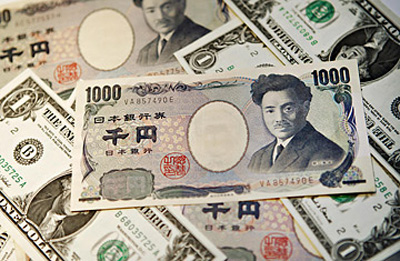
 NEW YORK: The dollar rose 3 percent against the yen on Friday after the Group of Seven launched its first coordinated intervention in currency markets since 2000, and traders braced for more efforts to prevent runaway yen gains in the weeks ahead.
The Federal Reserve and Bank of Canada said they had sold yen, bolstering European and Japanese efforts to reverse the currency's recent sharp gains and calm markets after Japan's devastating earthquake and tsunami and an unfolding nuclear disaster sparked a week of near panic in world markets.
The dollar rose as high as 82.00 yen early in European trade before easing to 81.10 in New York, up about 3 percent. The yen's plunge to a record low near 76 yen earlier this week had pushed the G7 into action.
Hedge funds and other speculative accounts tested official resolve by buying into the yen sell-off, but analysts said authorities were set to fight any attempt to push it back up.
"It's evident this is not just a one-day event. The G7 has made an extended commitment that we think will stretch over a number of weeks, and we think it will be successful," said Michael Woolfolk, senior strategist at BNY Mellon in New York.
"They've put a floor under dollar/yen at 80 and they will be happy to stabilize it between 80 and 85," he said.
Tokyo market estimates had the Bank of Japan selling some 2 trillion yen ($25 billion) over the course of the day, similar to it’s a one-day bout of intervention in September.
Nomura Securities, which called the G7 move "a once-in-a-decade event," estimated the European Central Bank intervened to the tune of about 5 billion euros ($7.1 billion). Markets remained on alert for more Fed and Bank of Canada action.
The euro hit a session high around 115.56 yen before easing to 114.63, up about 3.6 percent.
As the dollar rebounded, it became cheaper to hedge against further yen gains. Implied volatility on one-month dollar/yen options stood at 13.5 percent, from 21 percent on Thursday.
The euro rose to a four-month high against the dollar of around $1.4145 after the intervention in euro/yen.
The South Korean and Chinese currencies also jumped against the yen. Those exchange rates are of particular interest to Tokyo, as excess yen strength undermines Japanese trade relative to its Asian neighbors.
CALMING THE WATERS
The first G7 joint intervention in a decade capped a frantic week for Japanese markets that saw the Nikkei suffer its worst two-day rout since the 1987 crash and the yen soaring as investors watched the country's nuclear crisis escalate.
Expectations that Japanese retail and corporate investors would start bringing money home for rebuilding after a massive earthquake and tsunami drove the yen up this week.
So did heavy selling by margin traders who were forced to unwind positions funded with cheaply borrowed yen as the currency rose to a record high against the dollar.
Analysts said central bank determination would help counter those flows. Upside targets were seen around Monday's peak of 82.45, followed by the 100-day moving average of 82.61 and 83.30, the intraday high from last Friday. Nomura currency strategists said the 82.70-83.00 range would be an "ideal level" for computer-driven model accounts to buy dollars.
"I would expect strong defense of 80 yen," said David Mann, head of research at Standard Chartered in New York, adding any move lower would prompt authorities to redouble yen selling.
LIMITS TO INTERVENTION
Paresh Upadhyaya, strategist at BofA Merrill Lynch, said it may take a move toward higher interest rates in the United States to sustain downward yen momentum.
"For intervention to be successful, it needs to be followed by policy action," he said. "If the Fed starts openly debating exiting quantitative easing, that would move interest rate differentials sharply in favor of the dollar against the yen."
The Fed said this week that higher commodity prices were putting upward but temporary pressure on inflation, and it reiterated its pledge to keep interest rates -- currently near zero -- at very low levels for an extended period.
But Mann said investors may want to temper expectations when it comes to upside targets for the dollar and other currencies against the yen.
"With each intervention, you end up seeing a diminishing marginal return," he said. "The first time usually has the biggest impact. The next round is less of a shock. It'll become increasingly difficult for intervention to be successful".






















Comments
Comments are closed for this article.