



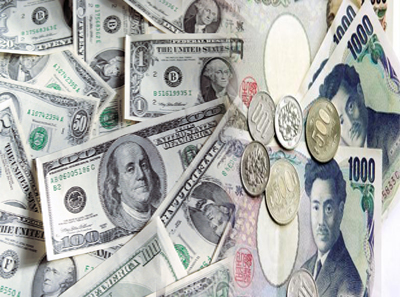
 NEW YORK: The yen slipped slightly against the dollar on Thursday a day after hitting a post-war high as the market awaited key talks by the Group of Seven top economies on the Japan crisis.
Speculation was rife that the G7 might intervene to try to stabilize the yen as member Japan, the world's third-largest economy, grapples with devastation after a monstrous earthquake and tsunami and an unfolding nuclear crisis.
The market was on tenterhooks for the G7 finance chiefs' teleconference later Thursday, called by French Finance Minister Christine Lagarde.
"We must be at the disposal of our Japanese friends on the monetary side," she said. The G7 also includes Britain, Canada, Germany, Italy and the United States.
The dollar was trading at 78.95 yen around 2200 GMT, up from 77.86 late Wednesday in New York.
The euro firmed against the greenback, rising to $1.4014 from $1.3906 Wednesday.
The shared European currency also gained against the Japanese currency at 110.67 yen, compared with 108.15 yen the previous day.
"The G7 is likely to stand behind the Japanese authorities in their efforts to stabilize markets, including the yen. Hence, we expect the G7 to effectively endorse yen intervention," said Jens Nordvig at Nomura.
But he said that conditions were not fully in place for coordinated foreign-exchange intervention -- with direct participation of the US Federal Reserve and the European Central Bank -- "at least not on a sustained basis."
"The statement may be more general, including standard phrases about 'excessive volatility of the yen,' and endorsement of FX intervention may happen only more informally," he said.
The Japanese authorities continued efforts to address the impact of last Friday's 9.0-magnitude earthquake and tsunami, and avert a potential nuclear catastrophe at a quake-stricken nuclear plant.
The official toll, of the dead and missing, from the twin disasters that smashed the northeast coast has approached 15,000.
The Bank of Japan on Thursday pumped six trillion yen into the financial system, raising total funds injected since Monday to 34 trillion yen as it tries to stabilize the short-term money market and soothe sentiment.
The central bank also offered to buy a total of 3.86 trillion yen worth of government bonds and short-term securities next week to add extra liquidity.
"We see Japanese authorities mounting further near-term resistance to yen strength, possibly with international backing at the G7 level," Vassili Serebriakov and Nick Bennenbroek, currency strategists at at Wells Fargo, said in a client note.
They said that intervention would not necessarily imply a weaker yen in the near term, but longer term the consequences from the earthquake would add "to the already substantial negatives for the Japanese currency."
In late New York trade, the pound rose to $1.6137 from $1.5991 late Wednesday.
The dollar held steady against the Swiss franc at 0.8986 francs, compared with 0.8988 the day before.





















Comments
Comments are closed for this article.